Verivorst: Estonian Blood Sausage With Barley
The Christmas sausage that tastes of marjoram and toasted grain
Contents
↓ Jump to recipeThere is a smell that arrives in an Estonian kitchen in the third week of December and belongs to nothing else in the year. It is marjoram hitting hot pork fat. A whole fistful of it, dried and crumbled, going into a bowl of blood and barley, at a dose that would flatten any tomato sauce in the Mediterranean. If you have eaten verivorst at a Tallinn Christmas table, that smell is the memory. The blood is a texture. The marjoram is the flavour.
Verivorst is simply veri (blood) and vorst (sausage), and it is the centre of the Estonian Christmas plate, alongside sauerkraut, roast pork, potatoes baked in their skins and a wobbling slab of sült, the pork brawn. From late November, Estonian supermarket chill cabinets fill with metre-long coils of it, and Estonians buy it by weight the way the British buy sprouts, with the same annual sense of duty and pleasure mixed together.
Verivorst: Estonian Blood Sausage With Barley
Ingredients
- 200 g pearl barley
- 600 ml water, for the barley
- 1 tsp fine salt, for the barley water
- 250 g pork back fat or fatty belly, cut into 5 mm dice
- 2 large onions (about 300 g), finely chopped
- 500 ml fresh or defrosted pig's blood, strained
- 2 tbsp dried marjoram
- 1 tsp ground allspice
- 1/2 tsp ground black pepper
- 1/4 tsp ground caraway
- 12 g fine salt
- 2 m hog casings (about 32-36 mm), rinsed and soaked
- 40 g butter or lard, for roasting
- Lingonberry preserve and sauerkraut, to serve
Method
- Toast the pearl barley dry in a wide pan over medium heat for 4-5 minutes, stirring, until it smells nutty and a few grains colour. Add 600 ml water and 1 tsp salt, bring to the boil, cover and simmer 20 minutes until the grains are tender at the edge and still firm in the middle. Drain any free water and spread on a tray to cool.
- Rinse the hog casings inside and out under cold running water and leave them to soak in fresh cold water for 30 minutes.
- Render the diced pork fat in a frying pan over medium-low heat for about 10 minutes until the pieces are pale gold and swimming in their own fat. Add the onions and cook 12-15 minutes more until soft and lightly browned. Scrape everything, fat included, into a large bowl and cool to room temperature.
- Strain the blood through a fine sieve into the bowl to catch any clots. Add the cooled barley, marjoram, allspice, pepper, caraway and 12 g salt. Mix thoroughly with your hand. The mixture should pour slowly, like a thick batter.
- Fry a teaspoon of the mixture in a small pan until set and taste it. Adjust salt and marjoram now.
- Slide a casing onto a wide sausage funnel or a piping bag with a 10 mm nozzle. Knot the end. Fill the casing to about two-thirds, never tight, leaving the sausage soft and floppy. Twist or tie into 15 cm lengths and knot the far end.
- Prick each sausage 6-8 times with a fine needle.
- Bring a wide pan of water to 80C (small bubbles at the base, no rolling boil). Lower the sausages in and poach 35-40 minutes, holding the temperature at 78-82C, until a skewer pushed into the centre comes out clean and the juices run clear brown.
- Lift out with a slotted spoon, lay on a tray and cool completely. Chill at least 4 hours or overnight.
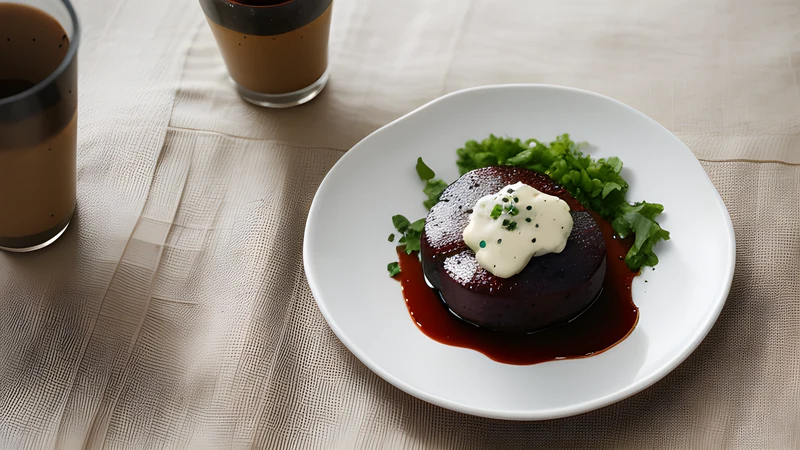
- To serve, melt the butter or lard in a heavy frying pan over medium heat. Fry the sausages 4-5 minutes a side until the skin blisters and darkens. Serve hot with lingonberry preserve and sauerkraut.
Why barley, and why this matters
Every blood sausage in northern Europe is a solution to the same engineering problem: fresh blood sets into a solid, slightly grainy block when heated, and on its own that block is unpleasant. It needs a filler that absorbs, opens the texture and gives the mouth something to work on. The choice of filler is basically a map of what grows where.
Scotland uses oats, and Stornoway black pudding has that soft, mealy crumble as a result. Sweden’s blodpudding uses rye flour and gets baked in a tray, so it slices like a dense cake. Tampere’s mustamakkara in Finland uses rye flour and crushed rye, giving a dark, almost sour density. Spain’s morcilla de Burgos uses rice, which stays in visible white pearls.
Estonia uses pearl barley — kruubid — and barley behaves differently from all of them. It does not dissolve. Each grain stays a discrete, slippery, faintly chewy bead suspended in set blood, so a slice of verivorst has a specific texture that no other blood sausage has: soft, dark, and studded. Barley was the grain that ripened reliably in the short Estonian summer long before wheat did, and it turns up everywhere in the old kitchen — in mulgikapsad, in soups, and toasted to a flour in kama.
That kama connection gives us the one change I make to the traditional method, and it is worth the extra five minutes. Toast the barley dry before you boil it. Estonians have toasted grain for centuries in kama; it seems strange that verivorst never picked up the habit. Dry-toasting the pearl barley until it smells like a biscuit tin adds a nutty, slightly roasted note that survives the poaching and pushes back against the iron sweetness of the blood. It also firms the grain slightly, so it holds its shape better through the long simmer.
The Christmas pig
The reason verivorst is Christmas food, and not year-round food, is a matter of calendar and refrigeration. The jõulusiga, the Christmas pig, was killed in the cold weeks of early winter when the carcass could hang without spoiling and there was no fodder to spare for feeding an animal through to spring. That single day produced everything: the roast, the brawn, the salted fat, the rendered lard for the year — and a bucket of blood that had a shelf life measured in hours.
Blood sausage is what you make when you cannot waste anything and you have to decide in one afternoon. The Estonian farmhouse solution was to stir the blood constantly as it drained, so the fibrin caught on the stirring arm and could be pulled away in threads, then to stretch that blood as far as possible with boiled barley and onions and stuff it into the intestines, which had also just become available. The whole dish is one animal, one day, and one grain from the barn.
Sausage-making in these midwinter households produced a small family of related things from the same bowl. Verikäkk is the same mixture bound with flour and formed into dumplings, poached and then fried — the version you make when the casings run out. Verileib, blood bread, folds the mixture into a rye dough and bakes it. Latvia has asinsdesa, close enough to be a cousin, and the Setu people of the south-east make a version with more onion and less grain. All of them share the marjoram.
Soviet-era food production did something unusual to verivorst: it industrialised it without killing it. State meat combines kept making it, families kept eating it, and when Estonia restored independence in 1991 the sausage came out the other side intact rather than as a heritage revival. Rakvere and Nõo, the two big producers, still shift it by the tonne every December. The recipe below is a farmhouse one, and the difference from the factory version is mostly the marjoram — commercial verivorst is cautious with it, and homemade should not be.
Sourcing the blood
This is the part people assume will be impossible and then find takes one phone call. Any butcher who takes whole carcasses can get pig’s blood, usually frozen in half-litre tubs, usually for very little money, and usually with mild surprise that you have asked. Polish, Turkish and Chinese grocers often have it in the freezer without needing to be asked at all. Ask for it defibrinated or stirred — that means the clotting fibrin has already been removed and the blood will stay liquid.
Frozen blood is fine. Defrost it slowly in the fridge overnight and strain it through a fine sieve before use — there will always be a few rubbery threads to catch, and one of them in a finished slice is unpleasant. Fresh blood should be used within about two days and must smell clean and metallic. If it smells sour or of anything else, throw it away without negotiating.
Hog casings come salted in tubs from the same butcher. They keep for a year in the fridge. Rinse a length inside by slipping it over the cold tap and letting water run through, which also shows you any splits before you have committed a bowl of filling to them.
Getting the fill right
The single most common failure is overfilling. Barley absorbs liquid all the way through the poach and swells noticeably. A sausage stuffed tight goes into the water and comes out split, having donated its filling to the pan. Fill to about two-thirds, so the casing is loose and the sausage flops when you lift it. It will plump into a proper cylinder in the water and look exactly right.
The second failure is heat. Blood proteins set somewhere around 70-75C, and above about 85C they contract hard and squeeze out water, which gives a dry, crumbly, slightly bitter sausage. Hold the water at 78-82C — a thermometer earns its place here, but if you have none, aim for the state where a few bubbles rise lazily from the base and the surface trembles without breaking. Never let it boil. This is the same reason a terrine goes in a bain-marie: proteins that set gently stay juicy, and proteins that set violently weep.
The third is temperature at the mixing stage. The rendered fat and onions must be properly cool before they meet the blood, or the blood begins to set in the bowl and you end up piping lumps. Room temperature is the target. Cold from the fridge is fine too; the mixture will simply be stiffer and need a firmer hand on the funnel.
Pricking the casings gives trapped steam somewhere to go. Do it before the sausages go in, not after they have already ballooned. A fine sewing needle is the right tool; a fork tears.
Fry a teaspoon of the mix before you fill anything. Blood is assertive and salt behaves oddly against it — a mixture that tastes correct raw will often taste flat cooked, because the set protein mutes it. The test spoon takes ninety seconds and it is the only honest way to check the marjoram, which is the flavour you are actually making.
Cooling completely before frying matters as much as the poach. Warm verivorst is soft and will collapse in the pan. Chilled overnight, it firms into something you can fry hard, and the blistered, almost crackling skin against the soft inside is the whole point.
What goes alongside
Lingonberry preserve is not optional in Estonia and it should not be optional here. The acidity and the light bitterness of lingonberry cut the fat and the iron directly. A raw-stirred preserve, made the Swedish way with no cooking at all, is sharper and better than a jam. Cranberry sauce loosened with a squeeze of lemon is a passable substitute.
Sauerkraut is the other fixture, ideally something you have fermented yourself — cabbage, salt and time — and warmed through with a spoonful of the fat left in the frying pan. Potatoes baked in their skins, split and given butter, complete the plate. Pickled cucumbers are welcome. Anything green is a modern intrusion, and I make it anyway.
Storage, make-ahead and variations
Poached and chilled sausages keep 4 days in the fridge and freeze extremely well for 3 months. Freeze them poached and undressed, defrost overnight, then fry from cold. This is exactly how Estonian households handle the Christmas quantity, and it is why the recipe is worth making in a full batch.
If casings defeat you, make verikäkk instead. Stir 100 g plain flour into the mixture, form heaped tablespoons into rough dumplings, poach them at the same 80C for 20 minutes, chill, then fry in butter until the outsides catch. The texture is denser and the flavour is identical.
For a smokier version, replace half the pork fat with diced smoked bacon and hold the onions back a little — the smoke fills the space they would have taken. Some southern Estonian recipes use a spoonful of double cream in the mix, which softens the set noticeably and makes a sausage that spreads more than it slices. Marjoram is the one thing to keep fixed. Cut it and you have a good blood sausage from somewhere, and no longer verivorst.
If frying whole sausages feels like a commitment, slice the chilled verivorst into 1 cm coins and fry them like black pudding discs, crisp at the edges. That is a weeknight breakfast, and it is how most of a Christmas coil actually gets eaten.
Related Content