Crispy-Bottomed Vegetable Gyoza
Golden, juicy potstickers with a chilli-soy dip
Contents
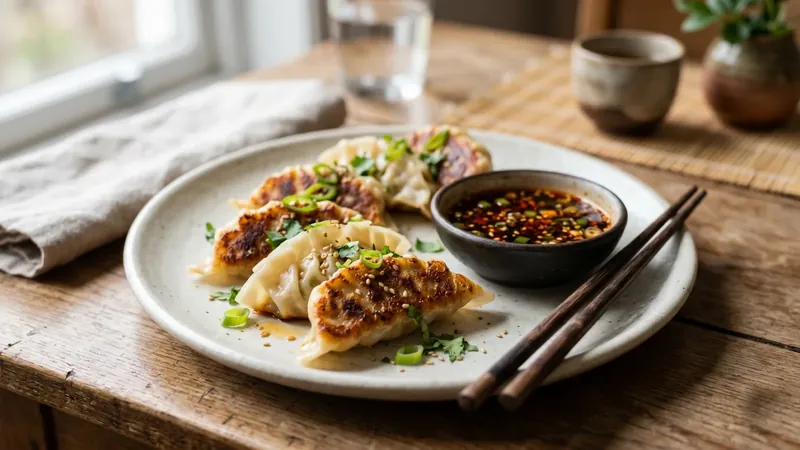
↓ Jump to recipeGyoza are all about contrast: a lacy, crisp-fried base giving way to a soft, juicy steamed top and a savoury vegetable filling. The twist is technique, the classic crisp-steam method that fries the bottoms golden, then steams the parcels through under a lid in one pan. A sharp chilli-soy dip, bright with vinegar and a slick of chilli oil, cuts the richness. They take a little folding patience, but the reward is a proper plate of potstickers.
Crispy-Bottomed Vegetable Gyoza
Ingredients
- 200g white cabbage, very finely chopped
- 1 tsp fine salt
- 100g shiitake mushrooms, finely chopped
- 1 carrot, finely grated
- 3 spring onions, finely sliced
- 2 garlic cloves, grated
- 1 tbsp grated fresh ginger
- 1 tbsp soy sauce
- 1 tsp toasted sesame oil
- 1 tsp cornflour
- 24 round gyoza wrappers
- 2 tbsp neutral oil, for frying
- 100ml water, for steaming
- 3 tbsp soy sauce, for the dip
- 1 tbsp rice vinegar, for the dip
- 1 tsp chilli oil, for the dip
- 1 tsp toasted sesame seeds, for the dip
Method
- Toss the chopped cabbage with the salt and leave for 15 minutes, then squeeze out as much liquid as you can in a clean cloth.
- Mix the drained cabbage with the shiitake, carrot, spring onions, garlic, ginger, soy sauce, sesame oil and cornflour to make the filling.
- Place a wrapper on your palm and add a heaped teaspoon of filling in the centre. Wet the edge with water.
- Fold the wrapper over and pleat one side towards the centre, pressing firmly to seal into a half-moon that sits flat. Repeat with the rest.
- Heat the oil in a large non-stick frying pan over a medium-high heat and arrange the gyoza flat-side down in a single layer.
- Fry undisturbed for 2-3 minutes until the bases are golden.
- Pour in the water, cover at once and steam for 4-5 minutes until the wrappers are translucent and the water has gone.
- Uncover and cook for another minute to re-crisp the bases.
- Mix the soy sauce, rice vinegar, chilli oil and sesame seeds for the dip and serve alongside the hot gyoza, crisp-side up.
From Chinese jiaozi to Japanese gyoza
Gyoza are the Japanese version of the dumpling, and like a good deal of Japan’s everyday food, they arrived from elsewhere and were made entirely their own. Their direct ancestor is the Chinese jiaozi, the crescent-shaped dumplings eaten across northern China. The usual account is that Japanese soldiers stationed in north-eastern China (Manchuria) encountered them during the 1930s and 1940s and brought the taste home, and gyoza took off in Japan in the years after 1945. The city of Utsunomiya, north of Tokyo, still markets itself as Japan’s gyoza capital and holds an annual festival built around them.
Over time a distinctly Japanese style settled in: thinner, more delicate wrappers than the Chinese original, a more pronounced hit of garlic, and a strong preference for the pan-fried form (yaki-gyoza) over the boiled (sui-gyoza) or purely steamed versions common in China. That garlic-forward seasoning is a genuinely Japanese fingerprint, and it is why gyoza taste of themselves rather than of generic dumpling.
The fry-steam-fry trick
The signature of a Japanese gyoza is that crisp base, which is why they are so often sold as “potstickers”. The method is a neat piece of kitchen cleverness done in one pan. You first fry the dumplings so their bottoms turn golden, then pour in water, clamp on a lid at once, and let the trapped steam cook the filling through and soften the upper wrapper. As the water boils away, the bases re-crisp, leaving a single dumpling with two textures: crunchy underneath, tender on top. The lid matters; add the water and cover immediately or it spits fiercely, and do not lift it during the steam or you lose the heat that cooks the filling.
Two things go wrong most often. The first is a soggy base, caused by too little initial frying or by crowding the pan so the dumplings steam before they crisp; give them room and a full two to three minutes undisturbed before the water goes in. The second is sticking and tearing when you try to lift them, which is why a non-stick pan earns its place here. If you want the restaurant-style “wings”, whisk a teaspoon of flour or cornflour into the steaming water; it dries into a delicate, lacy crust connecting the dumplings. Worth trying once the basic method feels comfortable.
The filling, and why you salt the cabbage
The filling here leans fully vegetable, and it loses nothing for it. Finely chopped white cabbage is the traditional bulk, and the salting step is not optional: cabbage is largely water, and salting it, resting it for 15 minutes, then wringing it out in a cloth draws that water off. Skip it and the moisture leaches into the filling as it cooks, splitting the parcels and steaming them from the inside. Shiitake mushrooms bring a savoury, almost meaty depth, while ginger, garlic, spring onion and toasted sesame oil supply the aromatic lift that makes the filling taste unmistakably of gyoza. A teaspoon of cornflour binds everything and holds the juices in.
Folding takes a little practice. The pleats look impressive but matter less than a firm, complete seal, so wet the rim, press the edges together hard, and resist overfilling; a heaped teaspoon is plenty, and a bulging parcel bursts. A flat bottom edge lets each dumpling stand upright in the pan so the whole base fries evenly.
Wrappers, and shaping without a fuss
Round gyoza wrappers, sold frozen or chilled in East Asian grocers and increasingly in larger supermarkets, are thinner than Chinese dumpling skins and the right choice here. Keep the stack under a damp cloth as you work, because they dry out and crack within minutes of being exposed to the air, and a cracked wrapper will not seal. If you can only find square wonton wrappers, cut them into circles with a glass or cutter; they are a little thicker but perfectly usable.
The classic gyoza fold has all the pleats on one side, which pulls the parcel into a gentle crescent that curves and sits flat on its seam. To do it, hold the filled wrapper open in one hand, and with the other, make small tucks along the front edge only, pressing each tuck back against the flat rear edge. Five or six pleats is plenty. If pleating defeats you, simply fold the wrapper into a half-moon and press the whole rim firmly sealed; it will not be as pretty, but it fries and steams exactly the same. The one non-negotiable is that flat base and a complete seal, so no filling leaks into the pan and no steam escapes.
The dip, substitutions and freezing
The dipping sauce is the final, essential touch: soy sauce and rice vinegar sharpened with chilli oil and a scatter of sesame, bringing acidity and gentle heat that cut cleanly through the fried richness. If you keep a jar of homemade chilli oil with crispy shallots and Sichuan peppercorn, a spoonful of it lifts the dip considerably. Swap the shiitake for chestnut mushrooms if that is what you have, or fold in finely chopped firm tofu for more body; add a little grated carrot for sweetness, as here.
Gyoza freeze beautifully raw, which is the real reason to make a big batch. Set the folded parcels on a floured tray so they do not touch, freeze until solid, then bag them. Cook them straight from frozen by the same method, adding an extra minute or two to the steaming time. One practical note on cooking from frozen: do not thaw the parcels first, or the wrappers turn soft and stick to each other and to the pan. Go straight from the freezer into the hot oil, arrange them flat-side down in the pan, and add a good splash more water than usual for the steaming stage, since the filling starts colder and needs a little longer to heat through. Give them an extra minute under the lid and check that the centre is piping hot before you serve.
Serve gyoza as a starter for four, or as a light main for two alongside a bowl of steamed rice, a little miso soup and some quick-pickled cucumber. They are a good thing to cook with other people, one folding while another fries, and a batch of two dozen disappears faster than you would think, which is the best argument for doubling the filling and freezing half for another night. Served crisp-side up so the golden bases stay crunchy, they rarely last long on the table. For more in this vein, a bowl of red lentil and coconut dal makes a comforting counterpoint on a cold night.
Related Content