Vanilla-Orange French Toast with Caramelised Banana
A weekend treat with a citrus lift
Contents
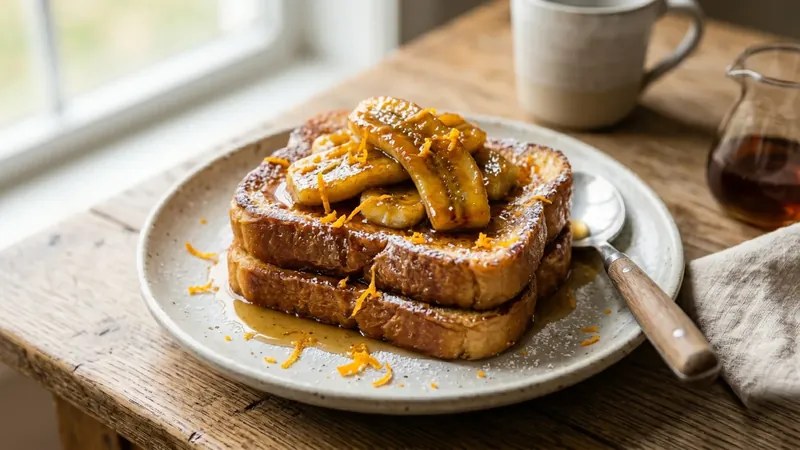
↓ Jump to recipeFrench toast starts from something almost embarrassingly basic: bread, eggs, milk, a hot pan. This version lifts it with bright orange zest and vanilla folded through the custard, so each slice tastes faintly of marmalade and cream. On top sits caramelised banana, cooked cut-side down in a quick brown-sugar caramel until soft and glossy. It is a generous, leisurely sort of breakfast, the kind that turns an ordinary Saturday morning into a small occasion, and it takes about twenty-five minutes from cold pan to plate.
Vanilla-Orange French Toast with Caramelised Banana
Ingredients
- 2 large eggs
- 120ml whole milk
- Finely grated zest of 1 orange
- 1 tsp vanilla extract
- 1 tbsp caster sugar
- Pinch of fine salt
- 4 thick slices of brioche or day-old white bread
- 30g unsalted butter, plus extra for the bananas
- 2 ripe bananas, halved lengthways
- 2 tbsp soft light brown sugar
- Maple syrup, to serve
Method
- In a wide, shallow dish, whisk together the eggs, milk, orange zest, vanilla, caster sugar and salt.
- Lay the bread slices in the custard and leave for 1 minute, then turn and soak the other side until just saturated but not falling apart.
- Melt half the butter in a large non-stick frying pan over a medium heat.
- Add two slices and fry for 2 to 3 minutes each side until deep golden and set in the middle. Keep warm while you cook the rest with the remaining butter.
- Wipe out the pan and return it to the heat with a small knob of butter.
- Scatter in the brown sugar and let it melt and bubble.
- Lay the banana halves cut-side down in the bubbling caramel and cook for 1 to 2 minutes until golden and soft.
- Turn the bananas to coat them in the caramel for a further minute.
- Divide the French toast between two plates and top with the caramelised banana.
- Drizzle with maple syrup and any caramel left in the pan, and serve at once.
A dish invented to save stale bread
French toast solves a problem every household has faced: what to do with bread that has gone hard. Soaking dry slices in egg and milk softens them, and frying them in butter turns something past its best into a treat. The idea is old. A recipe close to it appears in Apicius, the Roman collection compiled around the fourth or fifth century, which describes soaking bread in milk (and sometimes egg), frying it and serving it with honey. Medieval European cookbooks carried the technique forward under a dozen names.
In Britain it has long been called eggy bread, a plain and honest label. In France the dish is pain perdu, meaning “lost bread”, a name that captures the thrift at its heart exactly: bread you would otherwise have thrown out, reclaimed. The American term “French toast” is something of a misnomer, since versions predate and sit well outside France, but it is the name that stuck. Whatever you call it, the logic is the same everywhere: rich custard, dry crumb, hot butter.
That frugal origin is worth remembering when choosing your bread. Slightly stale, sturdy slices soak up the custard without disintegrating, where fresh soft bread can turn to mush. If your loaf is fresh, dry the slices in a low oven at 120C (100C fan) for 8 to 10 minutes first. Brioche works beautifully because its enriched, buttery crumb holds the liquid and crisps at the edges, but a good day-old white loaf does the job just as well. Cut the slices about 2cm thick; thinner slices go soggy, thicker ones stay raw in the middle.
Why orange zest, not juice
The twist in this recipe lives in the custard. Orange flavour that reads as clean and floral comes from the essential oils in the zest, held in the coloured outer layer of the skin, not from the juice. Juice brings acidity and water, which would thin the custard and risk curdling it; a fine grating of zest delivers the perfume with none of that. Paired with vanilla, it gives the toast a flavour reminiscent of marmalade and custard at once. Grate only the orange layer and stop at the white pith beneath, which is bitter. A rasp-style grater does this best.
Keep the soak brief. The bread should be saturated but still hold its shape, roughly one minute a side for 2cm slices. Over-soaking floods the crumb, and it collapses in the pan and stays wet in the centre. If you press a slice gently and custard floods out, you have gone too far. Fry over a medium heat, not high: too hot and the outside scorches before the egg inside sets, leaving a raw, slippery core. Deep golden and springy in the middle is what you want, two to three minutes a side.
The banana, and the caramel you keep
Banana is a natural partner. Ripe bananas are high in sugar, and when laid cut-side down in a hot pan with brown sugar and butter, the sugars on their surface caramelise quickly into something soft, sticky and deeply sweet. The technique borrows from Bananas Foster, the New Orleans dessert created at Brennan’s restaurant in 1951 and named for Richard Foster, a regular customer, where bananas are cooked in a brown-sugar and butter sauce and flamed with rum. Here the method stays simple and stovetop-friendly, no flames required. Use bananas that are ripe and freckled but still firm; a mushy banana will fall apart before it caramelises. The caramel that forms in the pan is too good to waste, so it gets spooned over the finished plate along with a little maple syrup.
What makes the dish satisfying is its balance of richness and brightness. The eggy bread is soft and custardy, the banana sweet and yielding, and the orange cuts through both so the whole plate never feels heavy. It rewards a relaxed pace, a hot pan and good butter, and asks for very little in return.
Getting the custard ratio right
The custard here is two eggs to 120ml of milk, which works out at roughly 60ml of liquid per egg. That ratio matters more than it looks. Too many eggs and the toast turns dense and omelette-like, tasting of scrambled egg rather than custard; too much milk and it never sets, staying wet and floppy in the middle. If you want a richer, more French result, swap 30ml of the milk for double cream, which gives a custard that fries to a faintly crisp, golden edge. The tablespoon of caster sugar in the mix is there to help the surface brown and caramelise in the pan through the same reaction that colours a seared steak; without it the slices stay pale however long you cook them.
Salt is the other quiet essential. A pinch in the custard sharpens the vanilla and orange and stops the whole thing tasting flat and one-dimensionally sweet. Whisk the custard thoroughly so the egg is fully broken up and the zest is evenly dispersed, then strain it if you want it very smooth, though I rarely bother for a home breakfast.
Butter, heat and the order of cooking
Use unsalted butter and keep the heat at a steady medium. Butter browns and eventually burns because of the milk solids in it; over a medium heat those solids toast gently and add a nutty note, but crank the pan too high and they blacken and turn acrid before the toast is cooked. If you find butter alone catches too easily, add a teaspoon of neutral oil to the pan, which raises the point at which it burns without changing the flavour much.
Cook the French toast first and hold it warm, then do the bananas last in the wiped-out pan, because the caramel sets fast as it cools and is best spooned over while it is still loose and glossy. If you are cooking for more than two, keep the finished slices on a rack in a low oven at 120C (100C fan) rather than stacked on a plate, where they trap steam and go soft underneath.
Substitutions and make-ahead
Whole milk gives the softest custard, but you can swap up to half of it for double cream for a richer result, or use a plant milk (oat is closest in body) for a dairy-free version, frying in a neutral oil instead of butter. No orange to hand? A finely grated lemon or clementine zest works, though lemon is sharper, so add an extra teaspoon of sugar. If you dislike banana, caramelise halved plums or apple wedges the same way, or skip the fruit and serve with just maple syrup and a spoonful of yoghurt.
You can whisk the custard the night before and keep it covered in the fridge; give it a stir before using. The fried slices hold in a low oven at 120C (100C fan) for up to 20 minutes while you cook the rest, so everyone eats together. The caramelised banana, though, is best done at the last minute, as it firms up as it cools. For a savoury companion breakfast at the other end of the table, the same relaxed weekend energy suits a batch of warm gougères, and if you have a glut of over-ripe bananas, the ones too soft for this recipe are exactly right for sourdough discard banana muffins.
Related Content