Unagi Don: Grilled Eel With Kabayaki Glaze
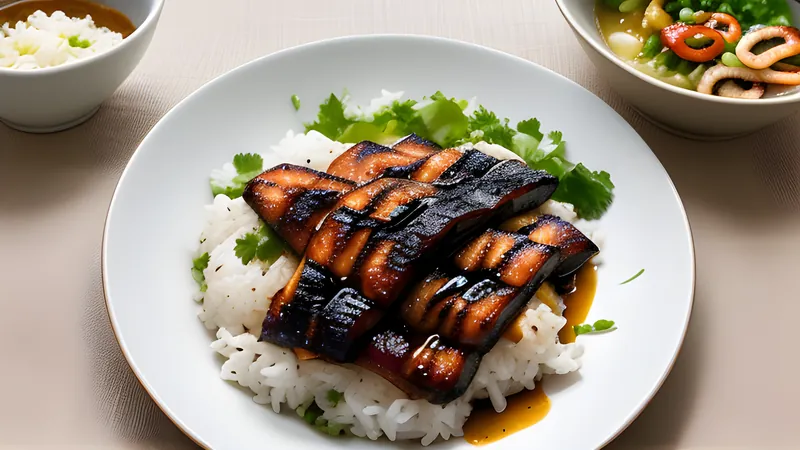
Freshwater eel lacquered in a soy-mirin glaze and laid over rice
Contents
↓ Jump to recipeUnagi don takes freshwater eel, grilled and lacquered in a soy-mirin glaze called kabayaki, and lays it whole over hot rice. It’s the most expensive, most technically demanding rice bowl in the standard donburi repertoire, traditionally requiring years of apprenticeship to prepare from live eel — and also one of the easiest to make well at home, because the eel itself comes ready-cooked.
Unagi Don: Grilled Eel With Kabayaki Glaze
Ingredients
- 2 pre-cooked, vacuum-packed unagi (grilled freshwater eel) fillets, about 150g each
- 60ml soy sauce
- 60ml mirin
- 30ml sake
- 25g sugar
- 2 servings cooked short-grain rice, kept hot
- 1 tsp sansho pepper, plus extra to serve
- 1 sheet nori, cut into thin strips
- 1/2 tsp toasted white sesame seeds
Method
- Combine soy sauce, mirin, sake and sugar in a small saucepan and simmer over medium heat for 5-6 minutes until reduced by roughly a third and slightly syrupy.
- Preheat the grill or oven to 200C.
- Remove the eel from its packaging, pat dry, and lay skin-side down on a foil-lined tray.
- Brush generously with the reduced kabayaki sauce and grill for 3-4 minutes.
- Turn, brush the other side, and grill for a further 3-4 minutes until the glaze bubbles and turns slightly sticky at the edges.
- Brush with a final layer of sauce in the last minute for a deeper lacquered sheen.
- Slice the eel into strips roughly 2cm wide.
- Pile the hot rice into bowls, lay the sliced eel over the top, and spoon over any remaining sauce from the tray.
- Sprinkle with sansho pepper, nori strips and sesame seeds, and serve immediately.
Why eel takes years to learn
There’s an old saying among Tokyo unagi chefs, roughly translated as needing “three years to learn skewering, eight years to learn splitting, a lifetime to learn grilling.” That progression describes the traditional three-stage process of preparing live eel: skewering it while still moving, splitting it open along the spine with a single motion, and then grilling it over binchotan charcoal while basting repeatedly with the kabayaki sauce, judging doneness purely by touch and smell over the course of many passes across the fire. Regional style matters too — Tokyo-style unagi is typically steamed briefly between the splitting and grilling stages, producing a softer, more custardy texture, while Kansai-style around Osaka skips the steaming step and grills straight through for a firmer, crisper result.
None of that apprenticeship is realistically available to a home cook, and it doesn’t need to be. Good-quality pre-cooked, vacuum-packed unagi fillets — already grilled, glazed and frozen at the point of preparation — are sold in most well-stocked Asian supermarkets and online, and reheating one properly gets you most of the way to a genuinely good bowl. The skill that remains within reach at home lies entirely in the reheating and re-glazing.
Buying eel you can actually cook
Look for vacuum-sealed unagi kabayaki in the frozen section, usually imported from Japan, China or Taiwan, and check the ingredient list favours a short, recognisable set of soy sauce, mirin, sugar and eel rather than a long list of stabilisers and colourings — quality varies a lot between brands at similar price points. A single fillet, roughly 130-160g, is a generous single portion once laid over rice.
Thaw frozen unagi overnight in the fridge inside its sealed packaging rather than at room temperature, which lets the flesh come up to temperature evenly without any part turning warm and starting to spoil while the rest is still icy. Pat it thoroughly dry before it goes anywhere near the grill; residual moisture on the surface stops the glaze from developing the sticky, lacquered finish that defines the dish.
Rebuilding the glaze
Pre-cooked unagi already carries a factory-applied glaze, but it’s rarely enough on its own, and building a fresh batch of kabayaki sauce to brush on during reheating makes a real difference to the finished flavour. The classic ratio is roughly equal parts soy sauce and mirin, a splash of sake, and sugar to taste, simmered down until it thickens slightly and coats the back of a spoon.
Reduce the sauce over medium heat rather than high — a hard boil can scorch the sugar and turn the sauce bitter before it’s had time to properly thicken. Around five to six minutes at a gentle simmer usually gets it to the right consistency: syrupy enough to cling to the eel in a visible layer, short of the point where it sets hard like caramel. Keep back a little of the finished sauce, unreduced, to spoon over the rice at the end — the reduced glaze on the eel is deliberately concentrated, and a lighter pour over the rice underneath balances it out.
Reheating without drying it out
The single biggest risk with pre-cooked eel is overcooking it a second time — it was already fully grilled once, so reheating is really about warming it through and rebuilding the glaze’s texture rather than cooking anything from raw. A hot grill or a 200C oven for six to eight minutes total, turning once and basting twice, is usually enough. Watch for the glaze starting to bubble and slightly caramelise at the edges — that’s your visual cue that it’s ready, well before the flesh itself has had time to toughen from prolonged heat.
If you’re using a grill rather than an oven, keep the eel a reasonable distance from the direct heat source; unagi’s high fat content means it can flare up if fat drips onto an open flame, and a sudden flare will char the glaze unevenly rather than caramelising it gently across the whole surface.
Rice and assembly
Short-grain Japanese rice, properly hot and freshly cooked, is essential — this bowl doesn’t tolerate lukewarm or day-old rice the way some other donburi can get away with, since the fat rendered from the eel needs hot rice underneath to melt into it properly rather than sitting as a separate greasy layer on top. Lay the sliced eel over the rice skin-side up, spoon over the reserved unreduced sauce, and finish with sansho pepper, which cuts through the richness with a citrusy, faintly numbing note that plain black pepper can’t replicate. Nori strips and a scattering of toasted sesame seeds are standard finishing touches at most specialist unagi restaurants in Japan.
Some shops serve unagi don with the rice and eel in separate layers repeated twice — rice, eel, more rice, more eel — a style called unaju when it’s presented in a lacquered box rather than a bowl, designed so every mouthful gets both eel and rice-soaked-in-sauce rather than concentrating the eel entirely on top.
The Nagoya way of eating it
In Nagoya, unagi is traditionally served as hitsumabushi — grilled eel over rice in a flat wooden box, meant to be eaten in three distinct stages rather than straight through. The first portion is eaten plain, to appreciate the eel and glaze on their own terms. The second gets a scattering of spring onion, wasabi and nori mixed through. The third is doused in hot dashi or green tea and eaten almost like a savoury porridge, called ochazuke-style, which softens the rice further and mellows the richness of the glaze. It’s a genuinely useful way to stretch a single portion of an expensive ingredient across three different eating experiences, and worth trying even outside Nagoya if you want more variety from the same bowl of eel — a technique with real kinship to how ochazuke is eaten on its own as a separate, simpler dish.
Sourcing sansho and nori
Sansho pepper is worth seeking out specifically rather than substituting, since its citrusy, faintly numbing quality plays a genuinely different role here than a simple chilli heat would. It’s sold ground, in small tins or jars, at most Japanese grocers and keeps well for months in a sealed container away from light. Nori for garnish is different from the toasted sushi-nori sheets you’d use for rolls — either works, but a slightly thinner, more delicate sheet cut into fine strips (called kizami-nori) is the traditional garnish and tears into finer strands than a thick standard sheet.
If you can only find raw eel
Occasionally a well-stocked fishmonger or Asian supermarket will stock raw, pre-butterflied unagi rather than the fully cooked vacuum packs — usually frozen, already split open along the spine but not yet grilled or glazed. This is a genuine step up in difficulty, closer to the traditional process, but manageable at home with a hot grill or a griddle pan. Pat it completely dry, grill skin-side down first for four to five minutes untouched to render the fat and firm up the flesh, then turn and brush with the kabayaki sauce in three or four light layers, letting each one dry slightly under the heat before adding the next, rather than pouring it all on at once. Building the glaze in thin layers this way is what gives restaurant-grade unagi its deep, almost lacquered sheen rather than a single sticky coating that slides off during slicing.
Steaming the eel briefly before grilling, Tokyo-style, softens the texture considerably and is worth trying if your raw eel feels tough or overly fatty — ten minutes over simmering water, covered, before it goes anywhere near direct heat. Kansai-style skips this step entirely and grills straight through for a firmer bite, and neither approach is more correct than the other; they’re simply two regional traditions that developed independently before eel became a nationally standardised dish.
Choosing your rice
Because unagi don is built around fat rendering into hot rice, the rice itself needs to be freshly cooked short-grain Japanese rice, cooked slightly firmer than you might for a plainer bowl — a little too soft and it turns claggy once the eel’s fat and the sauce soak in. Rinse the rice thoroughly before cooking to remove excess surface starch, which otherwise makes the finished bowl gummier than the dish wants. If you’re using a rice cooker, the standard water ratio for short-grain rice works fine here; there’s no need to adjust it specifically for this recipe.
What to serve alongside
Unagi don is rich enough that it benefits from a sharp, palate-clearing side rather than another heavy dish. A small bowl of clear soup with a few slices of cucumber, or pickled vegetables with real acidity, works well against the fatty richness of the eel. Avoid pairing it with another sweet-glazed dish, like yakitori finished in tare, in the same meal — the two share such a similar flavour profile that having both together mutes the impact of each rather than complementing it. A crisp cucumber sunomono salad, dressed simply in rice vinegar, sugar and a little salt, is the classic counterpoint served alongside unagi don at most specialist restaurants.
The environmental question
It’s worth knowing that Japanese eel populations have declined sharply over recent decades due to overfishing and habitat loss, and the species is now listed as endangered by the IUCN. Farmed eel, which is what almost all commercially sold unagi actually is, still relies on wild-caught juvenile glass eels for stocking, since full-cycle eel farming from egg to adult remains commercially unviable at scale. If you cook this dish, it’s worth buying from suppliers who can speak to sourcing, and treating unagi don as an occasional meal rather than a weekly one — a position increasingly shared by chefs in Japan itself as prices for genuine unagi have climbed accordingly.
Storage
Leftover cooked, glazed eel keeps for up to two days in the fridge in an airtight container, though the glaze softens and loses some of its sheen on standing. Reheat gently under a low grill or in a covered pan with a splash of water to loosen the sauce, rather than the microwave, which tends to dry out the flesh unevenly. Freezing already-cooked, glazed eel a second time isn’t recommended — the texture turns notably mushier on a second thaw. If you’ve bought more unagi than you need for one sitting, it’s better to keep the extra portions frozen in their original sealed packaging and only thaw what you plan to cook, much as you would with any other rice-bowl protein like the beef in gyudon.
Related Content