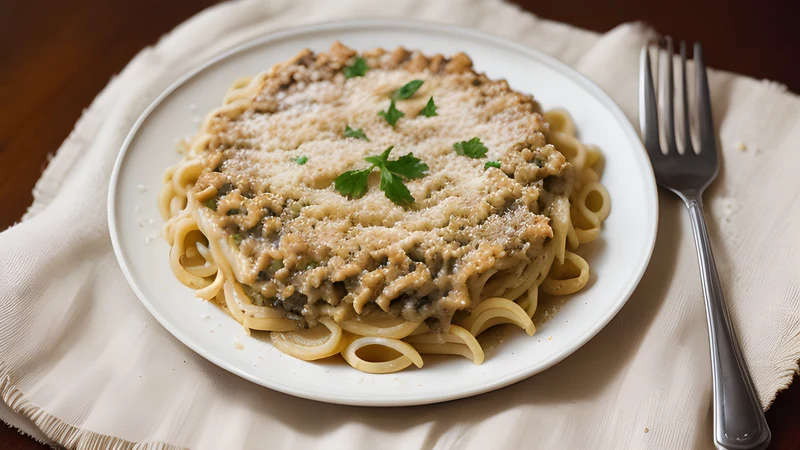
Túrós Csusza: Hungarian Pasta With Curd Cheese and Bacon
Four ingredients, ten minutes, and an argument about sugar
Contents
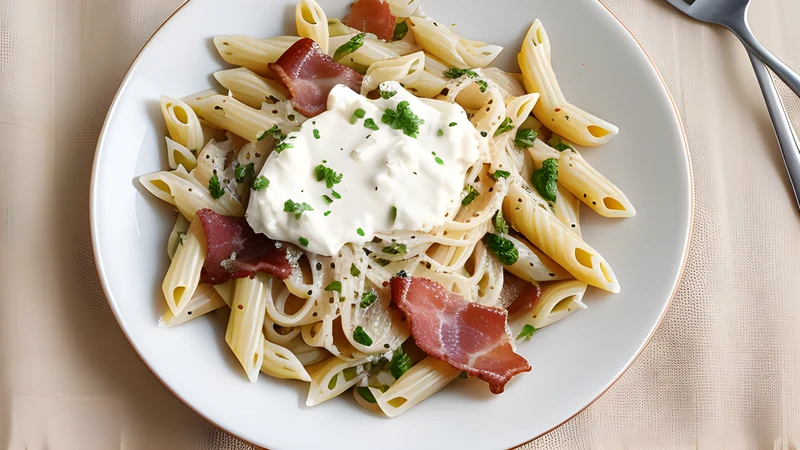
↓ Jump to recipeTúrós csusza is a plate of pasta, curd cheese, bacon and soured cream, and it takes about ten minutes to cook once the dough is made. It is also the dish that reveals whether someone actually grew up eating Hungarian food, because the moment you put sugar on it half the room will tell you that you have ruined it and the other half will tell you that you have finally made it properly.
My twist: I toss the drained pasta through the rendered bacon fat before anything else touches it, and I keep the soured cream fridge-cold rather than letting it come to room temperature. Hot pasta, warm fat, cool cream, cold curd — the whole dish is a temperature argument, and it is much better when you sharpen it.
Túrós Csusza: Hungarian Pasta With Curd Cheese and Bacon
Ingredients
- 300g plain flour, plus extra for dusting
- 3 large eggs
- 1 tsp fine sea salt, for the dough
- 1 tbsp water, if needed
- 200g smoked streaky bacon or Hungarian szalonna, cut into 5mm lardons
- 400g túró (Hungarian fresh curd cheese), or full-fat dry curd cheese
- 250g thick soured cream (tejföl), fridge-cold
- 1 tbsp fine sea salt, for the pasta water
- Black pepper, to finish
- 2 tbsp caster sugar, for the sweet version (optional)
Method
- Make the dough: tip the flour onto a board, make a well, crack in the eggs and add 1 tsp salt. Work it together with your fingers, adding the tablespoon of water only if it refuses to come together. Knead for 8-10 minutes until smooth and quite firm.
- Wrap the dough and rest it at room temperature for 30 minutes.
- Meanwhile, put the bacon lardons into a cold frying pan over a medium-low heat. Render for 10-12 minutes, stirring, until crisp and deep gold. Lift the lardons out with a slotted spoon onto kitchen paper and keep the fat in the pan.
- Roll the dough out on a floured board to 2mm thick, in two batches. Let each sheet dry on the board for 10 minutes so it stops sticking to itself.
- Cut or tear the sheets into rough squares of about 3-4cm. Irregular edges are correct.
- Bring 4 litres of water to a hard rolling boil and add 1 tbsp salt. Drop in the pasta and cook for 3-4 minutes from the moment it returns to the boil, until the squares float and taste cooked with no chalky centre.
- Drain, reserving a mugful of the water. Tip the pasta straight into the pan of warm bacon fat and toss until every piece is glossy. Add a splash of pasta water if it looks dry.
- Crumble half the túró over the hot pasta and toss once, briefly, so it warms without melting.
- Divide between four warm bowls. Top each with the remaining crumbled túró, a heaped spoon of cold soured cream, the crisp bacon and a grind of black pepper.
- For the sweet version, sift the caster sugar over the top instead of the pepper and omit nothing else.
- Serve immediately, while the contrast between hot pasta and cold cream is at its sharpest.
What túró is, and why it matters more than the pasta
Túró has no clean English translation and this is the single biggest obstacle to making the dish outside Hungary. It is a fresh, unripened acid-set curd cheese made from cow’s milk, drained to a crumbly, dry-ish texture with a clean lactic tang and around 15-20% fat in the standard supermarket block. It crumbles between your fingers into irregular curds. It does not melt, string or go greasy when it meets heat.
That last property is the whole reason the dish works. Túró warmed through in a pan of hot pasta softens slightly at the edges and stays granular in the middle, so every mouthful has distinct pale curds against slippery pasta. A cheese that melts turns the plate into a beige sauce, and a beige sauce is a different and worse dish.
What to use if your local shop has never heard of it, in descending order of accuracy:
Dry curd cheese or farmer’s cheese (the pressed, crumbly, essentially fat-free-to-medium sort sold in Polish, Baltic and Russian delis as twaróg or tvorog) is the same animal under a different passport. Buy the półtłusty or semi-fat grade. This is the answer.
Full-fat cottage cheese, drained hard in a sieve lined with muslin for two hours in the fridge, then squeezed. It is wetter and the curds are rounder, but it behaves correctly under heat.
Ricotta is a poor substitute. It is made from whey rather than curd, it is sweeter, and it slumps rather than crumbles. It will produce something edible that is not this dish.
Cream cheese, quark whipped smooth, and anything sold in a tub with a plastic lid and the word “spreadable” on it will all fail, because they are emulsified and will turn to sauce.
Where the dish comes from
Túrós csusza is peasant food from a country that spent centuries with a lot of milk, a lot of pigs and not much money. Every farmhouse had souring milk, and souring milk becomes túró with nothing more than warmth, time and a cloth to drain it through. Every farmhouse that could keep a pig had szalonna hanging in the smokehouse. Flour and eggs were the other two things always in the house. The dish is what those four things become when you have twenty minutes.
Its written history goes back at least to the eighteenth century, and it appears in Hungary’s first great cookbooks of the nineteenth. The poet Sándor Petőfi is supposed to have declared it his favourite food, which every Hungarian will tell you within four minutes of the subject arising. There is a real regional dispute along the Tisza about whether the squares should be torn or cut, and a fiercer one about whether they should be dressed with the fat or the cream first.
The version with a fried lattice of pasta baked in a dish is called csuszatészta rakva and is a Sunday thing. The everyday version is the pan. In the Great Plain you will also meet it made with sheep’s curd where the flocks are, which pushes the whole plate somewhere sharper and more mineral — closer, in spirit, to what the Slovaks do with bryndza.
The pasta, and why it’s torn
Csusza means “slider” or “slipper”, from csúszik, to slip — the name describes what the wide, slack squares do on your tongue and in your throat. This is a fresh egg pasta, cut into rough irregular squares of roughly 3-4cm, and the irregularity is functional. Straight machine-cut edges give you a stack of identical shapes that clump. Torn edges have variable thickness, catch fat and curd in their ripples, and slide against each other rather than gluing together.
Three eggs to 300g of flour is a firm dough — noticeably firmer than an Italian pasta dough, and deliberately so. Hungarian egg pasta is meant to have chew. Knead it for a proper eight to ten minutes; the gluten development is what stops the squares dissolving into the water. Rest it for thirty minutes so the gluten relaxes and it stops fighting the rolling pin.
The ten-minute drying step after rolling is the one people skip and then regret. A freshly rolled 2mm sheet is tacky and will weld to itself the moment you fold it. Ten minutes in the air puts a dry skin on the surface, and the cut squares will stay separate.
If you are using dried pasta — and plenty of Hungarian households do, buying bagged csusza or kocka squares from the shop — go for the widest flat shape you can find. Broken lasagne sheets, pappardelle cut into lengths, or dried egg noodles all work. Cook them a shade under the packet time; they finish in the bacon fat.
Szalonna and the fat question
The bacon in question is szalonna, Hungarian cured and often smoked pork back fat, which renders out an enormous quantity of savoury fat and leaves behind small crisp golden nuggets called töpörtyű. Smoked streaky bacon is a fair substitute and the version I use in Britain, though it gives up less fat, so you may want to start with a teaspoon of lard in the pan.
Start it cold. A cold pan lets the fat melt out slowly over ten minutes; a hot pan seizes the exterior of each lardon and traps the fat inside, and you end up with chewy bacon in a dry pan. When the lardons are properly crisp, lift them out and hold them back until the very end — bacon that sits in a bowl of hot pasta and cream goes soft within a minute, and its crunch is doing structural work.
Do not drain the fat. Two hundred grams of streaky bacon gives roughly three tablespoons of rendered fat and that fat is the only sauce this dish has. Tossing the hot drained pasta through it coats each square in something savoury and smoky, and it is what stops the curd sticking in dry lumps.
The sugar war
Here is where Hungarian families stop speaking to each other. Túrós csusza is served either savoury — with bacon, soured cream and black pepper — or sweet, with sugar sifted over the top and the bacon still there underneath it.
The sweet version has a long provenance. Hungarian cooking has a broad seam of sweet-savoury pasta dishes: mákos tészta with poppy seed and sugar, diós tészta with walnuts, lekváros tészta with plum jam. Túró itself is used sweet at least as often as savoury, which is exactly what happens in Russian syrniki and across the Slavic curd-cheese belt. A generation of Hungarians ate the sweet version at school canteens and remembers it fondly. Another generation ate it at the same canteens and remembers it with horror.
I make it savoury, because I want the black pepper against the lactic tang and the smoke. But I have eaten the sweet version made well — the sugar sifted rather than stirred, the bacon left in, so you get salt and smoke and sweetness in the same mouthful — and it is a genuinely interesting plate of food. The failure mode is stirring the sugar through, which just makes it cloying. Sift it on top and let each forkful be a different ratio.
What goes wrong
The curd turns to sauce. You either used a melting cheese or you cooked the túró. It goes in at the end, off the heat or on the barest warmth, and it needs about twenty seconds of contact.
The pasta is gluey. Under-kneaded dough, or a pan that was too small. Four litres of water for 300g of flour sounds excessive and is what prevents the starch concentration that makes fresh pasta claggy.
Everything tastes of nothing. Salt the water like the sea — a full tablespoon in four litres — because fresh egg pasta absorbs seasoning from the water and there is no other opportunity to season it.
The cream splits. You warmed it. Soured cream at 20% fat curdles above about 80°C. It goes on cold, as a spoonful on top, and the eater stirs it in.
The case against
This is a plate of pasta, pork fat, cheese and cream with no vegetable anywhere in sight and no acid beyond the tang of the curd. Eaten as a main course it is a substantial amount of fat and refined carbohydrate for one sitting, and by the third or fourth forkful the richness can flatten out.
Hungarians know this, which is why it very often arrives as a tésztafélék course after a soup — a portion half this size, following a bowl of broth. If you are serving it as dinner, put something sharply pickled on the table: gherkins, or a simple salad of thinly sliced cucumber in vinegar and a little sugar, which is what a Hungarian cook would reach for. The same instinct that puts pickles next to pörkölt applies here.
It also does not keep. Reheated túrós csusza is a sad, dried-out thing with the curds seized into rubbery pellets. This is a dish you cook and eat within ten minutes.
Make-ahead and storage
The dough can be made a day ahead and kept wrapped in the fridge; bring it back to room temperature for twenty minutes before rolling. Cut squares can be dried fully on a floured tray for two hours and then kept in a tin for a fortnight, which is what Hungarian households did before dried pasta was cheap. They will need five minutes in the water instead of three.
Render the bacon up to three days ahead and keep the lardons and their fat in a covered jar in the fridge. Warm the fat gently and re-crisp the lardons for a minute before serving.
The finished dish keeps for nothing at all. If you have leftovers, fry them in butter the next morning until the pasta edges catch and crisp, add an egg, and call it a different breakfast. That is a good dish. It is no longer túrós csusza.
If you want the other side of Hungarian curd-and-flour cooking, rakott krumpli applies the same soured-cream-and-smoked-pork instinct to potatoes and eggs, and it does keep.
Related Content