Turkish Manti With Garlic Yoghurt
Tiny Kayseri dumplings under cold garlic yoghurt and hot pul biber butter
Contents
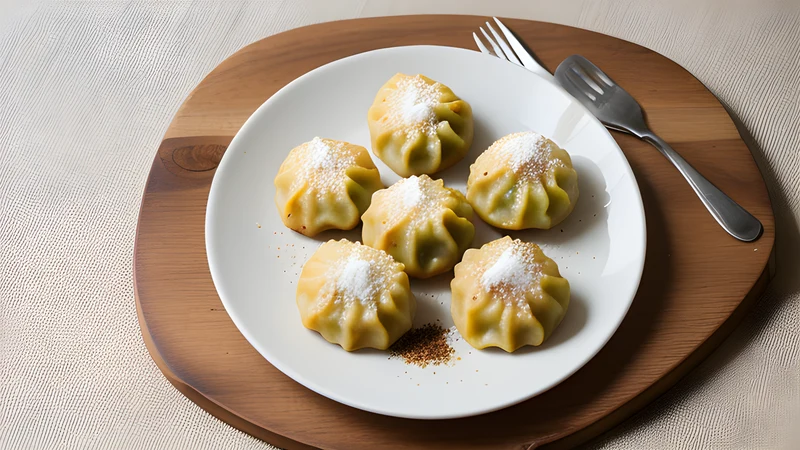
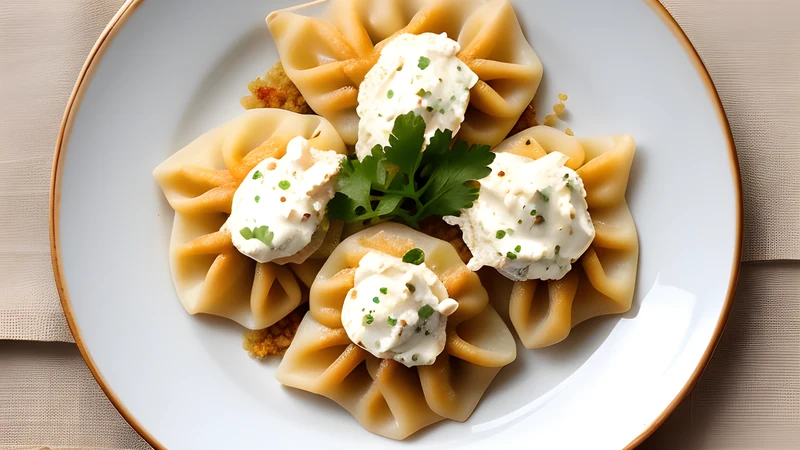
↓ Jump to recipeManti are the smallest serious dumplings anyone makes on purpose. In Kayseri, where they are taken most seriously, a well-made one is about the size of a thumbnail, and the four pinched corners stand up like a tiny parcel. They get boiled, buried under cold garlic yoghurt, and then hit with butter that has been cooked red with pepper paste. Hot, cold, sour, sharp, all in one spoon. It takes an afternoon to make a batch and about eleven minutes to eat one, which is a ratio you have to make peace with before you start.
Turkish Manti With Garlic Yoghurt
Ingredients
- 250g plain flour, plus extra for dusting
- 1 large egg
- 100ml water, at room temperature
- 1/2 tsp fine salt, for the dough
- 200g minced beef or lamb (about 15% fat)
- 1 small onion (about 80g), finely grated
- 2 tbsp flat-leaf parsley, finely chopped
- 1/2 tsp fine salt, for the filling
- 1/4 tsp freshly ground black pepper
- 1/4 tsp pul biber (Turkish red pepper flakes), for the filling
- 400g strained or thick Greek yoghurt, at room temperature
- 2 garlic cloves
- 1/2 tsp fine salt, for the yoghurt
- 75g unsalted butter
- 1 tbsp biber salçası (Turkish red pepper paste) or tomato purée
- 1 tsp pul biber, for the butter
- 1 tbsp dried mint
- Sumac, to serve
Method
- Mix the flour and 1/2 tsp salt in a bowl. Beat the egg with the water, pour in, and bring together into a stiff, shaggy dough. Knead on a work surface for 8-10 minutes until smooth and firm — it should feel noticeably drier than a pasta dough. Wrap and rest at room temperature for 45 minutes.
- Squeeze the grated onion hard in a clean tea towel and discard the juice. Mix the dry onion pulp with the mince, parsley, 1/2 tsp salt, black pepper and 1/4 tsp pul biber. Cover and chill.
- Crush the garlic to a paste with 1/2 tsp salt using the flat of a knife, then stir it through the room-temperature yoghurt. Leave it out on the worktop while you work — it must not be fridge-cold when it meets the manti.
- Cut the rested dough into four. Keep three pieces wrapped. Roll the first out on a floured surface as thinly as you can, aiming for 1-2mm; you should be able to see the shadow of your hand through it.
- Cut the sheet into 2.5cm squares with a knife or pizza wheel. Put a scant 1/4 tsp of filling in the centre of each — less than looks right.
- Bring the four corners of a square up to meet over the filling and pinch them together firmly, then pinch the four open seams closed. Set on a floured tray. Repeat with the rest, keeping finished trays covered with a tea towel.
- Bring a large pan of well-salted water to a rolling boil. Drop in the manti in two batches, stir once to stop them settling, and boil for 6-8 minutes from fresh (10-12 from frozen), until the dough at the pinched top is tender with no floury taste.
- While they boil, melt the butter in a small pan over a medium heat. When it foams, stir in the salça and 1 tsp pul biber and cook for 45 seconds, until the fat turns deep red and smells sweet. Take off the heat and crumble in the dried mint.
- Lift the manti out with a slotted spoon, draining well, and divide between four warmed shallow bowls. Spoon the garlic yoghurt generously over the top.
- Pour the hot pepper butter over the yoghurt, dust with sumac and serve immediately.
Kayseri, and forty on a spoon
Kayseri sits in central Anatolia under the extinct volcano of Erciyes, an old caravan city that has been a trading centre since Roman Caesarea and is known across Turkey for three things: pastırma, sucuk, and manti. Every Turkish cook concedes the city’s claim on the dish. The argument is over how small they have to be.
The folklore is specific. A prospective mother-in-law, sizing up the woman her son intends to marry, would have her make manti — and the test was whether forty of them would fit on one spoon. Bir kaşığa kırk manti sığmalı. You will hear this in Kayseri as a boast and elsewhere in Turkey as a joke about Kayseri, and it should be treated as folklore rather than social history. It does, though, encode something true: the smallness is the skill, the point, and the entire reason the dish carries status. Anybody can fill a big dumpling.
The route the dish took to get there is one of the more interesting things about it. The word manti has relatives across the whole of Asia — mantı in Turkish, manta among the Uyghurs, manti through Central Asia, mandu in Korea, mantou in Chinese, manjū in Japanese. The dumplings themselves travelled west with Turkic migration into Anatolia, and they got smaller as they went. Central Asian manti are big — palm-sized, steamed, often filled with lamb and pumpkin, eaten with your hands. The Anatolian version shrank to a fortieth of that, moved from the steamer to the boiling pot, and acquired a yoghurt sauce that the Central Asian ones do not have, because yoghurt is what Anatolia puts on everything. You can watch a food travel four thousand miles and become a different dish while keeping its name.
Armenian and Georgian kitchens have their own close cousins, and the yoghurt-and-garlic finish shows up across the region — the same instinct that produces çılbır, where poached eggs go over garlic yoghurt under chilli butter, and the same logic that runs through yayla çorbası. Turkey solves an enormous number of problems with yoghurt, garlic and hot butter.
Kayseri also gives the dish its one genuinely alien variation. Kuru manti — dry manti — are baked in a low oven until hard and biscuit-coloured before they are ever boiled, which drives out the moisture and turns them into a shelf-stable store cupboard item that keeps for months. When you want them you simmer them for rather longer than fresh ones and finish them the same way. It was a preservation method in a region with hard winters, and it survives as a texture preference: the baked dough stays firmer and slightly nutty in the bowl. It is also, incidentally, how a lot of Turkish supermarkets sell manti.
The dough wants to be dry
This is the first thing that surprises people who have made pasta. Manti dough is stiff — 250g of flour to one egg and 100ml of water lands around 55% hydration, and it will feel unpleasantly firm and reluctant when you start kneading it. Keep going. Ten minutes gets it smooth.
The dryness is functional. You are going to roll this sheet to 1-2mm and then leave cut squares sitting on a tray while you fill fifty of them, and a soft, wet dough goes slack and sticky and welds itself to the board within five minutes. A stiff dough holds its edges, takes a firm pinch that actually stays pinched, and survives the boil without bursting. It also produces the slightly chewy, substantial dough that manti are supposed to have — these are not delicate wrappers in the har gow sense.
One egg matters more here than the quantity suggests. Egg proteins and fat both interfere slightly with gluten development, giving a dough that is strong enough to roll thin without being so elastic that it fights you, and the yolk’s emulsifiers make the sheet more forgiving to handle. Water-only manti dough exists and is perfectly traditional in some households; it rolls thinner but it tears more.
Rest it for 45 minutes. Gluten forms in tight, tangled networks as you knead, and resting lets those bonds relax so the sheet stops springing back. Try to roll it immediately and you will fight it, get to 3mm, give up, and make thick manti. Rest it properly and the same dough rolls to a shadow with almost no effort. If you have an oklava — the long, thin Turkish rolling pin, essentially a dowel — it is genuinely better for this than a fat Western pin, because you roll from the centre with the sheet partly wrapped around it. A length of broom handle works.
Work with a quarter of the dough at a time and keep the rest wrapped. Exposed dough skins over in about four minutes, and a skinned sheet will not seal.
Filling: less than looks right
Two hundred grams of mince fills fifty-odd dumplings, which tells you how little goes into each — a scant quarter-teaspoon, a lump the size of a peppercorn. Every instinct will tell you to add more. Resist it, because the dough-to-filling ratio is the dish: a manti overstuffed to the size of a tortellini is a perfectly nice dumpling and an entirely different food, and it will also burst.
Squeeze the onion dry and use the pulp, keeping the juice out. This is the opposite of what I do for İskender kebab, where the juice is the prize and the pulp goes in the bin, and the reason is structural: onion water inside a 1mm-thick parcel turns to steam in the pot and blows the seams open. Dry pulp gives you the flavour and the texture with none of the risk. The mince also goes in raw and stays lean-ish — 15% fat is plenty, and a fattier mince renders inside the parcel and does the same job as the water.
The fold is the four corners brought up to a point over the filling and pinched, then the four open seams closed. Pinch harder than feels polite. Then a professional habit worth adopting: as the trays fill, keep them under a tea towel, and if you are working for more than half an hour put the finished trays straight into the freezer rather than leaving them sitting. Dumplings that sweat onto a tray will stick, tear when you lift them, and leak.
The yoghurt must be at room temperature
This is the rule that separates good manti from a disappointing bowl, and it is free.
Fridge-cold yoghurt spooned over boiling dumplings does two bad things. It drops the temperature of the whole bowl to lukewarm within seconds, and it makes the hot butter seize into little solid flecks the moment it lands instead of pooling into red slicks. Take the yoghurt out when you start rolling and it will be exactly right by the time you need it. Süzme — strained — is what you want; ordinary natural yoghurt needs an hour in a muslin-lined sieve, or use homemade labneh taken off the strain while it is still spoonable.
Crush the garlic to a paste with the salt rather than mincing it. The salt acts as an abrasive and breaks the cells down completely, which gives you garlic dispersed evenly through the yoghurt instead of hot little shards of it. Two cloves for four people is assertive and correct. This is a dish that tastes of raw garlic and admits it.
The butter, and the boil
Biber salçası, Turkish red pepper paste, is what makes the butter that specific deep red rather than an orange chilli oil. It is sun-cooked sweet pepper reduced to a paste, sold sweet or hot, and any Turkish grocer has it in a big jar for very little. Tomato purée is a fair substitute with a squeeze more pul biber. Cook the paste in the foaming butter for 45 seconds — long enough to lose its raw edge and bloom its colour into the fat, short enough to avoid catching, because salça has sugar in it and burns fast.
The dried mint goes in off the heat. Mint’s volatile oils are fragile and 30 seconds in hot butter turns them dusty and hay-like. Crumbled into butter that has stopped sizzling, it perfumes the whole bowl.
Sumac at the end is worth a sentence of its own. It is the dried, ground fruit of the sumac shrub, sour in a fruity, tannic way that behaves like a dry lemon, and its job in this bowl is to cut through the butter and the yoghurt’s fat at the last second. Skipping it will not ruin the dish. Including it is what makes the second spoonful taste as good as the first.
For the boil: well-salted water at a proper rolling boil, in two batches, stirred once as they go in so they do not glue to the bottom. Six to eight minutes for fresh. Test one — the pinched crown is the thickest part and the last bit to cook, and if it tastes of raw flour they all need another minute.
Freezing, which is the real reason to make them
Nobody makes manti for one dinner. Make the full batch, freeze what you do not eat on trays until solid, then bag them. They keep for three months and go straight from freezer to boiling water with four extra minutes and no thawing — thawed manti turn into a sticky, sagging mess, so do not.
Half a Sunday afternoon buys you three or four dinners that are ready in twelve minutes, which is roughly the economics of any dumpling worth the effort, whether you are folding potstickers or pierogi. Put on something long to listen to and accept that the first ten are ugly. They boil up exactly the same as the pretty ones.
Related Content