Tortellini in Brodo: The Capon Broth of Bologna
Christmas in Emilia, and a broth clear enough to read a menu through
Contents
↓ Jump to recipeThere is a stretch of Bologna in December when every sfoglina in the city is folding tortellini and the shop windows are full of trays of them, and the whole thing has the air of a small industry running at capacity. It is Christmas food. It is the Christmas food, and Bolognese families do not compromise about it.
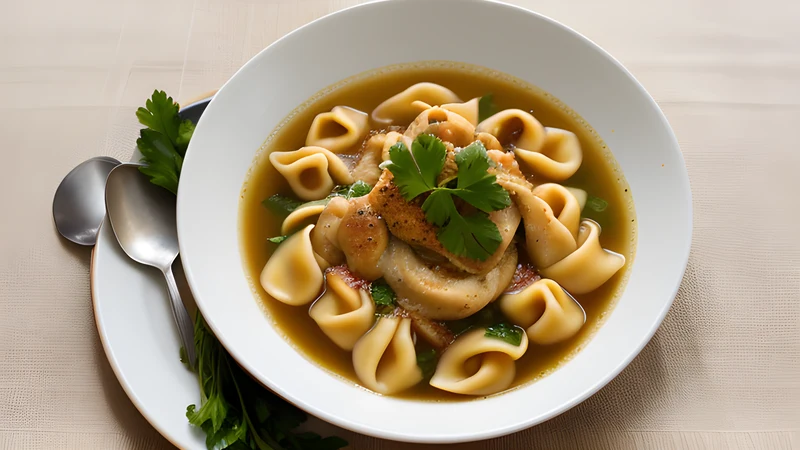
What arrives at the table looks almost apologetic: a wide white soup plate, a clear golden broth, thirty tiny navels floating in it, nothing else. No garnish. No cream. No vegetables. Two things on the plate and both of them took a day.
That austerity is the confidence of a dish that knows it is good.
Tortellini in Brodo: The Capon Broth of Bologna
Ingredients
- 1 capon or large free-range chicken, about 2 kg, jointed
- 800 g beef shin, in one piece
- 300 g beef bones, ideally marrow bones
- 2 onions, halved, skin on
- 2 carrots
- 2 celery sticks
- 4 black peppercorns
- 1 bay leaf
- 1 bunch parsley stalks
- 20 g coarse sea salt
- 300 g Italian 00 flour
- 3 large eggs
- 100 g pork loin, in one piece
- 100 g prosciutto di Parma, in one piece
- 100 g mortadella di Bologna
- 100 g Parmigiano Reggiano, aged 24 months, finely grated
- 1 large egg, for the filling
- 20 g unsalted butter
- 1 pinch freshly grated nutmeg
- 1 pinch fine sea salt
Method
- Put the capon, beef shin and bones in a very large pot. Cover with 5 litres of cold water and bring to the boil slowly over medium-low heat, which should take 40 minutes. Skim the grey foam off every few minutes as it rises.
- Add the onions, carrots, celery, peppercorns, bay, parsley stalks and salt. Drop the heat until the surface barely trembles - one bubble every few seconds, around 85C - and cook uncovered for 3 hours. Never let it boil.
- Strain through a colander, then through a sieve lined with a double layer of muslin, without pressing the solids. Cool, chill overnight, and lift the set fat off the top.
- For the filling, brown the pork loin in the butter over medium heat for 8 minutes until cooked through, then cool it completely with its pan juices.
- Mince the pork, prosciutto and mortadella together twice through the finest plate of a mincer, or blitz in a food processor until it forms a fine, smooth paste.
- Mix in the Parmigiano, the egg and the nutmeg. Season with a pinch of salt only - the cured meats and cheese bring most of it. Cover and chill for at least 4 hours, ideally overnight.
- Make the pasta: mound the flour, well in the centre, add the eggs, draw in and knead for 10 minutes until smooth and firm. Wrap and rest for 1 hour.
- Roll through a pasta machine to the thinnest setting. Cut into 3 cm squares, working with a small section at a time and keeping the rest covered.
- Put a pea-sized dot of filling on each square. Fold into a triangle, pressing the air out and sealing the edges firmly. Bend the two long points around your index finger and pinch them together, then flip the top point back.
- Rest the shaped tortellini on a floured tray for 30 minutes, uncovered, so the seals set.
- Bring the degreased broth to a gentle simmer and taste for salt. Cook the tortellini directly in the broth for 3-4 minutes, until they float and the folded points are tender.
- Serve 25-30 per person in warm soup plates with plenty of broth. Grate more Parmigiano at the table if you must.
The registered recipe and the navel
Bologna is one of the few cities to have deposited a recipe with a notary. On 7 December 1974 the Dotta Confraternita del Tortellino and the Accademia Italiana della Cucina lodged the official filling with the Chamber of Commerce: pork loin, prosciutto crudo, mortadella di Bologna, Parmigiano Reggiano, egg, nutmeg. That is the list. They did the same for tagliatelle, whose official width is 8 mm cooked, and for ragù.
You may reasonably find this ridiculous. It is also why the tortellino has stayed exactly what it is for fifty years while everything else drifted.
The shape has its own mythology. The story — told in Castelfranco Emilia, between Bologna and Modena, which claims the invention — is that Venus stopped at an inn for the night, and the innkeeper, overcome, peered through the keyhole and saw only her navel, then rushed to the kitchen and reproduced it in pasta. Bologna disputes the location energetically, as it disputes everything with Modena. The poet Alessandro Tassoni wrote the two cities’ rivalry into La secchia rapita in 1622 and it has not cooled since.
What matters practically is that the navel shape is functional. The ring holds broth in its hollow, the pinched join gives a chewier bite, and the flipped-back point catches on the spoon. It is a shape designed to be eaten in liquid.
The broth is the dish
Here is what people get wrong: they treat the broth as the medium and the tortellini as the content. Bologna sees it the other way round. Il brodo is the reason the dish exists, and the pasta is what you put in it.
So it needs to be made properly, and clarity is the measure. You should be able to read the pattern on the bottom of the plate through it.
Clarity comes from temperature and nothing else. Start in cold water, bring it up over 40 unhurried minutes, and skim relentlessly for the first stretch — the grey foam is coagulated albumin and blood proteins, and if you leave it it disperses back into the liquid and turns everything murky. Then hold it at a bare tremble, around 85C, for three hours. Never a boil. A boil emulsifies rendered fat into the water, mechanically shreds proteins off the meat, and produces something opaque and greasy that no amount of straining will rescue. Cloudy broth is boiled broth, every time.
Strain twice — colander first, then muslin — and do not press the solids. Pressing pushes the fine particles you have spent three hours avoiding straight through the cloth.
Then chill it overnight and lift the fat off in a solid disc. This is the step that separates a good broth from a great one, and it cannot be rushed with a ladle. Fat on the surface coats the tongue and flattens everything; a properly degreased capon broth is clean, sweet and startlingly intense.
Capon. A capon is a castrated cockerel, fattened, and it makes better broth than any chicken — more collagen, more intramuscular fat, more gelatine. Butchers have them at Christmas and you can order one. A large free-range boiling fowl is the best substitute; a supermarket roasting chicken is the worst, because it is nine weeks old and has no connective tissue in it.
The twist: rest the shaped tortellini uncovered
The change I make is thirty minutes of doing nothing, and it fixes the single most common disaster.
Tortellini burst in broth. When they do, the filling clouds the liquid you spent a day clarifying, and the dish is finished. The usual advice is to cook them in salted water and transfer them, which is a real technique and which I think is a surrender — cooking them in the broth is what makes the broth taste of them.
So: after shaping, leave them on a floured tray, uncovered, at room temperature for 30 minutes. The exposed surface dries very slightly, which does two things. The seal sets firm instead of staying tacky and reopening in hot liquid. And the outer skin of dough firms enough to resist the pressure of the filling’s water turning to steam.
Do it and you can cook them straight in the broth with confidence. Twenty minutes is the minimum; go past an hour and the dough cracks.
Folding, and the discipline of small
A proper Bolognese tortellino is tiny. Three-centimetre squares, a pea of filling, and 25-30 per person in a plate. The sfogline of Bologna work to about 7 grams each and a competent one folds 800 an hour.
The size is the difficulty and it is also the pleasure. Small tortellini have a high ratio of dough edge to filling, and the folded, doubled, pinched pasta at the join is the texture that makes them worth the work. Make them big and you have made ravioli in soup.
Roll the dough as thin as your machine goes. You should see your hand through it. Work on a small section at a time and keep the rest under a cloth, because dry pasta will not seal and there is no fixing a square that has skinned over.
The fold: square, dot of filling, fold corner-to-corner into a triangle, press the air out from the filling outwards and seal the edges hard. Then take the two long base points, bend them around the tip of your index finger until they meet underneath, and pinch. Finally flip the remaining top point back over the ring. It takes about fifteen goes before your hands understand, and then it becomes automatic and quite pleasant.
Trapped air is the enemy. Press it out as you fold the triangle; a bubble expands in hot broth and splits the seam.
The dough, and why there is no oil in it
Three eggs to 300 g of 00 flour. No oil, no water, no salt in the dough. That is the Emilian sfoglia and the omissions are deliberate.
Oil tenderises by blocking gluten, and this dough needs gluten more than almost any other pasta — it has to be rolled to a whisker, folded three times on itself, pinched into a ring, and then survive four minutes in liquid hot enough to turn its filling to steam. Salt in the dough tightens gluten in a way that makes it fight the machine and it draws moisture to the surface over the resting hour, giving a tacky sheet.
Knead for ten full minutes. The dough should end up firm, smooth and springing back slowly, and it should feel like hard work — this is a dry dough by design, and the urge to add a splash of water is almost always wrong. Rest it an hour, wrapped, at room temperature.
The classic Bolognese sfoglia is rolled by hand with a metre-long mattarello, and the sfogline who do it argue that a hand-rolled sheet has a faintly rough, porous surface that grips broth, where a machine-rolled one is burnished smooth by the steel rollers. They are right, and I still use the machine, because rolling a metre of pasta to transparency by hand is a skill measured in years. Set it to the thinnest notch and accept the small loss.
Filling, cooking and keeping
Mince twice, or blitz to a genuine paste. This is one filling where texture is wrong — it should be smooth and dense so it stays put inside a pea-sized pocket.
Season carefully. Prosciutto, mortadella and 24-month Parmigiano are all salty, and the broth is salted too. A pinch is enough, and taste the mixture raw before you chill it.
Chill overnight if you can. The filling firms up, which makes it far easier to portion, and the flavours settle into one thing rather than three.
Cooking. Three to four minutes in gently simmering broth. They float in about ninety seconds; the extra time is for the doubled dough at the join.
Freezing. Freeze them on a floured tray until solid, then bag. Cook from frozen, straight in the broth, 5 minutes. This is how to survive Christmas: make them in November.
The mortadella. Buy real mortadella di Bologna IGP, in a piece from a deli, with the visible cubes of fat and the black peppercorns. The pink rubbery stuff sold as mortadella in supermarkets is a different product and it will make the filling taste of ham paste. It is a third of the filling by weight and it is the ingredient that makes a tortellino taste Bolognese rather than merely meaty.
Salt in the broth. Season the broth at the start, with 20 g in 5 litres, and then taste and correct it after degreasing and before the pasta goes in. Three hours of uncovered simmering reduces it by a fifth or more, so what was right at the beginning may be too much at the end. It should taste seasoned and complete on its own from a spoon, because there is nothing else on the plate to fix it.
Serving. Warm, wide soup plates. Twenty-five to thirty tortellini and a generous ladle of broth, so they float rather than sit. Bologna serves it with nothing on top and there is a real argument in the city about whether grating Parmigiano over is acceptable — the traditionalist position is that there is already 100 g of it in the filling. Do as you like; nobody is watching.
Leftover broth. Freeze it in 500 ml batches. It is the best cooking liquid you will ever have to hand, and it makes risotto that no stock cube can approach.
The boiled meats. Three hours of capon and beef shin do not go in the bin. Chop them, dress them with olive oil, parsley and a little vinegar, and eat them the next day; or shred them into a frying pan with onions until crisp. Emilia has been eating the by-product for centuries and it is a good lunch.
What can go wrong. Cloudy broth means it boiled. Burst tortellini mean trapped air, a tacky seal, or no resting. A greasy plate means you skipped the overnight chill and fat lift. Tough, leathery pasta means the sheet was too thick. A filling that tastes flat means it was underseasoned raw — taste it before it goes anywhere near a square of dough.
Time. Two days, honestly, and that is the shape of it: broth on day one, chill overnight, filling and folding on day two. Bolognese families do it exactly this way and they do it with several people at the table folding, which is the correct arrangement. It is also, unusually for a project of this size, a dish where every hour of effort is visible in the plate.
If you want more of Emilia, the slow tagliatelle al ragù bolognese is the other registered recipe and the other half of a Bolognese education. For filled pasta in broth elsewhere, wonton soup with prawn and pork dumplings solves the same problem with a different wrapper, and Georgian khinkali put the broth inside the dumpling instead of around it.
Related Content