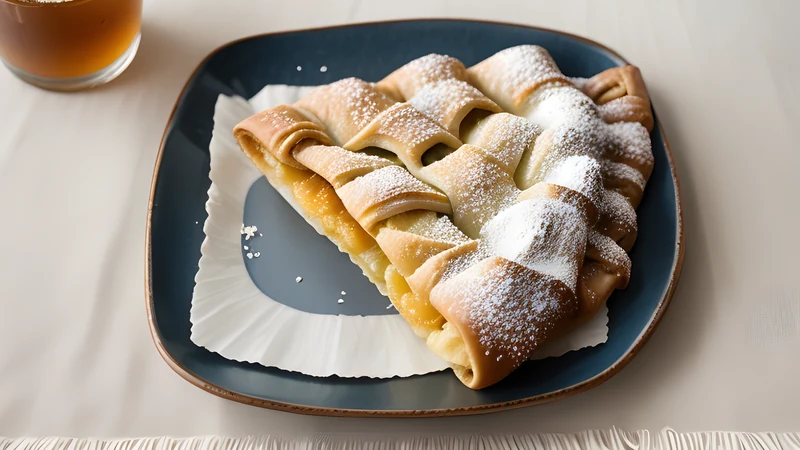
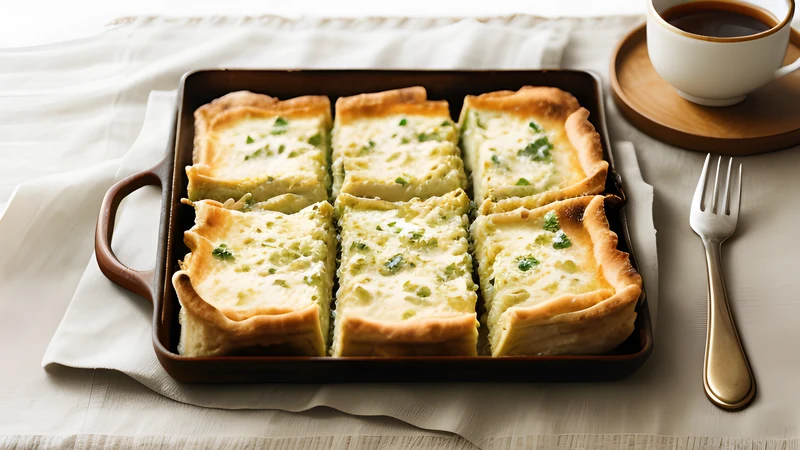
Topfenstrudel With Quark and Sultanas
The Viennese strudel that came before the apple one
Contents
↓ Jump to recipeThe 1696 manuscript in the Wiener Stadtbibliothek — the oldest strudel recipe anybody has found — describes a Milchrahmstrudel: a soft dairy filling wrapped in pulled dough and baked swimming in custard. Apples appear nowhere in it. The apple version, which is the one the entire world now associates with Vienna, came later.
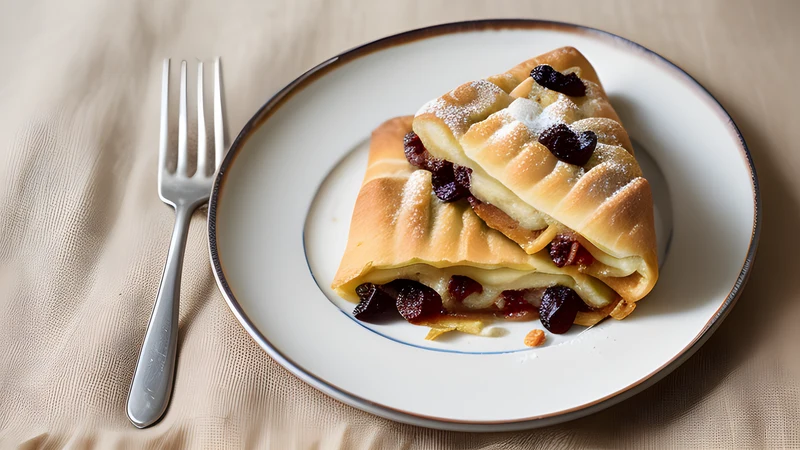
Topfenstrudel is the direct descendant of that original, and it remains the one Austrians order when they are eating for themselves rather than performing Austria for a visitor. It is milder, softer and stranger than the apple. The filling sets into something between a cheesecake and a soufflé, faintly sour, lemony, studded with rum-swollen sultanas, and the contrast against six layers of crisp pastry is the whole reason the dish exists.
Topfenstrudel With Quark and Sultanas
Ingredients
- 250 g strong white bread flour
- 125 ml warm water, at 40°C
- 2 tbsp sunflower oil, plus more for coating
- 1 tsp white wine vinegar
- 1/2 tsp fine salt
- 1 large egg yolk
- 80 g sultanas
- 3 tbsp dark rum
- 60 g fine semolina
- 30 g unsalted butter, for toasting the semolina
- 500 g quark (20% fat), drained overnight
- 100 g unsalted butter, soft
- 100 g caster sugar
- 4 large eggs, separated
- Finely grated zest of 2 lemons
- 1 tsp vanilla paste
- 1/4 tsp fine salt, for the filling
- 30 g caster sugar, for the whites
- 100 g unsalted butter, melted, for brushing
- Icing sugar, to finish
Method
- The night before, tip the quark into a muslin-lined sieve set over a bowl, cover, and drain in the fridge. Discard the whey — you should lose 60–100 ml.
- Knead the flour, warm water, 2 tbsp oil, vinegar, 1/2 tsp salt and egg yolk with a dough hook for 10 minutes, until very smooth and slack. Shape into a ball, coat in oil, cover, and rest somewhere warm for 45 minutes.
- Soak the sultanas in the rum for 30 minutes, then drain, reserving the rum.
- Melt the 30 g butter in a small frying pan over medium heat and toast the semolina for 5 minutes, stirring constantly, until it smells nutty and turns the colour of light sand. Tip onto a plate and cool completely.
- Beat the 100 g soft butter with the 100 g caster sugar for 4 minutes until pale. Beat in the egg yolks one at a time, then the lemon zest, vanilla, reserved rum and 1/4 tsp salt.
- Fold in the drained quark and the cooled toasted semolina. The mixture will be thick and slightly grainy.
- Whisk the egg whites to soft peaks, add the 30 g sugar and whisk to firm, glossy peaks. Fold a third into the quark to slacken it, then fold in the rest in two additions. Fold in the sultanas last.
- Heat the oven to 190°C. Cover a table with a floured cloth. Roll the dough to a 30 cm rectangle, then stretch it with the backs of your floured hands to about 70 x 50 cm, until translucent. Trim the thick edges.
- Brush the sheet with melted butter. Spoon the filling in a log along the near edge, leaving a 5 cm border, and level it to about 6 cm wide.
- Fold the side borders in, then use the cloth to roll the strudel away from you into a tight log. Roll it seam-side down onto a lined tray and brush generously with butter.
- Bake for 45 minutes, brushing twice more, until deep golden and firm. Cool for 25 minutes, dust with icing sugar, and slice with a serrated knife.
What Topfen actually is
Topfen is the Austrian name for what Germany calls Quark: a fresh cheese made by acidifying milk with a mesophilic culture until the casein coagulates, then draining the whey. No rennet, or barely any. No ageing. It is one of the oldest cheeses in Europe because it requires nothing but milk and time.
The thing to understand is that Austrian Topfen is drier and firmer than most of what is sold as quark in Britain. Austrian Speisetopfen at 20% fat in dry matter has a moisture content of around 70%; a British supermarket tub is often closer to 80% and pours rather than crumbles. That difference of ten percentage points is the whole gap between a filling that sets and a filling that weeps rum-coloured liquid into the base of your strudel.
Hence the overnight drain, which is non-negotiable. Muslin, sieve, bowl, fridge, twelve hours. You will pour off 60–100 ml of whey and what remains behaves like the real thing.
Ricotta will not work, and the reason is chemical rather than snobbery. Ricotta is made from whey, so its protein is albumin and globulin; Topfen is made from milk, so its protein is casein. They coagulate at different temperatures and set into different structures. Ricotta in this filling stays granular and never binds.
The workable substitutes are drained full-fat quark, which is what I have specified; or 400 g of full-fat cottage cheese pushed through a sieve with 100 g of cream cheese; or, at a push, a firm labneh. Skyr is too sour and too low in fat.
Toasted semolina, which is my addition
Every Topfenstrudel recipe includes a starch — semolina, breadcrumbs or cornflour — because 500 g of quark plus four eggs releases water in the oven and something has to hold it. The Austrian default is to stir raw semolina in and let it hydrate for ten minutes.
I toast it in butter first, five minutes, until it smells of biscuits and turns the colour of light sand.
Two reasons. Flavour: dry-toasting semolina Maillards the wheat proteins against its own starch and produces a nutty, malty, faintly popcorn character that raw semolina cannot deliver. Against a filling this mild — quark, sugar, lemon — that toasted note is the only savoury thing in the mix and it stops the whole thing tasting like sweetened dairy.
And behaviour: toasting partially damages the starch granules, so they hydrate faster and more evenly, and the filling reaches full thickness in the oven rather than after it. A raw-semolina filling that has only sat for ten minutes is still thickening as it bakes, and that is when it slumps sideways inside the roll.
Cool it fully before it meets the quark. Hot semolina starts setting the yolks on contact.
The egg whites do the lifting
Four whites, whisked to firm peaks with 30 g of sugar, folded in at the end. This is what separates a Topfenstrudel from a cheesecake in a tube.
The mechanism is simple enough. The air cells in the meringue expand in the oven, and the coagulating egg protein and swollen semolina set around them before they collapse. What you get is a filling with an open, slightly quivering structure that eats light despite carrying 100 g of butter. Leave the whites out and the filling is dense, heavy and perfectly pleasant, and it is a different dish.
The sugar in the whites is doing real work: it stabilises the foam by increasing viscosity and slowing drainage, which buys you the ten minutes between whisking and the oven. Whites whisked without sugar will have started weeping before the strudel is rolled.
Fold in three stages, with a large spatula, cutting down and turning over. The first third is sacrificial — beat it in properly to slacken the stiff quark base, because folding a fluffy foam into a firm paste in one go destroys the foam and leaves lumps of both.
Sultanas last, and drained. The rum goes into the butter and sugar earlier, where it can flavour the whole filling instead of pooling.
Rolling a wet filling
The pastry is identical to the Apfelstrudel dough — strong flour, vinegar, oil, a warm 45-minute rest, then stretched with the backs of your hands over a floured cloth until you can read through it. The full pulling technique lives in that post and I will not repeat it here.
What differs is the assembly, because a quark filling is soft and heavy and behaves nothing like a pile of apple slices.
No crumbs. The apple version needs a bed of buttered breadcrumbs to absorb juice. This filling has its own starch built in, and a crumb layer here would rob it of moisture and leave the filling dry and cracked.
Keep the log narrow. Six centimetres wide, and level it with a palette knife. A wide, flat spread of soft filling squeezes out sideways the moment the roll begins.
Roll it tighter than you think. The filling expands as the whites lift, and a slack roll leaves a cavity between the pastry and the filling that fills with steam and then bursts through the top.
Pinch the ends firmly and tuck them underneath. This filling is liquid enough to run out of an open end for the first ten minutes of baking, before it sets.
Milchrahmstrudel, the wetter original
The 1696 version deserves a paragraph of its own, because it is still made in Vienna and it is a genuinely peculiar thing.
Milchrahmstrudel takes essentially this filling, rolls it the same way, and then bakes it sitting in a bath of sweetened milk and cream — around 300 ml of milk, 150 ml of double cream, 40 g of sugar and a vanilla pod, poured into the dish around the roll. Forty-five minutes later the bottom half of the strudel has drunk the custard and gone soft and pudding-like, while the top half has stayed crisp. One dish, two textures, divided by a horizontal line.
It sounds like a mistake and it is the single best argument for the quark filling over the apple one, because a soft dairy filling can survive that treatment and a pile of apple slices cannot. If you want to try it, use a deep ceramic dish barely larger than the roll, pour the custard around rather than over, and add ten minutes to the bake.
It is also proof of how the dish was originally eaten: hot, from the dish, with a spoon. The neat sliced wedge under icing sugar is a nineteenth-century coffee-house invention.
Variations worth knowing
Poppy seed. Swap 150 g of the quark for 150 g of ground poppy seed scalded with hot milk. This is Mohn-Topfenstrudel, common across Lower Austria, and the poppy’s bitterness fixes the mildness problem in a single move.
Sour cherry. Two hundred grams of drained Schattenmorellen scattered over the filling before rolling. Draining matters — undrained cherries reintroduce exactly the water you spent a night removing.
Nussstrudel filling. The same dough with ground walnuts, milk, sugar and rum instead of quark. Faster, sturdier, and the standard Christmas version in half of Austria.
Failure modes
It weeps. The quark was not drained. There is no way to correct this after the fact.
The filling sinks to the bottom of the roll. Either the whites were folded too aggressively or the strudel sat on the tray too long before going in. Get it into the oven within five minutes of rolling.
It cracks along the top. Overbaked, or the oven is too hot. Forty-five minutes at 190°C, and the strudel should be firm rather than rigid when you press it.
The base is pale. Use a preheated heavy tray, or bake on the lower shelf. A soft filling shields the base from the oven’s radiant heat and it browns more slowly than the apple version does.
It falls apart when sliced. You cut it too early. This needs a full 25 minutes for the filling to set, and it slices best at just-warm.
Storage, and what to pour over
Best warm, about half an hour out of the oven, when the pastry is still crisp and the filling has set but has not chilled. It keeps two days covered at room temperature and it is genuinely good cold on day two, when the filling has firmed into something much closer to a baked cheesecake and the lemon has come forward.
Avoid the fridge if you can. It hardens the butter in the filling and turns the pastry to leather.
The Viennese pour warm vanilla sauce over it — a thin crème anglaise, 300 ml of milk to three yolks and 40 g of sugar, cooked to 82°C. This is the correct move and it converts the dish from a pastry into a pudding. Stewed apricots or a spoonful of soft-set redcurrant are the sharper alternative, and both are better if you are serving it after a heavy meal.
The case against, honestly
The filling is mild and it stays mild. Two lemons’ worth of zest and 3 tablespoons of rum sound assertive on paper, and in 500 g of quark they land as a whisper. Use unwaxed fruit and grate the zest straight over the bowl so the oils land where you want them. People expecting the sweetness and drama of the apple version often find this underwhelming on first taste, and it takes a second slice to hear what it is doing.
It is also the fussier strudel. The overnight drain, the toasted semolina, the whisked whites and the pulled dough add up to a dish spread across two days, and the filling is less forgiving in the roll than apple ever is.
And it depends entirely on the quark. Get a good, firm, properly sour one and this is among the best things in Austrian baking. Use a watery tub straight from a supermarket chiller without draining it and no technique in this post will save you.
Where it sits
Kaiserschmarrn makes the same argument about eggs and lift with a fraction of the work, and it comes from the same Viennese instinct for turning dairy and eggs into something that eats lighter than it should.
Mustikkapiirakka shows what northern Europe does with the identical cheese and a completely different pastry logic, and Marillenknödel is the Austrian summer answer once the apricots arrive.
Related Content