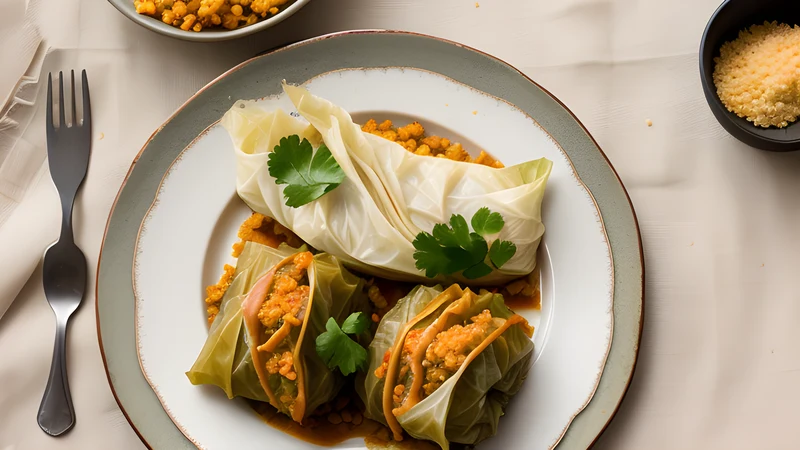
Töltött Káposzta: Hungarian Stuffed Cabbage Rolls
Soured cabbage leaves around pork and rice, buried in kraut, and left alone for two hours
Contents
↓ Jump to recipeTöltött káposzta is a two-hour dish that everyone tries to make in one, and the shortcut always shows. The rice inside the roll needs to swell and cook through from raw while the pork around it goes from firm to yielding, and the cabbage leaf holding both together needs long enough to stop being leathery. There is no version of this that works in forty minutes.
What you get in exchange is a pot that improves for three days and feeds six people twice. It is Christmas and Easter food in Hungary, and it is also the thing a family cooks on a Sunday in February because the weather is grey and there is nothing else to do.
Töltött Káposzta: Hungarian Stuffed Cabbage Rolls
Ingredients
- 1 whole soured cabbage (about 1.5 kg), or 16 jarred soured cabbage leaves
- 500 g minced pork, around 20% fat
- 100 g long-grain rice, uncooked
- 1 large egg
- 2 medium onions, finely diced
- 4 garlic cloves, finely chopped
- 3 tbsp lard
- 3 tbsp sweet Hungarian paprika
- 1 tsp hot Hungarian paprika (optional)
- 2 tsp caraway seeds
- 1.5 tsp fine salt
- 1 tsp freshly ground black pepper
- 400 g sauerkraut, drained
- 300 g smoked pork ribs or a 250 g piece of smoked bacon, in one lump
- 150 g smoked sausage (kolbász), sliced
- 800 ml water or light stock
- 2 bay leaves
- 1 tbsp plain flour
- 200 ml soured cream, at room temperature, plus more to serve
Method
- Carefully separate 16 whole leaves from the soured cabbage. Cut out the thick rib at the base of each with a shallow V, or shave it flat with a knife held parallel to the leaf. Rinse the leaves if they taste very sharp; taste one first.
- Shred any remaining soured cabbage and mix it with the 400 g of sauerkraut.
- Melt 2 tbsp of the lard in a frying pan over a medium heat. Cook the onions for 8 minutes until soft. Add the garlic and 1 tsp of the caraway, cook 1 minute more, then take off the heat.
- Wait 20 seconds, then stir in 1 tbsp of the sweet paprika. Swirl for 30 seconds in the residual heat. Scrape half this mixture into a large bowl and leave the rest in the pan.
- To the bowl add the minced pork, uncooked rice, egg, 1.5 tsp salt and the black pepper. Mix with your hands for a full minute until it is sticky and homogenous, then fry a teaspoon of it to check the seasoning.
- Lay a leaf flat, put about 2 heaped tbsp of filling near the base, fold the sides in, and roll up firmly but without compressing — the rice needs room to swell. Tuck the loose end in. Repeat for 12 rolls.
- Return the frying pan with the remaining onion to a medium heat with the last 1 tbsp lard. Off the heat again, stir in the remaining 2 tbsp sweet paprika and the hot paprika, swirl 30 seconds.
- Line the base of a heavy casserole with a third of the shredded kraut. Sit the smoked ribs on it. Arrange the rolls seam-side down in a single layer, tuck the sausage slices between them, and cover with the remaining kraut.
- Whisk the paprika-onion mixture into the 800 ml water with the bay and remaining 1 tsp caraway, and pour it over. The liquid should just reach the top of the kraut; add a little more water if not.
- Bring to a bare simmer on the hob, cover, and cook over the lowest heat for 2 hours. Do not stir at any point.
- Lift the rolls, ribs and sausage onto a warm plate. Whisk the flour into the soured cream, temper with 200 ml of the hot cooking liquid, then stir it back into the pot and simmer 5 minutes without boiling.
- Return everything to the pot, rest 15 minutes off the heat, and serve with extra soured cream and white bread.
Where the dish comes from
Stuffed cabbage arrived in Hungary with the Ottomans, and the linguistic trail is clear enough: the Turkish sarma means “wrapped”, and the same word carries into Bosnian, Serbian, Croatian and Bulgarian for the same object. Ottoman cooks had been wrapping rice and meat in vine leaves for centuries. Push that technique north into a climate where vines are seasonal and cabbage is not, and where cabbage was already being fermented for winter, and töltött káposzta is the obvious consequence.
Hungary then did the Hungarian thing to it, which was to add paprika — an ingredient that only became central to the cuisine in the nineteenth century, long after the rolls themselves — and soured cream, which came from the other direction entirely, out of the Slavic north. The dish as it stands is a three-way sediment: an Ottoman technique, a Central European preservation method, and a New World spice that arrived via the Balkans and took two hundred years to become the national flavour.
Regional versions diverge sharply. Around Kolozsvár — Cluj, in Transylvania — the rolls are layered with more kraut and smoked meat and the whole thing is baked rather than braised. In parts of the Great Plain the filling includes a proportion of smoked bacon minced in with the pork. Some households add a spoonful of tomato purée, which older cooks regard as an innovation of doubtful merit.
The Christmas association is strong and practical. A pot made on the twenty-third is at its peak on the twenty-fifth, which is exactly when a Hungarian kitchen has no capacity to spare. Making a dish that improves while you ignore it is a solved problem, and this is one of the solutions.
Serving it
A spoonful of cold soured cream on each plate is standard and it is structural rather than decorative — it is the only thing on the table that cuts the fat and the smoke. Use full-fat; a low-fat soured cream is watery and its acidity is unbalanced.
Bread on the side, white and plain, for the liquid. Boiled potatoes appear in some households and I think they are redundant against the rice.
Two rolls per person is a serving, and nobody eats two. Budget three and make twelve for six people knowing that four will go into a box for Tuesday.
For drink, a dry Hungarian white with real acidity works — a Furmint, or a Juhfark from Somló — because the fat and salt need cutting and a soft wine simply vanishes. A red will fight the sourness. Beer is the pragmatic answer and what most people are actually drinking.
Soured cabbage, and why it is a different ingredient
The most important decision in this recipe happens before you cook anything, and it is about the cabbage.
Hungarian töltött káposzta uses whole soured cabbage leaves — leaves from a head of cabbage that was fermented intact in brine, sold whole or in jars in Central European shops. Fermentation does two things that boiling a fresh cabbage cannot. It develops lactic acid, which is the sourness the dish is built on, and it breaks down pectin in the leaf, which makes it pliable enough to roll without tearing and tender after braising.
Blanched fresh cabbage leaves are the common substitute and they produce a different dish. It is a perfectly nice dish. It is closer to the Romanian sarmale or the Balkan sarma in some households, and it lacks the specific sharp backbone that makes the Hungarian one taste the way it does. If you go fresh, add 2 tablespoons of white wine vinegar to the braising liquid to compensate, and be aware you are compensating.
Whole soured cabbages are sold in Polish, Hungarian and Turkish shops through the winter, usually in a bucket of brine, and cost very little. Jarred whole leaves are the convenient option and are widely available online.
Taste a leaf before you use it. Sourness varies enormously between producers. If it makes you wince, rinse the leaves under cold water; if it is mild, use them as they are. And save the brine — it is a useful adjustment at the end if the finished pot tastes flat.
Taming the leaf rib
Cut a shallow V out of the thick central rib at the base of each leaf, or lay a knife flat against the leaf and shave the rib down to the thickness of the surrounding tissue. Skip this and two things go wrong: the rib refuses to bend, so the roll cracks along it, and after two hours you are chewing a woody spine in an otherwise tender mouthful.
Shave rather than cut out if you can manage it — removing the V leaves a notch that the filling escapes through, and you have to overlap the leaf to compensate.
Raw rice, and the roll that must not be tight
The rice goes into the filling uncooked. This is the detail people get wrong most often, usually by reasoning that raw rice in a two-hour braise sounds risky.
Raw rice is correct and it is doing something specific. As it cooks it absorbs the pork’s rendered fat and juices along with the water that migrates in from the braise. That is where the filling’s flavour comes from — a pre-cooked rice has already filled its capacity with plain water and can absorb nothing. The finished texture is different too: rice cooked inside meat is looser and more separate than rice cooked in a pan and then bound.
Which means the roll cannot be tight. Rice roughly triples in volume, and a roll packed to bursting will burst — you will lift the lid after two hours and find twelve split parcels leaking rice into the kraut. Roll firmly enough that it holds its shape and loosely enough that you could squeeze it slightly. Two heaped tablespoons of filling per leaf is about right.
Mix the filling properly. A full minute of hand-mixing extracts myosin from the pork, which is what makes it sticky and what stops the filling crumbling when you cut a roll. Under-mixed filling falls apart on the plate.
The layering, and the no-stir rule
Build in layers and then leave it alone. Kraut on the base, ribs on the kraut, rolls seam-side down in one layer, sausage tucked between, kraut on top, liquid over.
The bottom layer of kraut is insulation — it stops the rolls sitting on the metal and catching, in a pot containing several tablespoons of scorchable paprika. The top layer is a lid within the lid, keeping the rolls submerged in steam and stopping the exposed ones drying.
Never stir. Two hours of gentle braising leaves the rolls structurally delicate, and a spoon through the pot produces cabbage rags and loose rice. If you need to redistribute anything, move the whole casserole.
A single layer of rolls is better than two. If you have made too many for your pot, cook them in two batches or find a wider pot; stacking means the bottom layer takes the weight and the pressure, and those rolls split.
Two hours at the barest simmer — the occasional lazy bubble at the edge. This is a braise where the rice needs sustained gentle heat, and a hard boil agitates the rolls apart while the outside overcooks.
The smoked meat
Something smoked in one lump is the difference between this dish and a sad one. Smoked ribs are traditional and the best option: they contribute salt, phenolic smoke compounds and, over two hours, real gelatine from the bones and cartilage. A 250 g lump of smoked bacon works nearly as well.
The sliced kolbász is a second, different smoke — sharper, paprika-forward, and it stays identifiable in the finished pot in a way the ribs do not. Polish kiełbasa wiejska is the easiest good substitute.
The lump stays in for the full two hours and comes out to be carved into six pieces at the end, one per plate. Two hours of low braising renders enough of its fat into the kraut around it to matter, and the rib meat itself pulls away from the bone in shreds that are arguably the best thing in the pot.
Do not salt the braising liquid. Between the soured cabbage, the sauerkraut, the ribs and the sausage you have four salted ingredients contributing over two hours, and their cure strengths vary wildly. Taste at the end and adjust then.
Failure modes
Split rolls. Packed too tight, or stacked, or boiled hard.
Crunchy rice. Under-cooked. Two hours is the floor; give it 2 hours 30 if your rolls are large.
Woody ribs in every bite. You skipped the leaf-rib step.
Bitter. Burnt paprika. The off-heat, twenty-second, thirty-second-swirl routine exists for a reason and it governs everything Hungarian, including pörkölt.
Filling that crumbles. Under-mixed pork, or mince too lean. Twenty percent fat is a minimum.
Curdled cream. Boiled after the cream went in. Flour into cold cream, temper with hot liquid, bare simmer only.
Flat, dull, no lift. Under-soured. This usually means a mild jarred cabbage and a rinse it did not need. Stir a few tablespoons of the reserved cabbage brine into the finished pot and taste again; the dish should have a sourness sharp enough that the soured cream on top feels necessary rather than optional.
Everything the same texture. The sausage went in sliced too thin and dissolved. Five millimetres minimum, and a coarse sausage that holds together.
Storage and the honest note
This gets significantly better on days two and three, as the acid softens and the smoke works through the filling. Refrigerate for up to four days and reheat very gently, covered, in a low oven. It freezes for three months if you leave the soured cream out and add it fresh on reheating.
My reservation about my own version: I use 800 ml of liquid, which produces a fairly wet pot — closer to a stew than some Hungarian households would recognise. A drier töltött káposzta, where the kraut is barely moistened and the rolls almost roast in their own steam, is arguably more traditional and gives you a more concentrated flavour. It also gives you far less margin before something catches on the base. If you have a heavy enough casserole and a low enough hob, drop to 600 ml and see what you think.
Related Content