Toast Skagen: Prawns, Dill and Bleak Roe
Sweden's great restaurant starter, invented on a boat in 1956
Contents
↓ Jump to recipeToast Skagen has an author, a date and a witness list, which makes it almost unique among the dishes people think of as traditional. Tore Wretman invented it in 1956, on a boat, for guests he had not planned for, using what was in the galley. He was the most influential Swedish restaurateur of the twentieth century — the man who ran Riche and Operakällaren in Stockholm and who did more than anyone to drag Swedish restaurant cooking out of its French cringe and give husmanskost a white tablecloth. The dish went onto his menus, then onto everyone else’s, and it has been on the first page of Swedish restaurant menus ever since.
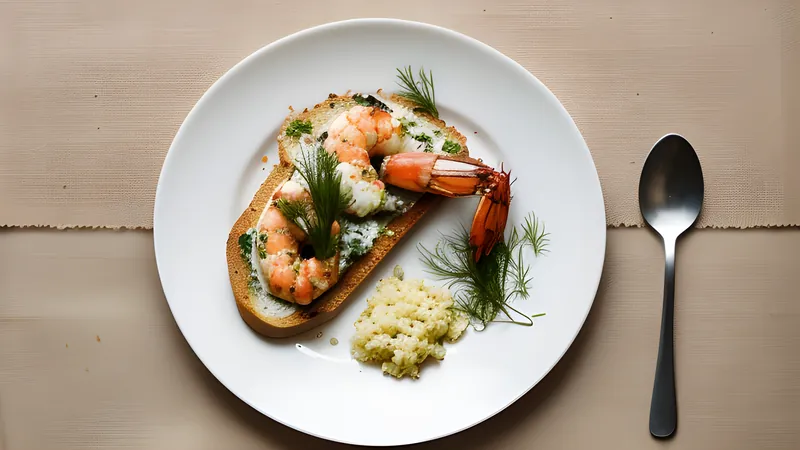
It is prawns bound in a dill-and-mustard dressing, piled on fried bread, crowned with bleak roe. It takes twenty minutes and it is very easy to make badly.
Toast Skagen: Prawns, Dill and Bleak Roe
Ingredients
- 400 g cooked cold-water prawns, peeled, well drained
- 4 tbsp good mayonnaise
- 2 tbsp crème fraîche
- 1 tsp Dijon mustard
- 15 g fresh dill, fronds only, finely chopped (about 4 tbsp)
- 2 tbsp finely chopped red onion or shallot
- 1 tsp finely grated lemon zest
- 2 tsp lemon juice
- 0.25 tsp fine sea salt
- 0.25 tsp freshly ground white pepper
- 4 thick slices white bread, such as a good pain de mie, crusts removed
- 50 g unsalted butter
- 60 g bleak roe (löjrom), or trout roe
- 1 lemon, cut into 4 wedges
- 4 small dill sprigs, to garnish
Method
- Tip the prawns into a sieve and leave to drain for 10 minutes, pressing gently. Excess water will wreck the dressing.
- Whisk the mayonnaise, crème fraîche, Dijon, lemon zest, lemon juice, salt and white pepper in a bowl until smooth.
- Fold in the chopped dill and red onion.
- Add the drained prawns and fold gently with a spatula, turning rather than stirring, until just coated. Keep the prawns whole.
- Cover and chill for 30 minutes.
- Melt the butter in a large frying pan over medium heat until foaming. Fry the bread slices for 1–2 minutes per side until deep golden and crisp at the edges but still slightly soft in the centre. Drain briefly on kitchen paper.
- Place each slice on a plate. Pile a quarter of the prawn mixture on top, mounded rather than spread.
- Spoon 15 g of bleak roe onto each mound. Add a dill sprig and a lemon wedge.
- Serve immediately, while the toast is still warm and the prawns cold.
Skagen, which is in Denmark
The name is a small geographical joke that has confused people for seventy years. Skagen is the town at the very northern tip of Jutland, where the Skagerrak meets the Kattegat and the two seas visibly collide in a line of surf. It is Danish. The dish is Swedish. Wretman named it after the fishing port because the prawns came from those waters, and the association with Skagen’s fishing fleet and its famous artists’ colony gave the thing a romance that “prawns on toast” lacks.
The prawns matter, and the geography is why. Cold-water prawns — Pandalus borealis, the Nordic or northern shrimp — grow slowly in water close to freezing, and slow growth in cold water produces a firmer, sweeter, more concentrated animal than the fast-grown warm-water alternatives. They are typically cooked and frozen at sea within hours of the trawl. Buy them frozen and thaw them yourself; the “fresh” ones on a British fish counter have almost always been frozen, thawed by someone else, and left sitting in their own leaked water.
Wretman’s timing was good. The 1950s were when Sweden’s restaurant scene was working out what a Swedish restaurant should serve, and Toast Skagen is a perfect artefact of that moment: Nordic ingredients, French technique, presented with confidence. It sits in the same tradition as gravlax, a peasant preservation method rehabilitated into fine dining, and it shares gravlax’s dill-and-cold-fish logic entirely.
The dressing ratio
Most recipes for this are mayonnaise-heavy and produce something that tastes of mayonnaise with prawns in it. The correct proportion is two parts mayonnaise to one part crème fraîche, with a teaspoon of Dijon, and the total volume kept low enough that the prawns are coated rather than swimming.
The crème fraîche is doing real work. It thins the mayonnaise’s fat wall so the prawn flavour can get out, it brings lactic acid that reads as brightness, and it drops the overall fat content enough that a second toast is imaginable. Soured cream works and is slightly tangier. Full-fat Greek yoghurt is too sharp and splits under the lemon juice.
The Dijon is structural as much as it is flavour — it emulsifies the crème fraîche into the mayonnaise and stops the dressing weeping as it sits. A teaspoon is enough to do that without tasting of mustard.
Four hundred grams of prawns to six tablespoons of dressing sounds mean. It is correct. You should be able to see individual prawns in the finished mound.
Fold it with a spatula
This is the technique that separates a good Toast Skagen from prawn paste, and it is worth being precious about.
Cold-water prawns are small and fragile, and their muscle fibres shear easily. Stir them in a bowl with a spoon and you will break perhaps a third of them, releasing their interior moisture into the dressing. That moisture thins the dressing, which makes you want to add more mayonnaise, which makes it heavier, and the whole thing slides towards a homogeneous pink paste. Once it is paste, it is paste.
So: a flexible spatula, a wide bowl, and a folding motion — down the side, across the bottom, up and over. Ten or twelve turns, no more. Stop while there is still visible unmixed dressing; it will distribute during the chill.
The draining is the other half of this. Prawns hold a startling amount of water, especially thawed ones, and any of it that reaches the dressing does the same damage as broken prawns. Ten minutes in a sieve, a gentle press, and then a pat with kitchen paper if they still look wet.
The bread
Fried, in butter, always. Toasted bread goes leathery under a wet topping within two minutes; fried bread has a sealed, fat-saturated surface that resists the dressing and stays crisp long enough to eat.
Use a close-crumbed white loaf — pain de mie, a good tin loaf, brioche at a push. Sourdough is wrong here; its acidity fights the lemon and its open crumb lets the dressing straight through. Cut the slices about 1.5 cm thick, remove the crusts, and fry in properly foaming butter for 90 seconds a side. You want deep gold at the edges and a centre that still yields — a completely crisp slice shatters when the fork goes in and the prawns end up on the tablecloth.
Fry the bread last, and assemble the second it comes out of the pan. The temperature contrast between warm bread and cold prawns is a large part of why this dish works, and it survives about four minutes.
The roe
Löjrom is roe from the bleak, a small freshwater fish from the Kalix river in Sweden’s far north, and it carries a protected designation of origin — Kalix Löjrom was the first Swedish product to get one, in 2010. The season is brief, roughly late September to early November, the harvest is small, and the price reflects both. It is worth it once: the eggs are tiny, bright orange, and pop with a clean saline sweetness that has none of the oily heaviness of larger roes.
For everything else, trout roe is the sensible substitute — bigger grains, a little more oil, widely available, and about a fifth of the price. Avoid dyed lumpfish roe, which is mostly salt and colouring, bleeds black or red into the dressing, and tastes of the jar.
Fifteen grams per portion. It is a punctuation mark and it is expensive; do not bury the dish in it.
The mayonnaise question
Shop-bought mayonnaise is acceptable here and I use it more often than I admit. Hellmann’s is the usual default and it is fine. Swedish kitchens reach for Kavli or Slotts, which are sweeter and eggier than the British standard and closer to what the dish expects.
Homemade is better, and takes four minutes. One egg yolk, a teaspoon of Dijon, and 150 ml of neutral oil driven in slowly with a whisk gives you a mayonnaise with a cleaner flavour and — importantly — no sugar, no starch and none of the stabilising gums that make commercial mayonnaise behave oddly when you fold acid into it. If you make your own, use rapeseed oil rather than olive; olive oil’s peppery polyphenols land badly on cold prawns.
The one commercial product to avoid is anything labelled “light”. Reduced-fat mayonnaise replaces the oil with water and thickeners, and water is the enemy of this entire dish. It will weep within ten minutes and the toast will be a sponge.
Getting the dill and onion right
Fifteen grams of dill for four portions is a lot of green in a small bowl, and that is the intended balance. Chop the fronds finely with a sharp knife — dill’s aroma sits in volatile terpene compounds held in the leaf tissue, and a blunt blade bruises them out onto the board instead of into the dressing. Discard the thick stems or save them for a fish stock.
The red onion is the part people get wrong most often. Two tablespoons, chopped as finely as you can manage — 2 mm dice, not slices — because you want the sharpness distributed rather than encountered. A large chunk of raw red onion in a mouthful of prawns is a wrecking ball.
If your onion is aggressive, rinse the chopped dice under cold water for ten seconds and pat dry. This washes off the sulphur compounds released by cutting, which are water-soluble, and leaves the sweetness. Shallot is milder and a perfectly good swap; spring onion is too grassy and white onion is too harsh.
The case against
This is an expensive starter pretending to be a simple one. Good cold-water prawns run to real money, löjrom runs to considerably more, and the whole thing amounts to a fairly rich pile of mayonnaise on fried bread. Eaten as a first course before something substantial it can be too much; Swedes often serve it as a light supper on its own, with a beer and a small aquavit, and that is the better use of it.
It is also entirely dependent on prawn quality in a way that no technique can rescue. Warm-water prawns — the large pink ones sold in rings — are watery, faintly ammoniac when they are past their best, and they have a rubbery snap that is wrong for this. If good cold-water prawns are unavailable, make something else. A dish with four ingredients has nowhere to hide.
Where it goes wrong
Watery mound. Under-drained prawns, or the dish sat too long before serving. Thirty minutes chilled is the maximum; beyond ninety, the salt has drawn more water out and it is over.
Pink paste. Over-mixed. There is no recovery. Fold next time.
Soggy toast. The bread was toasted rather than fried, or assembled ahead. Both are unforgivable and both are common in restaurants.
Bland. Almost always the lemon. The zest is doing more than the juice — the oils in the peel carry the aroma, and a teaspoon of zest is a noticeably different dish from none. Grate it directly over the bowl so the spray goes in.
Variations, and what not to do
A tablespoon of finely chopped fennel is a legitimate addition and Wretman-adjacent. A few drops of aquavit in the dressing is traditional in some kitchens and tastes of caraway, which is either a good idea or a distraction depending on your aquavit.
Do not put hovmästarsås anywhere near this — the mustard-dill sauce is sweet and would flatten the prawns entirely. Do not add tomato in any form. And do not scale it up into a bowl for a party, because the fried bread is half the dish and it does not exist as a canapé.
The dressed prawns will hold, covered, for a couple of hours in the fridge if you must, though they are best at thirty minutes. The bread has to be the last thing you do.
Related Content