Timpana: Malta's Baked Macaroni Under a Pastry Lid
Pasta, mince, egg and a pastry crust doing structural work
Contents
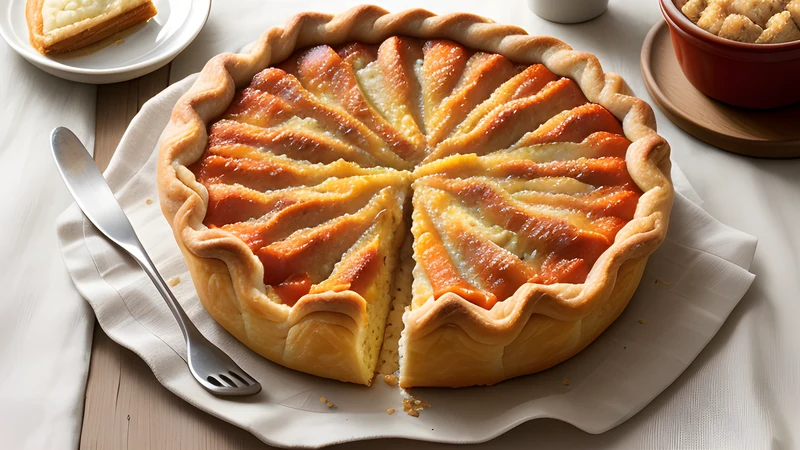
↓ Jump to recipeTimpana is Maltese food at its most maximalist: half a kilo of pasta, seven hundred grams of meat, four eggs and a pastry crust on top and underneath. It is carbohydrate wrapped in more carbohydrate, and it is served in wedges like a pie, cold or hot, at Sunday lunch and at every village festa.
The English-language instinct is to be sniffy about it. Resist that. A good timpana has a genuinely interesting texture — the eggs set the pasta into a sliceable custard, so a wedge holds its shape and reveals a cross-section of macaroni tubes standing in a savoury matrix. The pastry is doing structural work, and what happens under a sealed lid is different from what happens in an open dish.
Timpana: Malta's Baked Macaroni Under a Pastry Lid
Ingredients
- 500 g dried macaroni or penne
- 3 tbsp olive oil
- 1 large onion, finely chopped
- 2 garlic cloves, crushed
- 400 g beef mince
- 300 g pork mince
- 150 g chicken livers, trimmed and chopped (optional)
- 150 ml dry red wine
- 3 tbsp tomato purée
- 400 g tin chopped tomatoes
- 200 ml chicken stock
- 2 bay leaves
- 1/4 tsp freshly grated nutmeg
- 1 1/2 tsp fine salt
- 1/2 tsp coarsely ground black pepper
- 4 eggs, beaten
- 100 g grated pecorino or parmesan
- 500 g shortcrust pastry
- 1 egg yolk beaten with 1 tbsp milk, to glaze
Method
- Tip the dry macaroni into a large dry frying pan over medium heat. Toast for 6-8 minutes, shaking often, until roughly a third of the pieces are patched with gold and the pan smells of biscuits.
- Boil the toasted macaroni in well-salted water for 2 minutes less than the packet says — it must be distinctly firm. Drain and spread on a tray to cool.
- Heat the olive oil in a wide pan. Soften the onion over medium heat for 8 minutes, add the garlic and cook 1 minute more.
- Raise the heat, add both minces, and fry for 10 minutes, breaking them up, until browned and any water has cooked off. Add the chicken livers, if using, and fry 3 minutes more.
- Pour in the wine and boil for 2 minutes. Stir in the tomato purée and cook for 2 minutes.
- Add the tomatoes, stock, bay leaves, nutmeg, salt and pepper. Simmer uncovered for 30 minutes until thick and barely saucy.
- Remove the bay leaves and cool the sauce for 20 minutes — it must not be hot when the eggs go in.
- Combine the cooled macaroni, the sauce, the beaten eggs and the cheese in a large bowl. Mix thoroughly.
- Line a deep 25 cm round tin or a 30 x 22 cm dish with two thirds of the pastry, rolled to 3 mm. Tip in the filling and level it.
- Roll the remaining pastry into a lid, lay it over, trim, and crimp the edges firmly. Cut two 2 cm steam vents in the centre and glaze.
- Bake at 180C fan for 55-60 minutes until the pastry is deep gold. Rest for 30 minutes before cutting — it will collapse if cut hot.
Timballo, timpana, and the Knights
The dish descends from the Italian timballo, itself named after the kettledrum whose shape the mould supposedly resembled. Timballi were aristocratic Renaissance food — elaborate constructions of pasta, game, truffles and sweetbreads baked inside a pastry drum, the sort of thing that shows up in Lampedusa’s Il Gattopardo as a symbol of Sicilian grandeur.
Malta got the idea and did what Malta does, which is take the technique and make it feed a household. The truffles and game went; beef, pork and chicken livers came in. The mould got flatter. The pastry stayed, because the pastry is doing something.
Here is what: a sealed pastry case traps steam. The filling above the base and below the lid effectively bakes in a moist enclosed environment, so the eggs set gently and evenly rather than the top drying into a crust. It is a low-tech bain-marie. Bake the same filling in an open dish and you get a leathery top and a wet middle. It is the same reason a proper pork pie has a lid.
The Knights of St John ran Malta from 1530 to 1798 and their kitchens were staffed by Sicilians and Italians. The traffic of recipes across that period is the whole story of Maltese cooking, and timpana is one of the clearest surviving artefacts of it.
Choosing the pasta and the tin
Macaroni is in the name and macaroni is correct, but the specific shape matters more than the label.
You want a short tube with a hole big enough to fill. When the egg-and-ragù mixture goes in, some of it works its way inside the tubes, and in the oven it sets there — so each piece of pasta ends up with a plug of savoury custard in it. That is a large part of why timpana has the texture it does. Penne works, and penne rigate works better because the ridges hold sauce on the outside as well. Rigatoni is excellent if you can find it in a small enough size. Elbow macaroni, the tight bent kind, has a hole too small and too curved for anything to get in, and it produces a noticeably duller pie.
Avoid anything long, anything flat, and anything fresh. Fresh egg pasta will disintegrate over an hour in the oven — it has no dried-semolina structure to hold onto.
For the tin: 25 cm round and at least 7 cm deep, or a 30 x 22 cm roasting dish. A springform or loose-based tin is worth using, because getting the first wedge out of a fixed-sided dish without demolishing it is genuinely difficult. Line the base with a disc of baking paper regardless. Metal beats ceramic here — it conducts heat into the base pastry faster and gives you a crisp bottom instead of a pale, damp one, which is the same reason a pork pie is baked in metal.
Grease the tin properly before the pastry goes in, even if it is non-stick.
The twist: toast the macaroni dry
Before the pasta goes anywhere near water, it goes into a dry frying pan for six to eight minutes.
The logic is borrowed from fideuà and from Greek kritharaki, both of which toast their pasta before cooking, and it does two things here. The obvious one is flavour: dry heat on semolina drives the Maillard reaction on the starch and protein at the surface, and the pasta picks up a nutty, biscuity note that survives boiling and baking. Taste a toasted piece against an untoasted one raw and the difference is not subtle.
The less obvious one is structural, and it is why this matters for timpana specifically. Surface starch that has been partially dextrinised by dry heat gelatinises more slowly in water. Toasted pasta therefore holds its firmness better through the boil and through the hour in the oven, where it is sitting in sauce and continuing to soften. Timpana’s classic failure is mush. This buys you real margin.
Do not toast it evenly to brown. You want maybe a third of the pieces patched with gold and the rest pale. Fully browned pasta will not soften properly at all and you get a pie with gravel in it. The pan should smell of digestive biscuits when it is done.
The other things that decide it
Undercook the pasta by two full minutes. It will absorb sauce and egg for another hour. Al dente out of the pot means soft out of the oven; distinctly firm out of the pot means al dente out of the oven.
Cool the sauce before the eggs go in. Twenty minutes minimum. Beaten egg hitting a hot ragù scrambles instantly, and instead of a custard binding the pasta you get flecks of cooked egg and a filling that will not slice. This is the single most common failure.
Cook the sauce down properly. Thirty minutes uncovered, until it is thick and barely saucy. A loose sauce makes a wet pie and a soggy base.
Chicken livers are traditional and I would use them. A hundred and fifty grams across seven hundred of mince adds an iron-and-mineral depth that the pie is flat without, at a dose far below the point where anything tastes of liver. If you are cooking for someone who is certain about livers, leave them out and add an extra 100 g of pork.
Cut two vents. Steam has to leave. Without vents the lid domes, cracks somewhere you did not choose, and the filling pushes out.
Rest for thirty minutes. The eggs need to set fully as the pie cools below about 70C. Cut it hot and it slumps onto the plate. This is a real wait and there is no way around it.
The pastry, and whether to make it
Five hundred grams of shortcrust is a lot of pastry, and I will say plainly that bought shortcrust is fine here and I use it about half the time. This is street-adjacent household food and Maltese kitchens are not precious about it.
If you do make it: 500 g needs 300 g plain flour, 150 g cold fat — half lard, half butter is the Maltese instinct and it gives you a sturdier, shorter crust than all butter — a pinch of salt and about 70 ml of cold water. Rub, bring together, rest for an hour.
Roll it to 3 mm. Thicker and the base will not cook through under a kilo and a half of wet filling; thinner and it tears when you lift it. Line the tin with the base sheet and let it overhang, tip in the filling, then lay the lid on and crimp the two together firmly all the way round. That crimp is a seal and it is what traps the steam.
Do not blind bake. It is tempting, and it is wrong: a pre-baked base will not fuse to the lid at the crimp, the seal fails, and you lose the enclosed environment that sets the eggs gently. The filling here is thick enough and the oven long enough that the base cooks perfectly from raw.
Two vents in the centre, 2 cm across. Any smaller and they close over as the pastry sets.
Storage and variations
Timpana keeps five days refrigerated and is eaten cold in Malta as often as hot — arguably it is better cold, when the set is firmest and the flavours have married. Reheat wedges at 170C for 15 minutes to bring the pastry back. It freezes well baked; thaw overnight and reheat at 160C for 30 minutes.
Variations: some households add 100 g of chopped ham or a handful of frozen peas. Some use a puff pastry lid, which looks better and holds the steam less well. Some skip the base pastry entirely, which halves the work and produces something closer to ross il-forn’s macaroni sibling.
If you want to see the same egg-set-pasta idea handled differently, baked ziti with sausage and three cheeses uses cheese where timpana uses egg, and alplermagronen is the Alpine argument that macaroni belongs with potato. For the rest of the Maltese Sunday table, bragioli is the other half.
The 30-minute rest
I said this above and I am saying it again as its own section because it is the rule people break.
Straight out of the oven, the egg custard binding the pasta is above 80C and it is soft. It has set chemically — the protein network has formed — but it has not firmed physically, and the fat from the mince and cheese is still liquid and doing nothing to hold anything together. Cut into it at that point and the wedge slumps sideways onto the plate in a heap of macaroni. It will taste fine. It will look like an accident.
Thirty minutes takes the centre down to roughly 65C, the fat begins to set, and the custard tightens enough that a knife leaves a clean face. An hour is better if you can stand it. Cold, the next day, it slices like a terrine.
This is the same physics as a lasagne or a quiche, and it asks for the same discipline. The pie is finished half an hour after the timer goes.
Make it in a tin with a removable base if you own one. Your first attempt at lifting a wedge out of a fixed dish will teach you why.
Related Content