Tavë Kosi: Albanian Lamb Baked With Yoghurt
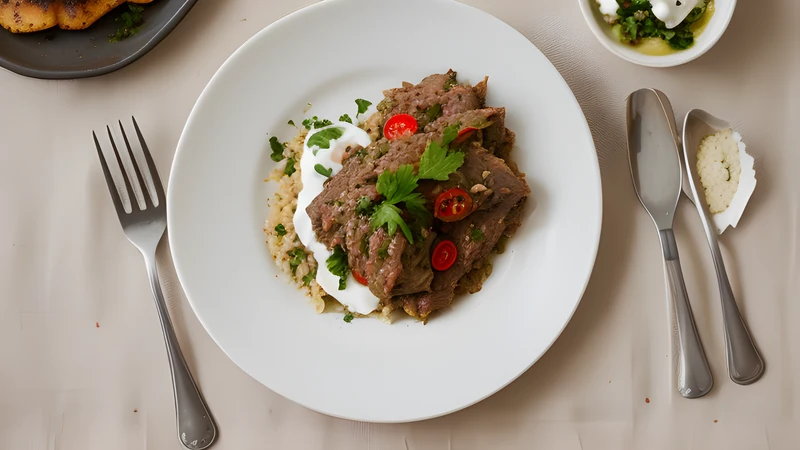
Lamb under a set custard of yoghurt, egg and rice flour, browned at the edges
Contents
↓ Jump to recipeTavë kosi is a savoury custard baked over lamb, and it is the sort of dish that ought to fail every time. Yoghurt curdles when heated. Egg curdles when heated. Combining the two, pouring them over hot meat and putting the lot in a 200C oven is, on paper, a plan to make grainy lamb soup. And yet it comes out of the oven puffed like a soufflé, set like a clafoutis, tangy and browned at the edges, holding together well enough to lift a wedge onto a plate.
The reason it works is a spoonful of flour, and the reason most home versions split is that people skip it or add it wrong.
Tavë Kosi: Albanian Lamb Baked With Yoghurt
Ingredients
- 1 kg lamb shoulder, cut into 4 cm pieces, bone in if possible
- 40 g unsalted butter
- 1 tbsp olive oil
- 2 garlic cloves, crushed
- 1 tbsp dried oregano
- 400 ml lamb or chicken stock
- 2 tsp fine salt, divided
- 1/2 tsp black pepper
- 800 g full-fat natural yoghurt, at room temperature
- 4 large eggs, at room temperature
- 40 g plain flour
- 30 g butter, for the roux
- 200 ml of the lamb cooking liquid, cooled to lukewarm
- 1/4 tsp freshly grated nutmeg
- 1 tbsp long-grain rice (optional, traditional)
Method
- Heat the oven to 170C fan / 190C conventional.
- Pat the lamb dry and season with 1 tsp of the salt. Heat the oil and 40 g butter in a heavy casserole over a high heat and brown the lamb in two batches, 4 minutes per batch.
- Return all the lamb to the pot. Add the garlic, the oregano, the black pepper and the stock. Bring to a simmer.
- Cover and braise in the oven for 75 minutes, until the lamb is tender enough to pull apart with a fork.
- Lift the lamb into a 30 x 20 cm baking dish, arranging it in one layer. Strain the cooking liquid and reserve; skim off the fat. Add the rice to the dish, if using.
- Melt 30 g butter in a saucepan over a medium heat. Whisk in the flour and cook for 2 minutes, stirring, until it smells biscuity but has taken no colour.
- Whisk in 200 ml of the lukewarm cooking liquid a splash at a time until you have a smooth, thin sauce. Take off the heat and cool for 10 minutes.
- Whisk the eggs in a large bowl until completely loose. Whisk in the yoghurt, the remaining 1 tsp salt and the nutmeg.
- Whisk the cooled roux mixture into the yoghurt mixture in a thin stream. The batter should pour like double cream.
- Turn the oven up to 180C fan / 200C conventional. Pour the batter over the lamb — it should cover it by about 2 cm.
- Bake uncovered for 30–35 minutes, until puffed, set with a slight wobble at the centre, and browned in patches.
- Rest 15 minutes before cutting. It will sink slightly; this is correct.
Elbasan, and the argument about the mosque
The dish is Albania’s national dish, and it is named for the city of Elbasan in the centre of the country — you will see it on menus as tavë Elbasani, and the two names are used interchangeably. Tavë means the pan itself, from the same Turkish and Persian root that gives you tava and tavë right across the region, and kosi means soured milk. The name is entirely literal: soured milk in a pan.
The origin story that gets told is that it was invented for an Ottoman pasha in Elbasan, sometime around the seventeenth or eighteenth century, when the city was a significant provincial centre with a garrison. The details vary by teller, and none of it is documented in a way a historian would accept. What is defensible is the context: central Albania in the Ottoman period was a place with sheep, with a strong yoghurt-making culture, and with a tepsi-and-oven tradition where households sent dishes to the communal bakery to be cooked in the falling heat after the bread came out. A dish that goes into a pan, needs no attention, and cooks in a dropping oven is a dish shaped by that infrastructure.
Whether a pasha was involved matters less than what it tells you about the cooking. This is a two-stage dish because the lamb needs a long, wet, gentle cook and the custard needs a short, dry, hot one. You cannot do both at once, and every version of the recipe from every era acknowledges that.
Rice is the interesting variable. Traditional Elbasan versions include a small amount — a tablespoon or two, uncooked, scattered under the custard — and it swells in the cooking liquid and the yoghurt, adding body and a few soft grains through the base. Some families leave it out. It is genuinely optional and I usually include it, because it gives the underside something to be.
The science of the custard
Yoghurt splits when heated because its casein proteins are already partly denatured and aggregated by fermentation. At around pH 4.5 the caseins have lost their electrostatic repulsion and are sitting in a loose gel; heating them above roughly 70C makes them contract and squeeze out water, and the gel breaks into curds and whey. This is not a maybe. Plain yoghurt heated to 190C will always split.
Two things stop it here.
Starch. The flour is the load-bearing ingredient. As it gelatinises around 60 to 70C, the starch granules swell and their released amylose forms a network through the liquid that physically obstructs the casein aggregates from finding each other and clumping. It also binds free water, so even where some contraction happens the whey has nowhere to pool. A tablespoon of flour per 400 g of yoghurt is roughly the minimum that works; this recipe runs a bit above that, which is why it sets firm enough to slice.
Egg. Egg proteins coagulate into their own network at 65 to 70C, giving the whole thing structure and letting it puff. They also emulsify. But egg alone will not save yoghurt — you need both, which is why versions that try to cut the flour out and add more egg produce something rubbery and weeping.
The roux route in this recipe is the one I trust. Cooking the flour in butter first for two minutes does two useful things: it hydrates and separates the starch granules in fat so they cannot clump into lumps when liquid hits them, and it cooks out the raw, pasty flour taste that a straight cold-slurry method leaves behind. It is exactly the same logic as a béchamel, which is why moussaka — the nearest relative on the next peninsula over — is built the same way.
Then everything goes together at compatible temperatures. Lukewarm roux into room-temperature yoghurt and egg, whisked in a stream. Hot roux into cold yoghurt scrambles the egg and shocks the casein, and you will see it happen in the bowl.
Making it
Brown the lamb properly. Dry meat, two batches, high heat, four minutes each — you want real colour on the surfaces, because the braise afterwards adds no browning of its own and the stock will taste of nothing without it. Shoulder is correct: it has the collagen that turns to gelatine over 75 minutes and it stays succulent. Leg is leaner and will be dry. Bone-in is better, and the bones go into the braise and come out before the custard.
Seventy-five minutes covered at 170C fan should get you to fork-tender. Test it: a piece should come apart under gentle pressure with no springiness left. If it resists, give it another twenty minutes; there is no benefit in rushing this, and the dish is unforgiving of chewy lamb because the custard is so soft that any resistance in the meat feels wrong.
Skim the fat off the cooking liquid, which is easier if you let it sit for five minutes and tilt the jug. Lamb fat in the custard makes it greasy and can interfere with the set.
Arrange the lamb in one layer. If it is heaped, the custard cannot get around it and you get a thick pale slab on top and nothing underneath.
Pour the batter to about 2 cm above the meat. Bake at 180C fan for 30 to 35 minutes. It is done when the edges are browned, the surface is puffed, and the centre still has a faint wobble — roughly 80C in the middle if you are measuring. Overbake and it goes from custard to sponge and starts to weep.
Rest it. Fifteen minutes minimum. It will deflate, and that is not a failure; a soufflé-like puff is a temporary structural state and what you want underneath is a set custard, which is what you get once it settles.
The yoghurt itself
Albanian kos is a set yoghurt, usually from sheep’s milk in the mountain villages and cow’s milk everywhere else, and it is noticeably tangier than the mild supermarket stuff most of us have in the fridge. That tang is the point of the dish — it is the acid that cuts an entire kilo of lamb shoulder, and there is nothing else in the pan doing that job. No lemon, no vinegar, no tomato.
So the yoghurt has to taste of something. A bland 5% Greek yoghurt makes a bland tavë kosi, and you will find yourself wondering why the dish has a reputation. Buy the sharpest full-fat natural yoghurt you can find, or a sheep’s-milk one if a Turkish or Balkan shop is within reach. If all you can get is mild, a tablespoon of lemon juice whisked into the batter gets you closer, though it is a patch rather than a fix.
Fat content matters mechanically as well as for flavour. Milk fat globules sit between the casein aggregates and physically interfere with them knitting together, which is a second line of defence against splitting alongside the starch. A 0% yoghurt has neither the flavour nor the insurance, and it will split even with the flour in. This is one of the recipes where the low-fat substitution genuinely does not work, and I say that as someone who normally shrugs at that argument.
Room temperature, too. Take the yoghurt and the eggs out of the fridge an hour before you start — about the time the lamb goes into the oven, which is a convenient piece of timing. Cold yoghurt makes the temperature-matching in the final whisk much harder, and a cold batter poured over hot lamb into a hot oven sets unevenly, giving you a browned rim and a slack middle.
Failure modes
It split — grainy texture, liquid pooling. Not enough flour, or the roux went in hot, or the yoghurt was fridge-cold. Temperature-match everything.
Lumpy custard. Roux not properly cooked out, or liquid added too fast. Add the stock a splash at a time and whisk it smooth before the next splash.
It weeps after cutting. Overbaked. Pull it at a wobble.
Rubbery, eggy. Too much egg relative to yoghurt, or a low-fat yoghurt. Full fat only — the fat is doing real work coating the proteins and softening the set.
Bland. Undersalted. Yoghurt and flour together absorb an alarming amount of salt, and two teaspoons across the whole dish is the floor. Also: reach for dried oregano over fresh. Dried Mediterranean oregano is much higher in carvacrol and is the correct flavour for this dish and for kleftiko alike.
Greasy. You did not skim.
The custard sat on top like a lid and never got underneath. The lamb was heaped rather than spread, or the dish was too small. A 30 x 20 cm dish for a kilo of shoulder gives you a single layer with gaps for the batter to find its way down. Bigger is better than deeper here.
Around it
Serve it hot, in wedges, with bread and something acidic and raw. A tomato and onion salad is standard in Albania; a shopska salata does the same job across the border. Nothing starchy is needed — the flour and the rice have that covered.
There is a chicken version, tavë kosi me pulë, which is a Tuesday dish and takes an hour less. There is a version with tripe. And the relationship to Turkish and Greek yoghurt cookery is worth sitting with: this is the same instinct that produces yayla çorbası, where flour and egg are used to stabilise yoghurt in a soup, for exactly the same physical reason.
It reheats decently at 160C for twenty minutes covered, though the puff never returns and the texture goes denser. It will keep three days. Cold, straight from the dish, standing at the fridge, it is also very good, and I would not be the first Albanian household to admit it. The one thing to avoid is the freezer: the starch network retrogrades and the custard comes back grainy and wet, undoing everything the flour spent the afternoon preventing.
Related Content