Tartiflette: The Reblochon Gratin of the Haute-Savoie
Potatoes, lardons, onions and half a wheel of washed-rind cheese, face down
Contents
↓ Jump to recipeA tartiflette contains, per person, roughly 300 g of potato, 60 g of bacon and 120 g of one of the strongest-smelling cheeses in France. It is designed to be eaten by someone who has spent seven hours on a mountain and it is completely indefensible in any other context. I make it in February anyway.
The thing worth knowing before you start is that it is not an old dish. Tartiflette was invented in about 1980, by a marketing committee, to sell more cheese. This turns out to be a good story rather than a disappointing one.
Tartiflette: The Reblochon Gratin of the Haute-Savoie
Ingredients
- 1.2 kg waxy potatoes (Charlotte, Belle de Fontenay or Ratte), peeled
- 1 whole Reblochon de Savoie (450–500 g)
- 250 g smoked lardons, or thick-cut smoked streaky bacon in 1 cm strips
- 2 medium onions (about 300 g), sliced 5 mm thick
- 1 garlic clove, halved
- 150 ml dry white wine, ideally a Savoie Apremont or Roussette
- 100 ml double cream
- 1 tbsp neutral oil
- 1/2 tsp fine salt
- 1/2 tsp black pepper, coarsely ground
- 1/4 tsp freshly grated nutmeg
Method
- Cut the potatoes into 1 cm thick slices. Put them in a pan of cold, well-salted water, bring to the boil and simmer for 8 minutes — they should be resistant at the centre. Drain and leave to steam dry for 5 minutes.
- Heat the oven to 190C fan / 210C conventional.
- Heat the oil in a large frying pan over a medium heat. Add the lardons and cook for 8–10 minutes, until the fat has rendered and the edges are properly brown and crisp. Lift out with a slotted spoon.
- Add the onions to the rendered fat with 1/4 tsp of the salt. Cook for 12 minutes, stirring, until soft and golden at the edges.
- Pour in the wine and let it bubble hard for 3 minutes, scraping the base, until reduced by half.
- Rub a 25 x 20 cm earthenware or cast-iron dish all over with the cut garlic clove.
- Layer half the potatoes into the dish. Season with half the remaining salt, pepper and nutmeg. Scatter over half the lardons and half the onion mixture. Repeat with the rest.
- Pour the cream evenly over the top.
- Cut the Reblochon horizontally through its equator into two discs, leaving the rind on. Lay both halves rind-side up on top of the gratin, cut side down, and press lightly.
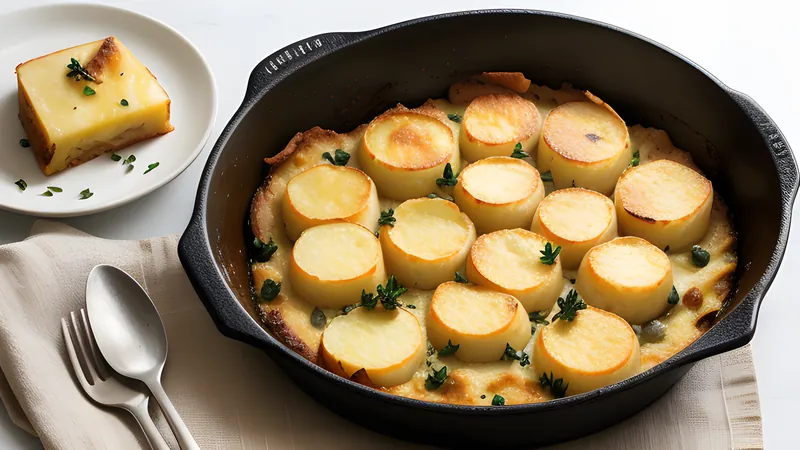
- Bake for 30–35 minutes, until the rind is blistered, deeply browned in patches, and the cheese has run down into the potatoes.
- Rest for 10 minutes before serving. It should be molten, not scalding.
A gratin with a press release
The Syndicat Interprofessionnel du Reblochon — the body representing Reblochon producers in the Haute-Savoie — had a problem in the late 1970s. Ski tourism was booming in the Alps, chalets were full, and Reblochon sales were flat. So they did what trade bodies do: they commissioned a dish. Something that used a whole wheel, that a chalet cook could assemble in advance, and that would feed skiers who had been outdoors all day.
They did not invent it from nothing. The base was péla, a real and old Savoyard dish — potatoes, onions and cheese cooked in a long-handled pan (une pêle, a shovel) over an open fire, using whatever cheese was to hand and whatever the pig had left. The syndicat took péla, specified Reblochon, added lardons and wine, put it in an oven dish, and gave it a name derived from tartifla, the Arpitan (Franco-Provençal) word for potato.
It worked spectacularly. Reblochon production roughly doubled over the following two decades. The dish is now so completely embedded in what people believe the Alps taste like that objecting to its provenance feels petty, and I do not object. A recipe that gets eaten by millions of people for forty years and makes them happy has earned its place at the table regardless of who signed the memo.
The cheese itself is genuinely ancient, and its origin is better than the dish’s. In the fourteenth century, farmers in the Thônes valley paid rent to landowners based on the volume of milk their herds produced, measured at a single milking under supervision. So they didn’t fully milk the cows while anyone was watching. Once the landlord had gone, they went back and did a second, illicit milking — re-blocher, in local dialect, meaning roughly “to pinch the udder again”. That second milking is much richer in fat, and the cheese made from it was the farmer’s own. Reblochon is, etymologically and historically, a tax dodge.
Buy the right cheese and split it right
Reblochon de Savoie carries an AOP and is made only in defined valleys of the Haute-Savoie and part of the Savoie. It is a washed-rind cheese: brushed with brine during ageing, which encourages Brevibacterium linens on the surface. That bacterium is what produces the farmyard smell, and it is also what produces the flavour. A Reblochon that smells of nothing has not been looked after.
There are two grades. Reblochon fermier, with a green casein disc on the rind, is made on the farm from a single herd’s milk, twice a day, raw. Reblochon laitier, with a red disc, is made in a dairy from pooled milk. For a tartiflette, the laitier is genuinely the better buy — it melts more predictably, it costs less, and the subtlety of a good fermier is entirely wasted under a kilo of potato and a pile of bacon. Save the green disc for a cheeseboard.
Substitutes are all compromises. A whole small Vacherin Mont d’Or or a Saint-Marcellin come closest in behaviour. Camembert is the usual suggestion and it is wrong — it is a bloomy-rind cheese and its rind turns bitter and chalky under sustained heat rather than blistering and browning.
Now the split. Cut the wheel horizontally through its equator into two discs, and lay them rind-side up, cut side down. This matters. The cut paste faces the potatoes and runs down into them; the rind faces the heat and blisters, browns and holds the whole thing together like a lid. Laying it rind-down means the rind sits between the cheese and the potatoes as a waterproof barrier, and the paste bubbles and separates on top. People do this. Do not do this.
Leave the rind on. It is where the flavour and the colour are, and it is the only thing in the dish capable of browning.
Potatoes, and the thing everyone gets wrong
Waxy. Charlotte, Belle de Fontenay, Ratte, Nicola. The difference is amylose content and cell structure: floury potatoes like Maris Piper or King Edward have larger cells with more starch granules that swell and rupture, and they disintegrate. In a tartiflette that gives you a bed of mash under the cheese, which is not the dish. Waxy potatoes hold their slices and keep distinct layers, and a good tartiflette should have visible discs in it. This is the same choice that governs gratin savoyard, and the opposite of what you want for aligot.
Part-boil, do not fully boil. Eight minutes from cold, well-salted water. They should still resist a knife at the centre. They will finish in the oven, absorbing wine, cream and rendered bacon fat as they go, and a fully cooked potato has no capacity left to absorb anything.
Start them in cold water. A slice of potato dropped into boiling water cooks its outer three millimetres to collapse before the centre has warmed up, and you get slices that are simultaneously mushy at the edge and raw in the middle. Cold start, gradual rise, even cooking. It is a small thing and it is the difference every time.
Steam dry for five minutes after draining. Surface water dilutes everything and prevents the fat from clinging.
Render the lardons properly
Eight to ten minutes, medium heat, until the fat has run out and the edges have actually gone brown and crisp. Brown, with dark tips and a dry, hard surface. “Cooked through” is several minutes short of where you need to be.
Two reasons. The rendered fat becomes the cooking medium for the onions and then the flavour base of the whole gratin — a pale lardon has kept its fat inside it and given you nothing. And a soft lardon in a finished tartiflette is a nasty thing to bite: everything else in the dish is molten, and you want the bacon to be the one element with resistance and crunch. It will soften in the oven anyway, so overshoot.
Smoked is standard in Savoie and correct. The wine deglaze afterwards lifts the fond off the pan base — that is where a real amount of the flavour is sitting, and losing it to the washing up is a waste.
Putting it together
Peel 1.2 kg of waxy potatoes and cut them into 1 cm slices — thick enough to survive, thin enough to cook through in half an hour. Into a pan of cold water, salted like pasta water, brought up to the boil and simmered eight minutes from the moment it breaks. Drain, and leave them in the colander to steam themselves dry for five minutes while you do the rest.
Oven to 190C fan. A tablespoon of oil in a wide frying pan over a medium heat, lardons in, and then leave them for eight to ten minutes with only occasional stirring. They will squeak, then sizzle, then go quiet as the water leaves and the fat takes over. Out with a slotted spoon onto kitchen paper. Pour off all but about a tablespoon of the fat.
Onions into that fat with a quarter-teaspoon of salt, twelve minutes over medium, stirring now and then, until they are collapsed and going gold at the edges. Then the wine, straight in, and let it bubble hard for three minutes while you scrape every brown speck off the base of the pan with a wooden spoon. It should reduce to a syrupy half-volume.
Halve a garlic clove and rub it hard all over the inside of a 25 x 20 cm earthenware dish, cut face down, until the clove is spent. Earthenware or cast iron, ideally — the same low-conductivity, high-mass argument that makes clay right for slow bakes gives you an even, gentle browning here and keeps the dish hot on the table.
Half the potatoes in, overlapping, then salt, pepper and half the nutmeg. Half the lardons, half the onions and their wine. Repeat with the second half. Cream poured evenly across the top.
Now the cheese. Reblochon flat on a board, one hand on top, and a long thin knife taken horizontally through the middle — go slowly, the paste is soft and it will drag. Two discs. Both laid rind-up on the gratin, cut side down, pressed lightly so they make contact.
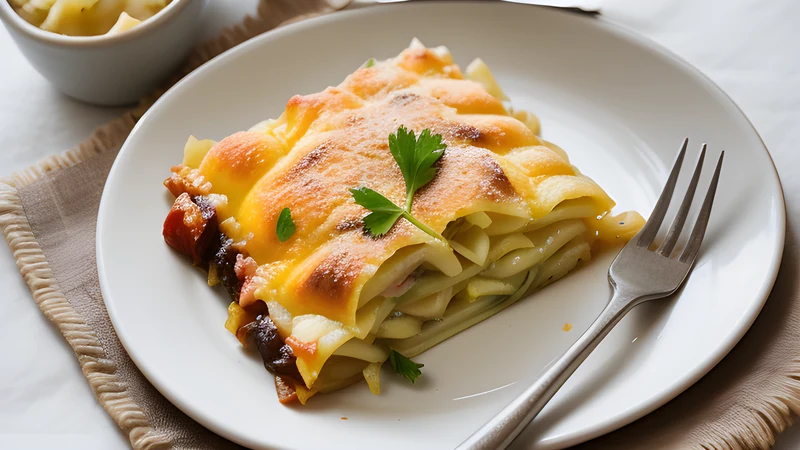
Thirty to thirty-five minutes at 190C fan. It is ready when the rind is blistered and dark in patches and cheese has run down the sides into the potatoes. Ten minutes’ rest, then serve.
What goes wrong
Greasy pool on top. Too much fat left in the pan when the onions went in, or a very fatty bacon. Pour off all but a tablespoon before the onions.
Watery. Potatoes not steam-dried, or the wine not reduced. Three minutes of hard bubbling; you want the alcohol gone and the volume halved.
Mush. Wrong potatoes, or fully boiled first.
Pale, sad cheese. Rind-side down, or the oven too low, or Camembert. 190C fan, rind up.
Bland. Undersalted potatoes. Salt the boiling water like pasta water — the interior of a potato slice takes seasoning only from the water it cooks in, and there is a kilo of it in there.
Eating it
Green salad with a sharp mustard vinaigrette, on the side, non-negotiable. Cornichons. A glass of the same Savoie white you cooked with, or a Mondeuse if you want red. Then a walk, or a lie down, or in my case both.
If it is a whole-table cheese-and-potato evening you are after, raclette is the other Alpine answer and involves less oven and more equipment. And for the quieter, creamier French take on the same three ingredients minus the bacon, gratin dauphinois is where to go.
Leftovers keep two days and reheat at 170C for twenty minutes covered, then five uncovered. The Reblochon rind will have gone soft and it never quite crisps again, which is the price of having made too much, which is a mistake I have never once regretted.
Related Content