Tarta de Santiago: The Almond Cake Under a Sword
Four ingredients, no flour, no butter, and a stencil of the Cross of Saint James
Contents
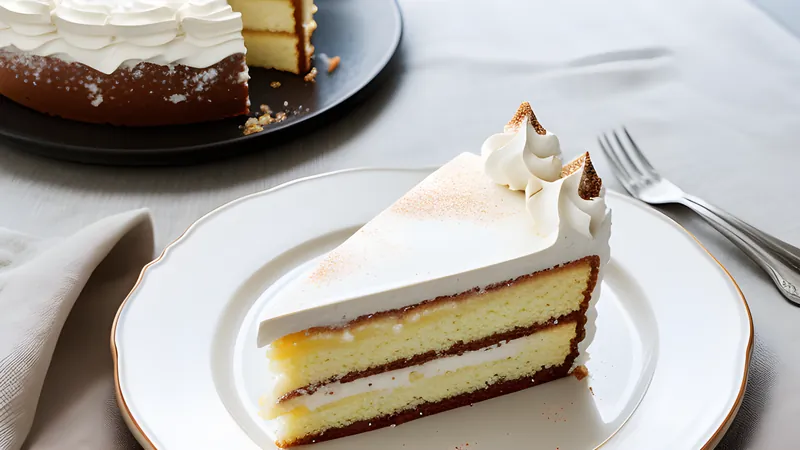
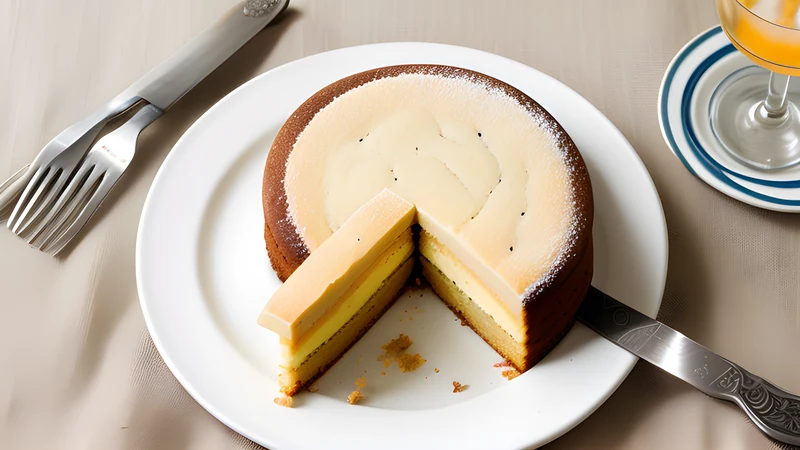
↓ Jump to recipeA cake with four ingredients has nowhere to hide, and this one has been getting away with it since the Middle Ages. Almonds, sugar, eggs, lemon. No flour. No butter. No baking powder. It is flat, dense, faintly damp, and it tastes overwhelmingly of almond, because there is nothing else in it to taste of.
Then somebody lays a sword-shaped stencil on top, dusts it with icing sugar, and lifts it away, and a plain brown disc becomes the most recognisable cake in Spain.
Tarta de Santiago: The Almond Cake Under a Sword
Ingredients
- 250 g whole blanched almonds
- 250 g caster sugar
- 4 large eggs (about 220 g out of the shell), at room temperature
- Finely grated zest of 1 unwaxed lemon
- 0.5 tsp ground cinnamon
- 0.25 tsp fine sea salt
- 1 tsp butter, for the tin
- 30 g icing sugar, for dusting
Method
- Heat the oven to 160C fan / 180C conventional. Spread the almonds on a dry baking tray and toast for 8 to 10 minutes, shaking once, until they smell nutty and are the colour of pale straw. Tip them onto a cold plate immediately and cool completely — at least 20 minutes.
- Butter a 23 cm loose-bottomed round tin and line the base with parchment.
- Grind the cooled almonds with 50 g of the caster sugar in a food processor, in 3-second pulses, until they are the texture of coarse semolina. Stop while there is still visible grain. Do not let it turn to paste.
- Whisk the eggs, the remaining 200 g caster sugar, the lemon zest, cinnamon and salt in a large bowl with an electric whisk for 5 minutes, until pale, thick, and holding a slowly dissolving ribbon.
- Tip in the ground almonds and fold them through with a large spoon in as few strokes as possible — about 20 — until no dry patches remain.
- Scrape into the tin and level the top. Bake for 30 to 35 minutes, until deep gold, slightly domed, and a skewer in the centre comes out with a few moist crumbs.
- Cool in the tin for 15 minutes, then release and cool completely on a rack. It will sink slightly and flatten — this is correct.
- Lay a Cross of Saint James stencil on the cooled cake, dust heavily and evenly with icing sugar through a fine sieve, and lift the stencil straight up without dragging.
The sword is a cross, and the cross is a nineteenth-century marketing decision
The Cruz de Santiago is a red cross with three of its arms flared into fleurs-de-lis and the fourth drawn out into a blade. It belonged to the Order of Santiago, a military brotherhood founded around 1170 to protect pilgrims walking to Compostela, and it has been the emblem of Galicia’s pilgrim city ever since.
It arrived on the cake late. The tart itself is documented far earlier — a torta real of almonds appears in Galician records from the sixteenth century, and there are references to almond cakes served at Compostela banquets from 1577. The stencilled cross is credited to Casa Mora, a confectioner in Santiago de Compostela, who started decorating theirs with it around 1924. It was, in every practical sense, branding. It worked so well that a hundred years later the cross is written into law: the Tarta de Santiago holds a Protected Geographical Indication granted in 2010, and the specification requires the cross on top, along with a minimum of 33 per cent almond by weight.
That percentage clause is the interesting one. It exists because the temptation to bulk out an expensive almond cake with flour and margarine is enormous, and the PGI is there to stop it. This recipe runs at about 34 per cent almond and no flour at all, which is well the right side of the line.
The pilgrimage explains the cake’s economics. Almonds do not grow in Galicia, which is far too wet and too cold for them; they come from the dry south, from Alicante and Murcia. An almond cake in rainy Compostela was always an expensive import made local, which is exactly what a pilgrimage city produces: things made for people who have walked a long way and will pay for a treat at the end. The cake keeps for a week, survives a bag, and needs no refrigeration, which is why it is still sold in every window on the Rúa do Franco.
Toasting the almonds first
This is the twist, and it is the only liberty I take. The PGI-compliant traditional method uses raw ground almonds, and the resulting cake is pale, sweet and slightly one-note. Toast the almonds first and the whole thing shifts.
The reason is that raw almonds taste of very little. Their flavour is largely locked up in precursors — amino acids and sugars sitting inertly next to each other — and toasting to around 140°C at the kernel drives Maillard reactions between them, generating pyrazines and furans that read as nutty in a way the raw nut simply is not. Eight minutes changes an almond from a texture into a flavour.
The discipline is that they must be completely cool before grinding, and I mean cold to the touch, twenty minutes on a cold plate. Warm almonds are soft, and soft almonds smear rather than shatter under the blade. Their oil comes out, and instead of coarse meal you get marzipan, which will make the cake greasy and heavy. Grinding them with 50 g of the sugar helps for the same reason: the sugar crystals act as an abrasive and a blotter, keeping the mixture moving and absorbing any oil that does escape.
Stop while it still looks like coarse semolina. Visible grain is the point. This cake’s texture is meant to be slightly sandy against the tongue, and a perfectly smooth almond flour gives you something closer to a flourless clementine and almond cake — very good, and a different animal.
Shop-bought ground almonds work if you are pushed. Toast them, spread thin on a tray, for 5 minutes at 160°C, watching, because they burn in seconds at that surface area. You will lose the texture but keep the flavour, which is the better half of the bargain.
Which almonds, and why blanched
Use whole blanched almonds and grind them yourself. Skin-on almonds will give you a speckled brown cake and a faintly bitter, tannic edge from the skins, which is pleasant in some bakes and muddying in one this bare. If blanched almonds are hard to find, cover skin-on ones with boiling water for 60 seconds, drain, and squeeze each one — the skin shoots off. It takes ten minutes for 250 g and is oddly satisfying.
Variety matters more than you would expect for a cake with four ingredients. Marcona almonds, the flat round Spanish ones, are higher in fat and sweeter, and they make a richer, denser cake that verges on marzipan. The Californian almonds sold in most supermarkets are drier and firmer and hold their grain better through grinding. I use Californian for the texture and I do not pretend Compostela would agree.
Whatever you buy, taste one first. Almonds are high in unsaturated fat and go rancid quietly — a stale almond tastes of cardboard and old paint, and in a cake that is one-third almond there is no rescuing it. If the bag has been open in a warm cupboard since last year, throw it out.
The eggs are the only structure
There is no flour and no raising agent, so the entire architecture of this cake is egg protein and the air you whisk into it. Five minutes with an electric whisk is a real five minutes. You are looking for the ribbon stage: lift the beaters and the mixture should fall back on itself in a thick band that sits visibly on the surface for two or three seconds before sinking in.
Room-temperature eggs whisk to roughly twice the volume of fridge-cold ones in the same time, because cold egg white is more viscous and traps air less willingly. Take them out an hour ahead, or sit them in a bowl of warm tap water for five minutes.
Then fold, and fold badly on purpose. Twenty strokes with a big spoon, cutting down through the middle and sweeping up the side, turning the bowl as you go. Every extra stroke is air leaving the bowl. A few streaks are acceptable; a perfectly homogeneous, deflated batter is a brick. The batter should still be light enough to mound slightly when you scrape it into the tin.
The cake will rise in the oven and then sink as it cools, and this alarms people. It is correct. There is nothing in there to hold the dome up — the structure sets, the trapped steam leaves, and the crumb settles into the dense, flat, slightly fudgy thing that Compostela sells. A tarta de Santiago that stays domed has flour in it.
The stencil, and getting a clean line
Print a Cross of Saint James at about 15 cm tall, cut it out of stiff card or baking parchment, and you have the tool. The cake must be stone cold — any residual warmth will melt the icing sugar into a wet grey smear within a minute, and a warm cake is also slightly tacky, so the stencil sticks and drags.
Dust generously through a fine sieve from a good height, 20 cm or so, in even passes. Thin dusting gives you a ghost. Then lift the stencil vertically, in one movement, with both hands. Any sideways drag and the edges blur.
Icing sugar on a cake this moist will dissolve within a few hours. Apply it immediately before serving. If you need it to last, do it at the table — the reveal is genuinely a good trick.
Faults, keeping, and what to drink
A greasy, heavy cake means the almonds were ground too far or ground warm. A dry, crumbly one means it was overbaked; pull it at the moist-crumbs skewer test rather than a clean one, because it carries on setting in the tin. A cake that will not release means you skipped the parchment — this batter is essentially a meringue full of oil and it grips bare metal.
It keeps five days in an airtight tin at room temperature and improves for the first two as the almond oil migrates through the crumb and it becomes damper. Do not refrigerate it. The fridge dries it and firms the fat, and it never fully recovers. It freezes for two months undusted.
Serve it with nothing, or with a small glass of something. Compostela drinks it with aguardiente de orujo, the fierce Galician grape spirit, or with a sweet Pedro Ximénez sherry whose raisin depth sits well against the toasted almond. A strong black coffee is the everyday answer.
For a fuller pudding, put a slice next to a spoonful of crema catalana and let the custard do the work the missing butter would have done. The almond and citrus logic also runs straight into an almond, olive oil and orange blossom cake if you want something taller and softer. But the cake alone, cold, with coffee, at eleven in the morning, is what it was built for.
The version with the pastry base
There is a second legitimate tarta de Santiago, and the PGI recognises both. The tarta de Santiago con base sits the almond mixture on a thin round of sweet shortcrust, baked blind for 15 minutes at 180°C before the filling goes in. It travels better, cuts more cleanly, and turns the cake into something you can hold.
The version without a base is the older and the better one, in my view, because the pastry adds flour to a cake whose entire identity is the absence of flour. Compostela sells both in the same window, at the same price, and the tourists buy the pastry one because it looks more like a tart. Make the plain one.
If you do want the base, roll it 3 mm thick, line the tin with a 2 cm collar up the side, dock it with a fork, and blind bake with beans. Reduce the almond batter by a quarter or it will overflow, and drop the bake time to 28 minutes because the pastry conducts heat faster than parchment does.
Scaling it
The recipe is a straight 1:1:1 ratio by weight — 250 g almonds, 250 g sugar, and roughly 220 g of egg, which is close enough that Galician bakers simply say equal parts of everything and count eggs. That makes it trivially scalable. Halve it into a 18 cm tin and drop the bake to 25 minutes. Double it into a 30 cm tin and go to 45, checking from 38.
The one thing that does not scale is the whisking. A doubled batch needs seven or eight minutes rather than ten, because the larger volume works the beaters harder, and it needs a genuinely large bowl — the eggs and sugar will triple in volume and there must be room to fold 500 g of almonds into them without knocking the air out against the sides.
Related Content