Tafelspitz: Vienna's Boiled Beef With Apple Horseradish
Two courses from one pot, and an emperor's favourite lunch
Contents
↓ Jump to recipeFranz Joseph I ruled Austria-Hungary for sixty-eight years, slept on an iron camp bed, rose at half past three in the morning, and ate boiled beef for lunch nearly every day of his adult life. Tafelspitz is the dish attached to his name, and the pairing tells you something true about it: this is food for someone with no interest in being dazzled.
It is also, quietly, one of the most technically demanding things in the Austrian repertoire, because there is nowhere to hide. No crust, no sauce cooked onto the meat, no browning. Just beef, water, time and temperature control. Get the temperature wrong and you have grey string in cloudy soup.
Tafelspitz: Vienna's Boiled Beef With Apple Horseradish
Ingredients
- 1.5 kg beef rump cap (picanha) or top rump, in one piece, fat cap left on
- 500 g beef marrow bones, cut into 5 cm lengths
- 300 g beef shin, on the bone
- 3 litres cold water
- 1 large onion, unpeeled, halved through the equator
- 2 carrots, peeled and halved lengthways
- 1 small celeriac, about 250 g, peeled and quartered
- 1 leek, split and washed
- 1 flat-leaf parsley root or 6 parsley stalks
- 8 black peppercorns
- 3 allspice berries
- 2 bay leaves
- 1 tbsp fine sea salt, plus more to finish
- 1 tsp lovage leaves, fresh or dried
- 2 Bramley or Boskoop apples, about 300 g
- 60 g fresh horseradish root, peeled
- 1 tbsp cider vinegar
- 1 tsp caster sugar
- 0.5 tsp fine salt
- 4 slices stale white bread, crusts removed
- 200 ml whole milk
- 150 ml soured cream
- 2 tbsp Dijon mustard
- 1 tbsp white wine vinegar
- 60 g chives, finely snipped
- 3 tbsp neutral oil
- 800 g waxy potatoes, peeled and cut into 1 cm dice
- 50 g unsalted butter
- 1 tsp caraway seeds
Method
- Put the marrow bones and shin in a large stockpot, cover with the 3 litres of cold water, and bring slowly to a bare simmer over a medium-low heat — this should take about 30 minutes. As the scum rises, skim it off with a ladle and discard. Keep skimming until the surface runs clear, roughly 15 minutes.
- Put the onion halves cut-side down in a dry frying pan over a high heat and leave them for 4–5 minutes until the cut faces are properly black. Add them to the pot; they give the broth its colour.
- Add the carrots, celeriac, leek, parsley root, peppercorns, allspice, bay and lovage. Lower the beef rump cap into the pot, fat cap upwards, and add enough extra hot water to cover it by 2 cm.
- Adjust the heat so the surface trembles with a bubble breaking every second or two — around 85°C. Never let it boil. Cook uncovered for 2.5 to 3 hours, skimming occasionally, until a skewer slides into the centre of the beef with no resistance.
- Add the 1 tbsp of salt in the final 30 minutes. Salting earlier draws too much flavour from the meat into the broth.
- While it cooks, make the apple horseradish. Peel, core and roughly chop the apples, put them in a small pan with 2 tbsp water, cover and cook over a low heat for 10 minutes until collapsed. Push through a sieve or blitz smooth and cool completely. Grate the horseradish finely on a Microplane — at arm's length — and stir it into the cold apple purée with the cider vinegar, sugar and 0.5 tsp salt. Chill.
- Make the chive sauce. Soak the bread in the milk for 10 minutes, then squeeze it out hard and blitz it with the soured cream, mustard and white wine vinegar until smooth. Fold in the chives by hand and season with a pinch of salt. Chill.
- When the beef is done, lift it out and keep it warm in a little of the strained broth. Strain the rest of the broth through a muslin-lined sieve into a clean pan, discard the bones and aromatics, and taste for salt. Skim the fat from the surface, reserving 3 tbsp.
- Make the potatoes. Boil the diced potatoes in salted water for 6 minutes until just tender, drain and steam dry for 3 minutes. Heat the oil and butter in a wide frying pan, add the potatoes and caraway, and fry over a high heat for 8–10 minutes, turning only every couple of minutes, until deeply crisp and golden. Salt them.
- Serve the clear broth first, in cups, with a few of the reserved cooked vegetables cut into fine dice.
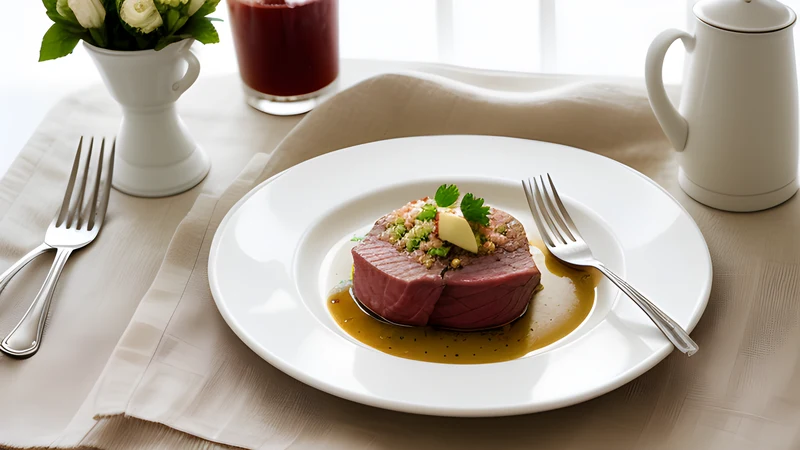
- Then carve the beef across the grain into 1 cm slices, arrange them in a warm dish with a ladle of hot broth poured over, and bring the apple horseradish, chive sauce and fried potatoes to the table.
What Tafelspitz actually is
The word names a cut before it names a dish. Tafelspitz is the triangular tip of the beef rump cap — the muscle Brazilians call picanha, sitting on top of the rump with a thick fat cap over it. Viennese butchery is famously granular: the traditional Vienna butcher’s chart divides a carcass into around forty named cuts, where a British butcher recognises perhaps a dozen, and many of those names exist purely to serve the boiled-beef repertoire. Schulterscherzel, Kruspelspitz, Mageres Meisel, Hüferschwanzl — each is a specific muscle with a specific texture and a specific cooking time, and a Viennese Beisl menu will list six of them separately, at different prices.
That granularity is the fossil record of a habit. Vienna in the second half of the nineteenth century ate an extraordinary quantity of boiled beef. Joseph Wechsberg, writing in the 1960s, described the Viennese bourgeois household as one where Rindfleisch was eaten several times a week and where the head of the house would specify which of the twenty-odd boiling cuts he wanted that day. The dish outlived the empire that produced it, and the cut names came with it.
If you cannot get rump cap, top rump (Hüferl) works well; brisket gives you a fattier, more collapsed result that is delicious and no longer Tafelspitz. Whatever you use, keep the fat cap on. It bastes the meat from above throughout the cook and you can trim it at the table.
The temperature is the recipe
Everything depends on holding the pot between about 80 and 88°C for three hours, and understanding why makes it easy to get right.
Two things happen to meat in hot liquid. The muscle proteins — myosin and actin — contract and squeeze out water, and this accelerates sharply above about 65°C. Meanwhile the collagen in connective tissue slowly hydrolyses into gelatine, a process that needs both time and temperature and runs perfectly well at 80°C given three hours. A rolling boil at 100°C speeds up the collagen conversion slightly, and wrecks the muscle fibres enormously. The meat squeezes itself dry, the fibres separate into threads, and you get the stringy, chalky texture that gives boiled beef its bad reputation in Britain.
At 85°C, the collagen still converts, the fibres contract far less, and the beef stays sliceable and moist. The difference between the two is entirely visible in the pot: a boil has a chaotic, churning surface; a proper Tafelspitz simmer has one bubble breaking every second or two, and the meat sits still.
The same physics keeps the broth clear. Boiling emulsifies fat into the liquid and mechanically shreds proteins into a cloudy suspension. A trembling simmer leaves both alone, so coagulated protein rises as scum you can lift off and fat pools on the surface where you can skim it. Clear broth is a temperature achievement.
Two more clarity rules: start the bones in cold water, so the soluble proteins rise slowly and coagulate into liftable rafts rather than dispersing, and skim relentlessly in the first twenty minutes. After that the pot mostly looks after itself.
The blackened onion is a genuine Viennese trick and not decorative. The caramelised and charred sugars on the cut faces dissolve into the broth and give it its amber colour and a faint bitterness that stops three hours of beef from tasting flabby. Burn it properly. The cut faces should be genuinely black across their whole surface; a tan blush does nothing.
The sauces, which are the point
The beef is deliberately mild. Everything interesting is in the bowls around it, and Vienna serves at least two.
Apfelkren — apple horseradish — is the essential one. The apple must be cooked and cold before the horseradish goes in, for a chemical reason: horseradish has no heat until you damage its cells, at which point the enzyme myrosinase converts sinigrin into allyl isothiocyanate, the volatile compound that goes up your nose. That compound evaporates fast and is destroyed by heat, so grating horseradish into warm apple purée throws away most of what you paid for. Grate it into cold purée, and eat it within two days. The acid in the vinegar also slows the enzyme’s decay, which is why it is in there.
Schnittlauchsauce — chive sauce — is the second, and its structure is a small surprise: it is thickened with bread. Soaked white bread blitzed with soured cream gives a body that no amount of cream alone provides, and it is a direct descendant of the medieval bread sauces that survive in odd corners of European cooking. Fold the chives in by hand at the end. Blitzing them turns the sauce swamp-green and bruises out the sulphur compounds you want raw.
Some houses add a third, Semmelkren, which is horseradish in bread sauce, and a good Beisl will bring all three plus a dish of chopped chives.
The vegetables, and the lovage
The root vegetables in the pot are doing two jobs and most cooks only think about one of them. They flavour the broth, obviously. They also come out and get eaten, cut into fine dice and floated in the soup course, so they need to survive three hours without collapsing. Celeriac and carrot manage this; parsnip and turnip do not, and will dissolve into a sweet cloud that muddies the broth.
Parsley root is the Viennese ingredient British cooks most often skip, and it is worth hunting down at a Polish or Turkish shop. It looks like a pale parsnip and tastes like the root end of parsley — earthy, faintly celery-ish, with none of the sugar that makes parsnip wrong here. A handful of parsley stalks is a reasonable stand-in.
Lovage is the other one. A single teaspoon of the leaves, fresh or dried, gives the broth the savoury note that most people identify as “tasting like stock cube” without knowing why — commercial bouillon is heavily lovage-flavoured, which is why the herb is called Maggikraut in German after the stock brand. Used sparingly it is the difference between a broth that tastes complete and one that tastes like beef water. Used generously it takes over entirely, so measure it.
The two-course rule
Tafelspitz is served as two courses from one pot, and skipping this is the most common way home cooks undersell it.
First, the broth, on its own, in a cup, with a few dice of the cooked root vegetables and perhaps a spoonful of chopped chives. Three hours of bones, shin, marrow and roots produce something with real gelatine and real depth, and it deserves its own moment. Some houses float a Frittatensuppe garnish — shredded pancakes — or a semolina dumpling.
Then the beef, sliced across the grain, sitting in a shallow pool of broth so it never dries, with the sauces and the crisp caraway potatoes. Bringing everything out at once turns the broth into gravy and wastes it.
The potatoes want the same treatment as any good fried potato: parboiled, steamed dry, then left alone in hot fat so a crust forms. If you want the full-scale version of that idea, crispy roast potatoes covers the mechanism properly. The caraway is Austrian and non-negotiable.
The rest of the repertoire
Tafelspitz and Wiener Schnitzel are the two poles of the Viennese table — one all restraint, one all crust — and a Beisl menu is essentially the space between them. If you want the horseradish idea in a colder, brighter form, roasted beetroot with horseradish crème fraîche uses the same enzyme trick. And for the French equivalent of the whole enterprise — boiled beef, clear broth, sauces on the side — pot-au-feu is the cousin worth knowing.
Afterwards, Kaiserschmarrn. Franz Joseph would have approved, though the evidence suggests he mostly did not eat pudding.
Troubleshooting, storage and the case against
The broth is cloudy. It boiled. There is no fix after the fact; a raw egg white raft will clarify it if you must, at the cost of some flavour.
The beef is stringy. Also boiled, or overcooked past the point where the fibres give up. Check with a skewer from 2.5 hours.
The horseradish has no bite. It went into a warm apple purée, or the root was old. Fresh horseradish should make your eyes water while you grate it.
The broth tastes thin. Not enough bone, or too much water. The 3-litre figure assumes you skim and reduce a little over three uncovered hours.
The honest case against Tafelspitz: it is a four-hour undertaking that produces a plate of pale beef, and if you serve it to people who want browning and char, they will be politely baffled. It rewards a specific appetite — the one that finds clear broth more interesting than gravy.
Both the beef and the broth keep for three days in the fridge, and the broth freezes for three months. Cold Tafelspitz, sliced thin with the leftover apple horseradish and a pickle, is one of the great sandwiches, and the broth reheated the next day with a handful of shredded pancake is better than most soups you will make deliberately.
Related Content