Syrniki: Russian Curd Cheese Pancakes
Dry curd, minimal flour, and a lid on the pan for the last two minutes
Contents
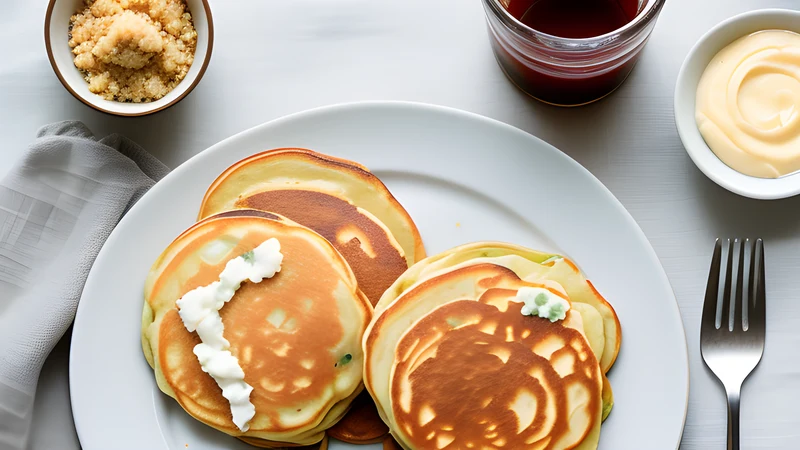
↓ Jump to recipeA good syrnik is a small paradox: a lacquered brown crust with a centre so soft it barely holds together, tasting of warm cheese and vanilla, collapsing under the fork. A bad one is a rubber disc that bounces. The distance between them is about forty grams of water.
That is the entire secret and it is not a metaphor. Wet curd needs flour to hold together, flour builds gluten and starch, and gluten and starch make a pancake. Dry curd needs almost no flour, and the egg and the cheese protein do the binding, and what you get is a thing that behaves like a soufflé that has been shallow-fried.
Syrniki: Russian Curd Cheese Pancakes
Ingredients
- 500g tvorog or full-fat curd cheese, 5-9% fat
- 1 large egg
- 30g caster sugar
- 1/4 tsp fine sea salt
- 1 tsp vanilla extract
- 45g plain flour, plus 40g for shaping
- 30g raisins, soaked in hot water for 10 minutes and drained (optional)
- 30g unsalted butter, for frying
- 1 tbsp sunflower oil, for frying
- 200g soured cream, to serve
- 4 tbsp sour cherry jam or honey, to serve
Method
- If the tvorog is at all wet, tip it into a sieve lined with muslin set over a bowl, cover, and drain in the fridge for at least 2 hours or overnight. It should be crumbly and hold its shape when squeezed.
- Press the drained tvorog through a sieve into a bowl with the back of a spoon, or blitz it for 15 seconds in a food processor, until smooth and free of lumps.
- Add the egg, sugar, salt and vanilla and mix with a fork until just combined. Do not beat.
- Sprinkle over the 45g of flour and fold it in with a spatula in as few strokes as possible, stopping the moment no dry flour remains. Fold in the raisins if using.
- Chill the mixture for 15 minutes to firm up.
- Spread the remaining 40g of flour on a plate. Divide the mixture into 12 portions of about 50g. Roll each into a ball between floured palms, drop it onto the plate of flour and press it into a disc 5cm across and 2cm thick, coating both sides. Tap off the excess.
- Heat the butter and oil together in a wide non-stick frying pan over medium-low heat until the butter foams and subsides.
- Fry 6 syrniki at a time for 3-4 minutes until the underside is deep golden. Flip once, then put a lid on the pan and cook for 3 minutes more.
- Lift onto a warm plate. Wipe the pan, add fresh butter and oil, and cook the second batch.
- Serve hot, with soured cream and sour cherry jam or honey alongside.
The cheese
Tvorog is a fresh acid-set curd cheese, made by souring milk until it separates and then draining the curds. It is the great dairy staple of Russia, Ukraine, Belarus, Poland (as twaróg) and the Baltics, and it turns up in everything from breakfast to Easter cakes. It is drier and grainier than ricotta, sharper than cottage cheese, and far less sweet than either mascarpone or quark.
The name syrniki comes from syr, which means cheese in modern Russian and which historically covered fresh curd as well as aged cheese. Old Russian did not distinguish; sirniki in nineteenth-century cookbooks are these. They also appear as tvorozhniki, which is more precise and less common.
Getting proper tvorog in Britain means an Eastern European or Polish shop, where it comes in vacuum packs at 5%, 9% or 18% fat. Nine per cent is the sweet spot: enough fat for tenderness and flavour, dry enough to behave. Eighteen per cent makes gorgeous, fragile syrniki that want careful handling.
Substitutes, in descending order of success: quark (widely stocked, close in acidity, usually needs draining); ricotta (drain it hard overnight, expect a softer, milkier result); cottage cheese (drain, then blitz, and accept that the flavour is blander). Cream cheese is a poor idea — it is stabilised, it has gums in it, and it fries into a puddle.
Draining, which is the recipe
Tip the curd into a muslin-lined sieve over a bowl and leave it in the fridge overnight. A 500g pack of wet tvorog can shed 60-80ml of whey, and every millilitre you lose is flour you do not have to add.
The test is physical. Take a small handful and squeeze it. If liquid appears between your fingers, it needs longer. If it packs into a crumbly lump that holds its shape, you are ready. Weighing before and after is even better — I aim to lose at least 10% of the pack weight.
If you are in a hurry, wrap the curd in a clean tea towel and twist it over the sink, wringing progressively harder for a minute. It is cruder and it works.
Then sieve it. Tvorog is granular, and those grains stay granular through frying, giving a syrnik with a slightly gritty interior. Pushing it through a fine sieve with a spoon breaks the curd structure down into a smooth paste, which is the traditional method and takes about three minutes of honest effort. A food processor does it in fifteen seconds and does it slightly too well — pulse briefly and stop.
Flour: as little as possible
Forty-five grams of flour to 500g of curd is around 9%, which is drastically less than most published recipes, which run at 20% or more. Those recipes are written defensively, for wet supermarket curd, and they produce syrniki that are reliable and dull.
Fold, do not stir. The moment flour meets a wet mixture, gluten begins to form, and every extra stroke tightens the crumb. Use a spatula, cut down through the middle, scrape and turn, and stop the instant the flour disappears. The mixture should look soft and slightly rough.
Semolina is the traditional alternative and it is genuinely worth trying: swap the 45g of flour for 40g of fine semolina and let the mixture rest for 20 minutes so the semolina hydrates. It gives a fractionally firmer bind with none of the gluten, and a very slightly sandy character that suits the dish. This is the same instinct behind Romanian papanași, the other great curd-cheese breakfast of the region.
The flour on the plate is separate from the flour in the mixture. It is a coating, and it is what gives the crust its snap; it fries into a thin shell before the interior gets hot enough to run.
Shape and heat
Fifty grams each, 5cm across, 2cm thick. Thickness is a design decision: a thin syrnik cooks through and becomes uniform, and a 2cm one develops a crust on both faces while the middle stays barely set and molten. That contrast is the point.
Medium-low heat, butter and oil together. Butter alone burns at these timings — milk solids scorch around 150C — and oil alone gives you no flavour. Together, the oil raises the effective smoke point and the butter still browns the crust.
Three to four minutes a side is slow, and slow is correct. High heat gives you a dark crust over a raw, gritty centre. You are looking for the colour of a good biscuit.
The lid is the step that gets left out of most recipes. After the flip, cover the pan for the last three minutes. The trapped steam raises the temperature inside the syrnik gently and evenly, setting the egg without drying the curd, and the interior comes out creamy rather than pasty. Take the lid off, and the second face crisps in the residual heat while you plate up.
Wipe the pan between batches. The flour that has come off the first batch will be black by the second and will taste of it.
Making your own tvorog
If no Polish shop is within reach, tvorog is one of the easiest cheeses to make, and homemade gives you total control over the moisture — which, given everything above, is the whole game.
Warm 2 litres of whole milk to 40C in a heavy pan. Stir in 500ml of kefir or plain live yoghurt, cover, and leave at warm room temperature for 8-12 hours until the milk has set into a soft, wobbly curd with clear whey pooling at the edges. Then return the pan to the lowest possible heat and warm it, without stirring, to 60C over about 25 minutes. The curd will contract and separate cleanly from greenish whey. Hold it there for 5 minutes, then ladle the curds into a muslin-lined sieve and drain for 2 hours. Two litres of milk yields roughly 350g of curd and a litre of whey.
Two things go wrong. Overheating past about 70C tightens the curd into squeaky rubber pellets that no amount of sieving will smooth. And stirring during the heat drives the curds into small fragments that fall through the muslin and shed their fat into the whey.
Keep the whey. It is faintly sweet, mildly sour and full of protein, and it makes exceptional bread — swap it for the water in a rye loaf — or it can serve as the base for a summer okroshka.
The Soviet breakfast, and why it stuck
Syrniki occupy a specific place in the Russian imagination: they are what a grandmother makes, and what a stolovaya — the Soviet canteen — served at eight in the morning, and what every Moscow café now sells at four times the price with a sprig of mint on top. The dish is old, appearing in eighteenth-century manuscripts and getting a full entry in Molokhovets in 1861, and the reason it survived the twentieth century intact is dairy logistics.
Soviet milk distribution was unreliable and Soviet fridges were small, and tvorog was the standard method for turning milk that was about to turn into something that kept. Every household had a bag of it draining over the sink at some point in the week. Syrniki were what happened to the batch on day three, when it had gone too sour to eat with a spoon. The dish is, in origin, a way of using something up — which is why the sugar is there, and why the jam is there, and why nobody in Russia treats it as a special occasion.
That domestic origin also explains why the ratios vary so wildly from household to household. Everybody’s grandmother had different curd, so everybody’s grandmother had a different flour quantity, and everybody is convinced their version is the correct one. Judge by the mixture in front of you rather than by any number, including mine: it should be soft, tacky, and just able to hold a ball between floured palms.
Failure modes
They spread into puddles. The curd was wet or the fat was too high. Add a tablespoon more flour, chill the mixture 15 minutes longer, and check that the pan is properly hot before the first one goes in.
They are rubbery. Too much flour, or the mixture was beaten rather than folded, or the heat was too high. This is the most common outcome and it is always over-correction for fear of the first failure.
The crust is dark and the middle is cold. Heat too high, discs too thick, or straight from the fridge into the pan. Medium-low, and use the lid.
They fall apart in the flip. Underset. Give the first side another minute — the crust is what holds the thing together, and a syrnik flipped before it has one has nothing to flip.
Grainy interior. The curd was not sieved.
Serving, and the case against
Soured cream is compulsory. Beyond that: sour cherry jam is the canonical partner and the acidity is doing real work against the fat, honey is the simplest option, and sguschyonka — Russian boiled condensed milk — is what a Soviet childhood would produce and is punishingly sweet. Fresh berries and a spoon of cream is the version I make most.
The case against is honest and short: syrniki are a fifteen-minute-window food. They are magnificent straight from the pan and merely acceptable ten minutes later, once the crust has softened under its own steam and the molten middle has set. They do not hold, they do not travel, and reheating recovers about half of what you had. Cook them, plate them, and call everyone to the table before you start the second batch, in the same spirit as buttermilk pancakes on a Sunday.
The mixture itself keeps a day in the fridge, covered, and is arguably easier to shape cold. Shaped, uncooked syrniki freeze on a tray for two months; fry from frozen over low heat for 5 minutes a side with the lid on.
Related Content