Svíčková na Smetaně: Czech Beef in Cream Sauce
Root vegetables blitzed into a sauce, with cranberry and a curl of cream
Contents
↓ Jump to recipeSvíčková is the dish a Czech grandmother is judged on, and the judging criteria are narrow. The sauce must be smooth to the point of being velvety. It must be simultaneously sweet, sour and savoury without any of the three winning. It must be a specific colour — pale orange-brown, the shade of a terracotta pot — and it must be thick enough that a spoonful sits on a dumpling without running off. The beef is almost incidental. People argue about the sauce.
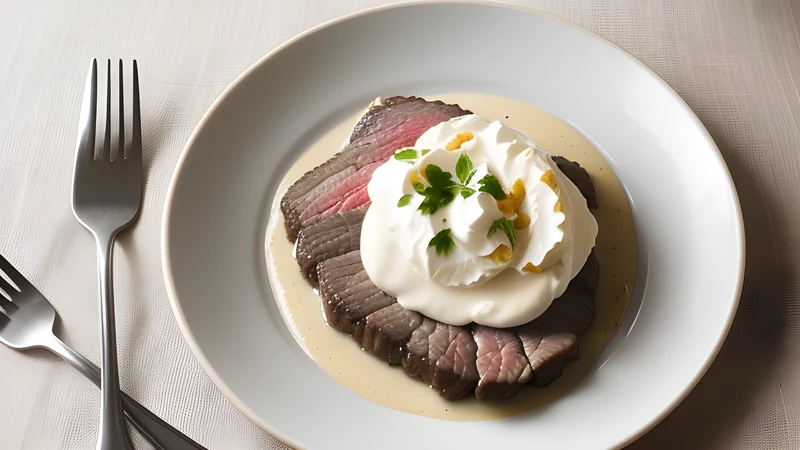
What makes it strange, from the outside, is the assembly. A slice of beef under a root-vegetable cream sauce, topped with whipped cream, a spoon of cranberry and a slice of lemon, with bread dumplings alongside. It reads like several dishes that collided. It works because every element is answering something: the cream softens the acid, the cranberry pushes the sweetness up, the lemon pulls it back down, and the dumplings are there to mop.
Svíčková na Smetaně: Czech Beef in Cream Sauce
Ingredients
- 1.4 kg beef topside or silverside, in one piece
- 100 g streaky bacon or pork back fat, cut into 5 mm batons
- 2 tsp fine salt
- 1 tsp black pepper, coarsely ground
- 80 g unsalted butter
- 2 tbsp neutral oil
- 400 g carrots, peeled and cut into 2 cm chunks
- 300 g celeriac, peeled and cut into 2 cm chunks
- 200 g parsley root or parsnip, peeled and chunked
- 2 large onions, roughly chopped
- 8 whole allspice berries
- 6 black peppercorns
- 3 bay leaves
- 1/4 tsp fresh thyme leaves
- 500 ml beef stock
- 2 tbsp red wine vinegar
- 1 tbsp caster sugar
- 250 ml double cream
- 1 tbsp plain flour (optional, for adjusting)
- Juice of 1/2 lemon
- To serve: 100 ml double cream, lightly whipped; 6 tbsp cranberry sauce; 1 lemon, sliced
Method
- Pierce the beef all over with a thin sharp knife and push the bacon batons into the holes, distributing them evenly. Season the joint with the salt and pepper. Refrigerate uncovered for 12 hours if you have time.
- Heat the oil and 20 g butter in a heavy casserole and brown the joint hard on all sides, 12-15 minutes total. Set it aside.
- Add the remaining butter and all the vegetables. Cook over a medium heat for 20 minutes, stirring, until they take on colour at the edges.
- Add the allspice, peppercorns, bay and thyme and cook 2 minutes.
- Sit the beef on top of the vegetables. Add the stock, vinegar and sugar. The liquid should come about a third of the way up the joint.
- Cover and cook at 150C fan for 2 hours, turning the joint once at the halfway point.
- Lift the beef out, cover loosely with foil and rest it. Remove and discard the bay leaves.
- Blend the vegetables and all the cooking liquid to a completely smooth purée with a stick blender, then pass through a fine sieve, pressing hard.
- Return the sauce to the pot, stir in the 250 ml cream and simmer 10 minutes. If it is thin, whisk the flour with 2 tbsp water and stir it in, then simmer 5 minutes more.
- Add the lemon juice. Taste and balance with more sugar, vinegar or salt until it is sweet, sour and savoury at once.
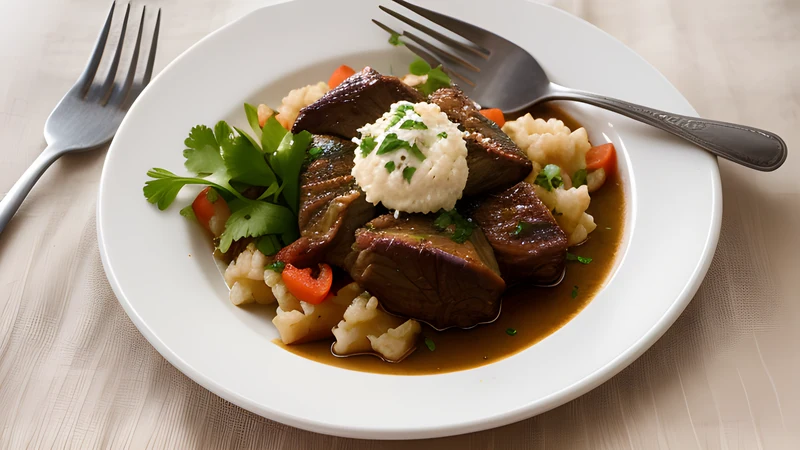
- Slice the rested beef against the grain, 8 mm thick. Ladle sauce over, top with a swirl of whipped cream, a spoon of cranberry and a lemon slice. Serve with bread dumplings.
The candle, and the argument about the name
Svíčková means “candle cut”, from svíčka, a candle. Which cut of beef that refers to is a genuine Czech argument with no settled answer. One camp says it means the tenderloin — the long tapered muscle that does look like a candle, and which sits near the kidney where tallow candles were once rendered from. The other camp points out that nobody in their right mind braises a tenderloin for two hours, and that the name attached itself to the dish rather than to the meat. What Czech cooks actually use is topside, silverside or the rump cap, and have done for at least a century.
The dish itself is Austro-Hungarian in its bones. It appears in nineteenth-century Bohemian cookbooks under the German name Rahmbraten, cream roast, and it belongs to the same court-and-bourgeois kitchen that produced Vienna’s tafelspitz — boiled beef, root vegetables, a sharp fruit condiment on the side. The Czech version kept the vegetables and the fruit and added the cream, and somewhere along the way the vegetables stopped being a garnish and became the sauce itself.
Magdalena Dobromila Rettigová, whose 1826 Domácí kuchařka is the founding text of written Czech cookery, gives a recognisable ancestor: larded beef on roots, soured cream, a long slow oven. Her version is more sour and much less sweet than a modern one, which tells you something about the twentieth century’s taste for sugar. The cranberry garnish is a later addition — brusinky, lingonberries in the original, are a Central European forest crop and the Czech equivalent of the Swedish habit of putting them next to köttbullar.
The whipped-cream swirl and the lemon slice are pure twentieth-century restaurant plating, and they survive because they work. The cream gives you a cold, unseasoned mouthful to reset against a rich sauce. The lemon is there to be squeezed.
The sauce is the vegetables
This is the mechanical fact that most people miss on a first read of the recipe. There is no roux, no stock reduction, no cornflour. The sauce is 900 g of root vegetables cooked to collapse in the braising liquid and then blended into it. That is where the body comes from, where the colour comes from and where the sweetness comes from.
Carrot, celeriac and parsley root — the Czech kořenová zelenina, root vegetables, a trinity sold bundled together in Prague markets — each bring something specific. Carrots supply sugar and the orange. Celeriac supplies the savoury, faintly mustardy backbone that makes the sauce taste of more than sweet vegetable. Parsley root is the one people substitute and the one that matters: it is the same species as leaf parsley, bred for the root, and it tastes like parsnip with a herbal edge. Parsnip alone will do, though it is sweeter and you will need less sugar.
The ratio is deliberate. Carrot leads at 400 g because it is doing the colour work. Push celeriac past 300 g and the sauce turns grey-green and bitter. There is no recovering from that.
Why it must be sieved
Blend it and you have a good sauce. Blend it and then push it through a fine sieve and you have svíčková. A stick blender leaves cell-wall fragments and fibrous threads from the celeriac and the parsley root, and those give the sauce a faint grain that a Czech palate detects instantly. Pressing through a sieve with the back of a ladle takes ten minutes and removes them.
The residue left in the sieve should be a dry-looking fibrous mat weighing 60-80 g. If you have more than that, you did not press hard enough. If you have almost nothing, your blender is better than mine.
Larding, and whether to bother
Špekování — piercing the joint and threading it with strips of fat — is traditional and the reason topside works at all. Topside and silverside are lean cuts with little intramuscular fat, and a two-hour braise renders them dry and stringy on their own. The bacon batons melt during cooking and leave channels of fat running through the slice, which is what stops it eating like a dry roast.
Use a thin, sharp, long knife. Push it in with the grain, twist to open a channel, and feed the baton in with your finger. Space them roughly 3 cm apart. The classic number is about 20 batons in a 1.4 kg joint, and you want them arranged so that every slice you cut later crosses several.
You can skip it if you use a fattier cut — a piece of chuck or brisket will not need it. Purists will object, and they are objecting to the wrong thing: the point of larding is fat distribution, and a cut with its own fat has already solved the problem.
The overnight fridge rest
Twelve hours uncovered in the fridge, salted, does two useful things. Salt migrates into the meat and, once inside, disrupts the muscle proteins so they hold onto water more tightly during cooking — a dry-brined joint loses noticeably less moisture over two hours than an unsalted one. And the surface dries out, which means it browns faster and darker when it hits the pan, because there is no water to boil off first. Skip it if you must; the dish survives.
Balancing the sauce
This is the part that requires you to taste and adjust rather than follow a number, because carrots vary wildly in sugar depending on the season and the variety. The target: sweetness from the carrot, sourness from the vinegar and lemon, savoury from the celeriac and stock, and enough salt to make all three legible.
Work in small increments after the cream goes in. A teaspoon of sugar, taste. A teaspoon of vinegar, taste. The cream mutes everything, so a sauce that tasted perfectly balanced before the cream will taste flat afterwards, and you will need more of both than you expect.
The lemon juice goes in last and off a rolling boil. Citric acid’s brightness is volatile in a way vinegar’s acetic acid is less so, and boiling it hard for ten minutes wastes it.
What goes wrong
The sauce split. You boiled it hard after the cream went in. Double cream at 48% fat is fairly stable, but a rolling boil in an acidic sauce will break it. Keep it at a lazy simmer. If it has split, take it off the heat and whisk in 2 tbsp of cold cream.
It is grey. Too much celeriac, or you browned the vegetables too far and took them past gold into properly brown. Twenty minutes at medium heat, gold at the edges, stop there.
It is thin. The vegetables did not collapse enough, or your joint gave off a lot of water. The flour slurry is the fix and is entirely traditional.
The beef is dry. Overcooked, or under-larded, or both. Two hours at 150C fan for 1.4 kg is the number; a smaller joint needs less.
Variations and the honest case against
Some cooks add a tablespoon of Dijon mustard to the sauce, which is very good. Others deglaze with 100 ml of white wine before the stock. A Moravian version adds a strip of lemon zest to the braise. The bacon-lardon topping — crisped and scattered over — is common in Prague restaurants and adds a texture the dish otherwise lacks.
The honest objection to svíčková is that it is heavy in a way that is hard to overstate: cream in the sauce, cream on top, larded beef, bread dumplings. There is no vegetable on the plate that has not been blended into liquid. It is also fiddly — larding, braising, blending, sieving, balancing — for a result that a lot of people describe, accurately, as tasting like a sweet gravy. If the sweet- sour axis appeals but the cream does not, Limburg’s zuurvlees does the same balancing act with vinegar and gingerbread and no dairy at all. For the other side of the Czech table, the pork and sauerkraut of vepřo-knedlo-zelo uses the same dumplings against an entirely acidic backdrop.
The dumplings
Houskový knedlík — bread dumpling — is the only correct accompaniment, and it exists to absorb sauce. It is a yeasted dough studded with cubes of stale white roll, rolled into a log, boiled or steamed for 20-25 minutes, and cut into 1 cm discs with a thread rather than a knife. A knife compresses and smears; a length of sewing thread pulled through gives a clean face that soaks properly.
The discs should be pale, faintly springy and slightly damp. If they are dense and gummy, the dough was over-kneaded or the log went into water that was boiling hard rather than gently — vigorous boiling batters the outside into a skin before the centre has set.
Two or three discs per person, laid flat, sauce ladled across. Czechs do not generally serve potatoes with svíčková and the dumplings are the reason: nothing else mops this well.
Storage
Svíčková keeps four days refrigerated, and the sauce improves — the spice and the acid integrate overnight. Store the sliced beef submerged in the sauce or it dries. Reheat gently to about 70C without boiling. The sauce freezes for three months; the beef does not freeze well and turns grainy on thawing, so freeze the sauce alone and braise fresh meat.
Related Content