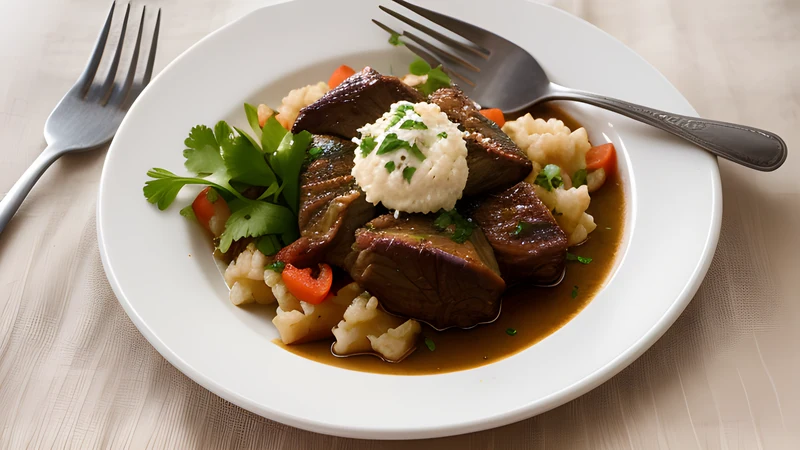
Stoofvlees: Flemish Beer Stew With Mustard Bread
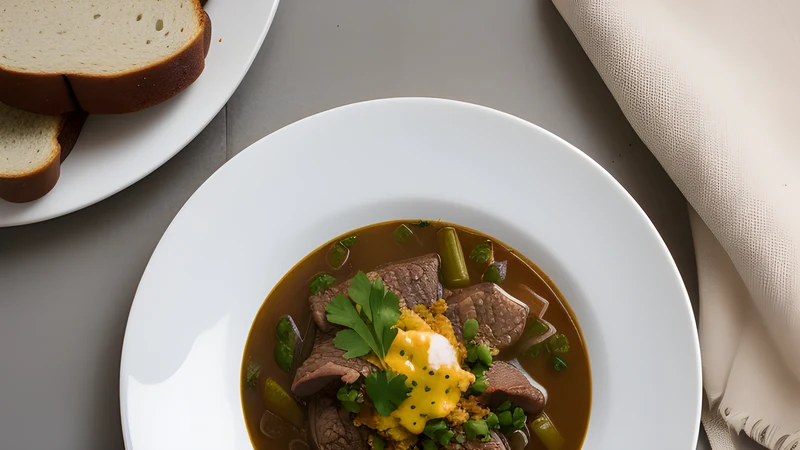
Beef, brown ale and a slice of bread painted with mustard
Contents
↓ Jump to recipeThere is a slice of bread in this stew, and it does the work three other ingredients would otherwise have to share. It thickens the sauce. It carries the mustard, which supplies the sharp edge that cuts through beer and beef fat. And because it is spread mustard-side down onto the surface of the liquid, it seasons the braise from the top while the meat cooks underneath. Flemish cooks have been doing this for long enough that nobody in Flanders finds it remarkable. Everyone else finds it remarkable immediately.
Stoofvlees — sometimes stoverij, sometimes carbonnades à la flamande depending on which side of the Belgian language line you are standing on — is the beef stew of the Low Countries. The bones of it are beef, onions, dark beer and time. What separates it from a French braise is what it leaves out: no wine, no tomato, no carrot, no stock cube pretending to be depth. The sweetness comes from onions cooked down until they are almost jam, plus a spoonful of brown sugar to answer the bitterness in the ale. The result is glossy, dark and faintly sweet-sour, and it is almost always eaten with chips.
Stoofvlees: Flemish Beer Stew With Mustard Bread
Ingredients
- 1.2 kg beef chuck or shin, cut into 5 cm cubes
- 2 tsp fine salt
- 1 tsp coarsely ground black pepper
- 3 tbsp plain flour
- 60 g unsalted butter
- 2 tbsp neutral oil
- 700 g onions (about 4 large), halved and sliced 5 mm thick
- 3 fat garlic cloves, sliced
- 500 ml Belgian brown ale (Westmalle Dubbel, Leffe Brune or an English brown ale)
- 250 ml beef stock
- 2 tbsp red wine vinegar
- 2 tbsp dark brown soft sugar
- 2 bay leaves
- 6 sprigs thyme
- 4 juniper berries, lightly crushed
- 2 thick slices day-old white bread, crusts on
- 3 tbsp coarse Dijon or Belgian mustard
- 1 tbsp cider vinegar, to finish
Method
- Pat the beef dry with kitchen paper. Toss with the salt, pepper and flour until every cube is dusted.
- Heat 1 tbsp oil and 20 g butter in a heavy casserole over a high heat. Brown the beef in three batches, 4 minutes per batch, turning once. Do not crowd the pan. Set the beef aside on a plate.
- Lower the heat to medium. Add the remaining butter and oil, then the onions and 1 tsp salt. Cook for 20-25 minutes, stirring often, until deep gold and collapsed. Add the garlic and cook 2 minutes more.
- Pour in 150 ml of the ale and scrape the base of the pan hard with a wooden spoon until no browned residue remains.
- Return the beef and any juices. Add the remaining ale, the stock, red wine vinegar, sugar, bay, thyme and juniper. The liquid should just cover the meat.
- Spread the mustard thickly on one side of each bread slice. Lay them mustard-side down on the surface of the stew.
- Bring to a bare simmer, cover, and cook at 150C fan for 2 hours 30 minutes, or on the hob at the lowest possible heat for the same time.
- Uncover and stir the bread in; it will have dissolved. Cook uncovered for 20-30 minutes until the sauce coats a spoon.
- Fish out the bay and thyme stalks. Stir in the cider vinegar. Taste and correct the salt and sugar. Rest 20 minutes before serving.
Where the beer came in
Beer in a braise is a matter of geography before it is a matter of taste. Flanders sits on heavy clay and cool cloud, which suits barley and hops and defeats the vine. Wine had to be imported and taxed; beer was made in the next street. Every Flemish town of any size had brewers by the fourteenth century, and by the sixteenth the region’s abbeys were producing the dark, malty, bottle-conditioned ales that still define the style. A cook reaching for the nearest cheap acidic liquid reached for beer, and the dish followed the supply chain.
The specific beer matters more than people admit. Belgian dubbels — Westmalle, Chimay Red, St Bernardus — are brewed with dark candi sugar, which gives raisin and fig notes and a dry finish. They braise beautifully. Very hoppy beers do not: hop bitterness is not volatile, so it does not cook off, and three hours in a covered pot concentrates it into something genuinely unpleasant. Stouts are a gamble. Roasted barley reads as burnt coffee once the sauce reduces, and it will bully the beef. If you cannot get a dubbel, an English brown ale is a safe substitute. A modern IPA will ruin the pot and there is no rescuing it afterwards.
The mustard bread is older than it looks. Before roux was standard in domestic kitchens, bread was the ordinary European thickener — medieval sauces were bound with breadcrumbs and vinegar, and the technique survives in Catalan picada, Spanish salmorejo and Italian pappa al pomodoro. Flanders kept it in the stewpot. Belgian mustard, which is coarser and more sour than Dijon, was the obvious thing to spread on the bread, and the acid it carries is doing exactly what a splash of vinegar does in any long braise: stopping the whole thing from tasting flat and brown.
The mustard question
Belgian mustard is its own thing and worth seeking out. Tierenteyn-Verlent in Ghent has been grinding it since 1790 and sells it from a wooden barrel; it is made without vinegar, using only water, and it is savage for about a week before it mellows. Bister, from Namur, is coarse and slightly sweet. Either is ideal. Failing those, coarse-grain Dijon is the closest supermarket match — it has the seed texture that gives the sauce its faint grain, and enough acid to matter.
Avoid English mustard here. Its heat comes from sinigrin in brown and black mustard seed converting to allyl isothiocyanate, and that compound is volatile: three hours at 150C drives it off entirely, so you lose the punch and keep only a dull yellow bitterness. Dijon and Belgian mustards are milder to begin with but hold their character better under heat, because more of what they contribute is acid and seed flavour rather than pungency. If you want mustard heat in the finished dish, stir half a teaspoon of the raw stuff in after the pot comes off the stove, on top of what the bread has already given you.
The cut, and why shin beats everything
Use chuck if you must. Use shin if you can. Shin is the hardest-working muscle on the animal and therefore the most heavily wrapped in collagen, and collagen is the entire point of a three-hour braise. Between roughly 65C and 80C, held for hours, collagen hydrolyses into gelatine. Gelatine is what makes a sauce cling to a chip instead of sliding off it, and it is why a proper stoofvlees sets to a wobble in the fridge overnight. Lean cuts — silverside, topside, anything sold as “braising steak” that looks suspiciously tidy — have little collagen and simply go stringy. They dry out while sitting in liquid, which sounds impossible until you have done it.
Cut the cubes large. Five centimetres looks absurd on the chopping board and is correct in the bowl. Small cubes have more surface area, shed more of their gelatine into the sauce, and end up as shreds. Large cubes hold together and give you something to cut with the side of a fork at the table.
Method notes that decide the outcome
Brown properly, in batches. The flour dusting helps here; it browns faster than the meat’s surface and gives you a head start on the Maillard reaction, which is where most of the savoury depth of the finished dish comes from. If you tip all 1.2 kg into the pan at once, the pan temperature crashes below 100C, the beef releases its water and you are boiling grey meat in its own juice. Three batches, four minutes each, and accept that this takes fifteen minutes.
The onions are half the recipe. Seven hundred grams sounds like a mistake. It is not. They collapse to roughly a third of their volume and become the body of the sauce — there is no flour-thickened gravy here beyond the light dusting on the beef. Give them the full 25 minutes over a medium heat and let them go past golden towards genuinely brown at the edges. Salting them early draws water out and speeds the process.
Deglaze with intent. The brown crust on the base of the pan is concentrated flavour, and once you add the full volume of liquid it is much harder to lift. Use a splash of the ale while the pan is still hot and scrape until the base is clean metal.
Keep it below a simmer. A rolling boil above 85C makes muscle fibres contract and squeeze out moisture faster than the collagen can convert. The oven is more reliable than the hob for this because it heats from all sides; 150C fan holds a covered casserole at a lazy blip. If you can see the surface moving vigorously, the oven is too hot.
What goes wrong
The sauce is bitter. Wrong beer, almost certainly — too hoppy or too roasted. Add another teaspoon of brown sugar and a knob of butter off the heat, which will mask some of it. Next time, dubbel.
The sauce is thin. Either the beef was too lean to give up gelatine, or you did not reduce it uncovered at the end. The final 20-30 minutes with the lid off is not optional; it takes the sauce from soup to gloss.
The meat is tough after three hours. Counterintuitively, this usually means it needs longer. Collagen conversion is a function of time at temperature. Give it another 40 minutes and check again.
It tastes flat. Acid. The cider vinegar at the end is there for exactly this, and a long braise dulls the palate’s read on sourness while it cooks. Add it after the heat is off, taste, and add a little more if the stew still feels heavy.
Variations, and the honest case against
Some Flemish cooks add a handful of prunes or a spoon of speculaas crumbs, which pushes the dish towards its Limburg cousin — see zuurvlees, where gingerbread does the thickening and the sweet-sour balance tips much further towards sour. Others swap half the ale for kriek, the cherry lambic, which gives a startling fruity acidity. A bay-leaf-and-clove version turns up around Antwerp.
The honest objection to stoofvlees is that it is monochrome. Beef, onion, beer, sugar, mustard: everything in the pot is brown and savoury-sweet, and after two bowls the palate stops registering the difference between them. This is why Belgians serve it with chips and mayonnaise rather than mash, and why a sharp salad or a pot of pickles alongside is a real improvement rather than a garnish. If you want a Belgian braise with more daylight in it, make waterzooi instead — same country, opposite argument, and it does not want three hours.
For the closer relative, carbonade flamande is the same dish under its French name, usually with the mustard whisked in at the end rather than carried in on bread. I prefer the bread. It gives the sauce a faint grain and a body you do not get from mustard stirred into liquid, and there is something satisfying about a thickener that also seasons.
About the chips
Chips are the delivery mechanism here, and they deserve the same attention as the pot. Belgian frites are cut thick — a full centimetre square — and fried twice, first at 150C for 6-7 minutes to cook the interior through without colouring it, then rested for at least 30 minutes, then blasted at 190C for 2-3 minutes to build the shell. The rest between fries matters: it lets surface moisture migrate outward and steam away, so the second fry crisps rather than fights the water. Bintje potatoes are the Belgian standard, floury enough to go fluffy inside. Maris Piper is the British equivalent and behaves the same way.
Beef dripping is traditional and gives a flavour that oil does not, though it smokes lower, so watch the second fry. Salt them the second they leave the fat, while the surface is still hot enough to hold the crystals.
Storage and make-ahead
Stoofvlees improves on day two and is arguably at its peak on day three. Cool it uncovered for an hour, then refrigerate for up to four days. The fat sets into a disc on top, which you can lift off if you want a cleaner sauce or stir back in if you want a richer one. Reheat gently — 15 minutes at a bare simmer, adding a splash of water if it has tightened. It freezes well for three months, though the sauce separates slightly on thawing and needs a brisk stir and a couple of minutes' reduction to come back together.
Serve it with chips fried twice in beef dripping, a pot of mayonnaise, and the rest of the bottle of dubbel. That is the whole meal, and Flanders has not felt the need to revise it.
Related Content