Stamppot Boerenkool: Kale Mash With Rookworst
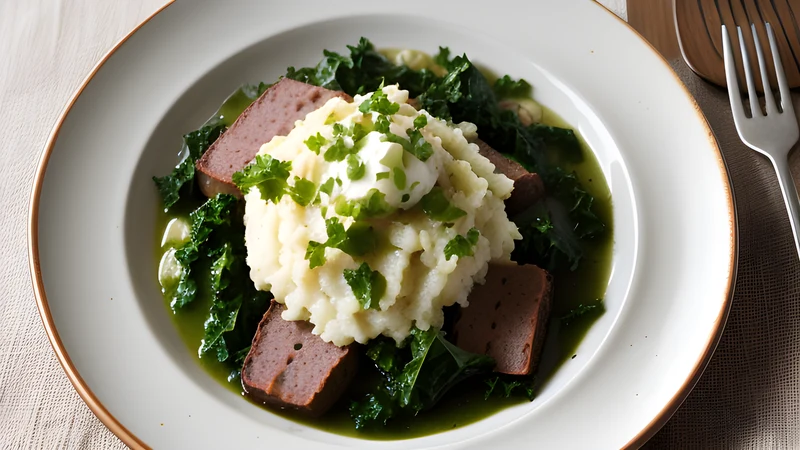
Curly kale beaten into floury potato, with a smoked sausage laid on top
Contents
↓ Jump to recipeThere is a particular sound that tells you kale stamppot is going right, and it arrives about forty seconds into the mashing: a wet, resistant thud that gradually turns dry and squeaky as the potato gives up its water and the kale threads through it. Get to that sound and you have supper. Stop early and you have soup with vegetables in it.
Boerenkoolstamppot is the most-eaten of the Dutch stamppotten, a family of dishes built on the same simple grammar — boil something with potatoes, beat the two together, put meat on top. It is winter food from a country that spent centuries being cold and wet and short of fuel, and it is designed around a single pan. That constraint is still the best argument for cooking it: everything happens in one pot, in stages, and the sausage steams itself in the vapour coming off the kale.
Stamppot Boerenkool: Kale Mash With Rookworst
Ingredients
- 1.2 kg floury potatoes (Bintje, Maris Piper or King Edward), peeled and cut into 4 cm chunks
- 500 g curly kale, thick stems stripped out, leaves shredded as finely as you can manage
- 1 tsp fine salt, for the potato water
- 150 ml whole milk
- 75 g unsalted butter, plus 15 g for the top
- 1 tsp Dijon mustard
- Freshly grated nutmeg, about 1/4 tsp
- 1/2 tsp freshly ground black pepper
- 1 rookworst (about 300 g), or another coarse smoked pork sausage
- 2 tbsp cider vinegar or the brine from a jar of pickled gherkins
- 200 ml beef or chicken stock, for the gravy well (optional but recommended)
- 1 tbsp plain flour, for the gravy
Method
- Put the potato chunks in a large pan, cover with cold water by 3 cm, add 1 tsp fine salt and bring to a boil. Reduce to a fast simmer and cook for 12 minutes, until a knife slides in with slight resistance.
- Pile the shredded kale on top of the half-cooked potatoes, press it down with a spoon, cover and cook for a further 10 minutes. The kale collapses into the steam and loses two-thirds of its volume.
- Lay the rookworst on top of the kale, put the lid back on and steam for 8 minutes, until it is heated through and the skin is taut.
- Lift the sausage onto a warm plate and cover with foil. Drain the pan thoroughly in a colander and let it stand for 2 minutes so surface water evaporates.
- Warm the milk and 75 g butter together until the butter has melted. Do not let it boil.
- Return the potato and kale to the dry pan over low heat for 30 seconds, then pour in the hot milk and butter. Mash with a stiff masher, straight up and down, until the potato is smooth and the kale is distributed through it in green threads.
- Beat in the Dijon mustard, nutmeg, black pepper and the cider vinegar. Taste and add more salt: kale mash needs more than you expect, usually around 1 tsp.
- For the gravy, melt 15 g butter in a small pan, stir in 1 tbsp flour and cook for 1 minute, then whisk in the stock and simmer for 3 minutes until it coats a spoon.
- Pile the stamppot into warm bowls, press a well into the middle of each with the back of a ladle, and fill the well with gravy. Slice the rookworst on the diagonal and lay it alongside. Serve immediately.
Why the Dutch beat their vegetables into potato
The word stamppot is literally “stamp pot” — the pot you stamp in. The stamper was a wooden pestle, often a repurposed tool handle, and the practice long predates the potato. Medieval Low Countries kitchens mashed root vegetables and pulses into a stiff paste called stamppot or hutsepot well before Andean tubers reached the Netherlands in the late sixteenth century, and even then it took two hundred years for potatoes to move from botanical curiosity to peasant staple. The potato only became normal Dutch food around 1750, when population growth outran the grain supply and the crop’s absurd calorie yield per hectare made it impossible to ignore.
Curly kale earned its place in that pot through pure agricultural stubbornness. Boerenkool means “farmer’s cabbage” and it is one of the few green things that keeps producing through a Dutch December. Growers still argue that it needs a frost before harvest, and the folklore is close enough to true: cold weather triggers the plant to convert stored starch into sugars as an antifreeze, so kale picked after a hard night genuinely tastes sweeter and less brutally bitter. The traditional rule is to wait until after the first proper frost, which put boerenkool on the table roughly from November to February — exactly when nothing else green was available.
Rookworst arrived from a different tradition. Dutch smokehouses were making coarse-ground pork sausage in natural casings long before Unox industrialised it in the 1930s, but the vacuum-packed supermarket rookworst is what fixed the dish in its modern form. A generation of Dutch children knows stamppot as the thing where the sausage floats in the pan and everybody wants the end slice. Buy the real thing from a Dutch butcher or a good deli if you can; it is coarser, fattier and considerably smokier than the plastic-sleeved version.
The gravy well is the detail that people outside the Netherlands most often miss. A stamppot without a kuiltje jus — a little crater of gravy pressed into the top of the mound — is regarded as somewhere between incomplete and rude. The well is functional. It keeps the gravy concentrated so each forkful gets a different ratio, rather than turning the whole bowl into a uniform brown sludge.
Getting the potato right
Floury potatoes are mandatory. Bintje is the Dutch default and it is worth seeking out; Maris Piper and King Edward do the same job. These varieties have high dry matter and large starch granules that swell and separate cleanly when cooked, giving you a fluffy mash that absorbs butter. Waxy salad potatoes have low starch and tight, small cells that resist breaking down, so mashing them shears the cells open and releases free starch into a gluey suspension. The result is wallpaper paste with kale in it, and no amount of butter rescues it.
Cut the chunks the same size — 4 cm is the sweet spot. Smaller pieces cook faster but waterlog, and waterlogged potato dilutes everything you add afterwards. Start them in cold water so the outside and inside come up to temperature together; dropping cold potato into boiling water cooks the exterior to mush while the centre is still raw.
The staging matters more than the recipe suggests. Potatoes get twelve minutes on their own, then the kale goes on top for ten, then the sausage on top of that for eight. The kale is steaming rather than boiling, which keeps its flavour in the pan instead of pouring it down the sink at the end. Shred the kale as finely as you have patience for. Long strands wrap around the masher and turn the mash into a ball of green rope; 5 mm ribbons distribute properly.
Drain hard, then let the pan sit off the heat for two minutes. Surface water is the enemy. Return the empty-ish potato to the dry hot pan for half a minute before adding anything and you will hear the moisture hiss away.
Warm dairy, cold dairy, and the mashing itself
Warm the milk and butter. Cold dairy hitting hot potato causes the starch to retrograde — the gelatinised granules begin recrystallising, and the mash goes tacky and slightly grey. Warm liquid keeps the granules swollen and receptive.
Use a masher, straight down and lifted straight out. A food processor or stick blender ruptures every starch cell in the pan within seconds and produces glue; this is the single fastest way to destroy a stamppot. A potato ricer gives a superior texture for plain mash, but it will not cope with kale, so the humble perforated masher wins here.
The seasoning triangle is salt, nutmeg and acid. Kale is bitter and potato is bland, and the two together will taste of nothing if you are timid. Nutmeg is the classic Dutch move and it works because its terpenes read as warmth against the sulphurous edge of the brassica. The acid — cider vinegar, or better, a splash of gherkin brine from the jar in the fridge door — cuts through the butter and makes the whole bowl taste sharper and more defined. A teaspoon of Dijon does similar work from a different angle. Season, taste, season again; kale mash absorbs salt like a sponge.
The sausage and the gravy
Rookworst is a wet-cured, coarsely ground pork sausage, smoked over beech and sold already cooked, which is why it only needs heating through. The best examples come from a butcher who still smokes their own and hangs them in links; you want visible fat specks in the grind and a casing that has taken colour unevenly. The industrial version is finer, paler and emulsified almost to the texture of a frankfurter, and it will do, though it gives back much less fat to the pan.
Never boil it. The casing is natural gut on a good sausage and it contracts faster than the filling as the temperature climbs, so a rolling boil bursts it and you lose the fat into the water. Eight minutes of steam on top of the kale brings the centre to about 70°C, tightens the skin and drips a small amount of smoked fat down into the mash below — which is the whole reason the sausage sits on top rather than beside.
The gravy is where Dutch cooks quietly disagree with each other. The purist version is jus, the pan juices from a roast, thinned and seasoned. The everyday version is a quick roux with stock, which is what the method above gives you. The disputed version comes out of a packet, and half the country uses it without apology. What matters is that it is dark, glossy and properly salty, because it is the only element on the plate with concentrated savoury depth. If you have a jar of beef dripping, melt a spoonful into the finished gravy and it gets most of the way to the roast version.
One further refinement worth the effort: after lifting the sausage out, tip a tablespoon of the smoky liquid from the bottom of the steaming pan into the gravy. It carries dissolved fat and smoke compounds, and it ties the sausage to the mash instead of leaving them as two separate things sharing a bowl.
Where it goes wrong
The mash is grey and gluey. You used waxy potatoes, or you blitzed it, or you added cold milk. All three are terminal. Start again.
It tastes watery. You boiled the kale in the potato water instead of steaming it on top, or you did not drain and dry properly. The fix next time is the two-minute rest in the colander and thirty seconds back in the dry pan.
The kale is tough and squeaky. Old kale, or stems left in. The thick central rib never softens in ten minutes of steam. Strip it out by holding the base of the stem and pulling the leaf away with your other hand.
Everything tastes flat. Under-salted, almost always. Kale mash needs roughly twice the salt you would put in plain mash.
The sausage split. The pan was at a rolling boil rather than a steam, or you pierced the skin. Keep it at a lazy simmer with the lid on.
Variations and what to do with the leftovers
Swap the kale for endive and you have andijviestamppot, where raw shredded endive is stirred through hot mash so it half-wilts and keeps a bitter crunch. Swap it for carrot and onion and you are making hutspot, the sweeter, older sibling with a much better origin story. Sauerkraut gives you zuurkoolstamppot, which wants a good bacon fat rather than butter.
Fried lardons stirred in at the end are traditional and excellent — render 150 g of diced streaky bacon until crisp and fold in the bits along with a spoonful of the fat. A crumbled blue cheese, about 75 g, melts into the hot mash and takes the dish somewhere more assertive. Northern Germany does a close cousin with Grünkohl mit Pinkel, where the kale is cooked much longer and the sausage is a groat-filled oddity worth trying once.
Leftovers are arguably the point. Cold stamppot sets solid in the fridge, and the next day you press it into thick patties, dust them with flour and fry them in butter over medium heat for four minutes a side until a proper crust forms. Serve with a fried egg. The same principle runs through Dutch and Belgian frugality generally, from erwtensoep improving overnight to bitterballen being a way of eating yesterday’s stew standing up in a bar.
It keeps four days covered in the fridge and freezes acceptably for three months, though the texture loosens slightly on thawing. Reheat in a pan with a splash of milk, over low heat, stirring. Microwaved stamppot develops hot and cold zones and dries at the edges, which is a sad end for something that started out this good.
Related Content