Spam Musubi: The Hawaiian Rice Block
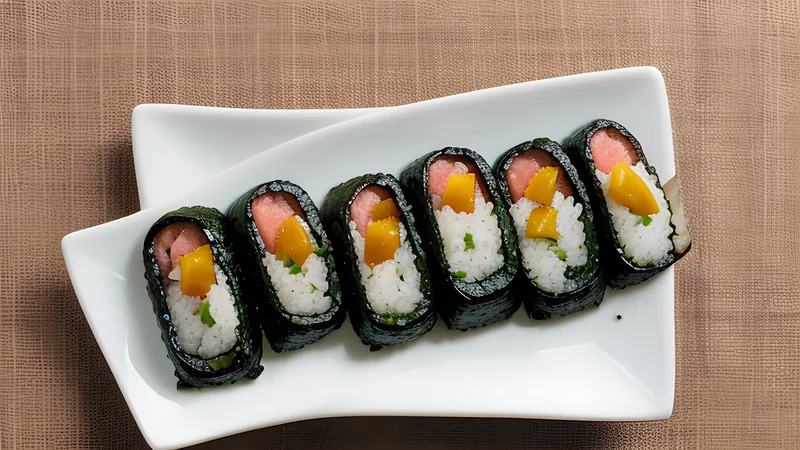
Grilled Spam glazed in soy and sugar, pressed onto rice and wrapped in nori
Contents
↓ Jump to recipeThere’s no dish that captures the layered history of modern Hawaii quite as bluntly as Spam musubi: American tinned meat, pressed onto Japanese short-grain rice, wrapped in a strip of nori the way Japanese onigiri have been wrapped for centuries, sold today from the exact same convenience-store counters that stock instant noodles and canned coffee. It’s fast food, but it’s fast food with a genuinely specific and traceable history behind every component.
Spam Musubi: The Hawaiian Rice Block
Ingredients
- 1 can (340g) Spam, cut into 8 slices lengthways
- 3 tbsp soy sauce
- 2 tbsp sugar
- 1 tbsp mirin
- 1 tsp rice vinegar
- 400g cooked short-grain Japanese rice, still warm
- 1 tbsp rice vinegar, for seasoning the rice
- 1 tsp sugar, for seasoning the rice
- 1/4 tsp fine sea salt, for seasoning the rice
- 4 sheets nori, cut into long strips about 5cm wide
- 1 tsp toasted sesame seeds (optional)
Method
- Season the warm rice with 1 tbsp rice vinegar, 1 tsp sugar and the salt, folding gently with a rice paddle or spatula. Cover with a damp cloth and set aside.
- Whisk together the soy sauce, 2 tbsp sugar, mirin and 1 tsp rice vinegar in a small bowl to make the glaze.
- Heat a non-stick frying pan over medium heat. Fry the Spam slices for 2-3 minutes per side until lightly browned at the edges.
- Pour the glaze into the pan and let it bubble and reduce, turning the Spam slices to coat, for 1-2 minutes until sticky and dark. Remove from the heat.
- Lay a strip of nori shiny-side down on a board or plastic wrap, and place a musubi mould (or the empty, washed Spam can with both ends removed) in the centre.
- Press a layer of rice into the mould, about 2cm thick, packing it firmly with damp hands or the back of a spoon.
- Place a glazed Spam slice on top of the rice, then press down firmly to compact everything together.
- Remove the mould carefully, lifting it upward while holding the rice block steady.
- Wrap the nori strip around the rice and Spam block, sealing the end with a few grains of rice or a dab of water.
- Repeat with the remaining rice, Spam and nori. Sprinkle with sesame seeds if using, and serve warm or at room temperature.
How Spam got to Hawaii
Spam’s arrival in Hawaii is a direct consequence of the Second World War. American military forces stationed across the Pacific were supplied with vast quantities of the tinned, precooked pork product because it needed no refrigeration, shipped easily, and kept for years — exactly the qualities that made it useful for a military logistics chain stretching across an ocean. Hawaii, as a major staging and supply point for the Pacific theatre, ended up with Spam in enormous surplus by the war’s end, and a local population that had already developed a taste for it, partly out of necessity and partly because a well-fried slice of Spam, caramelised at the edges, is genuinely good eating.
Rather than fading out once the war ended and fresh meat became easier to source again, Spam became a permanent fixture of Hawaiian cooking, worked into fried rice, stir-fries, and eventually the specific handheld form that became musubi. Hawaii today consumes more Spam per capita than any other US state by a wide margin, and the product occupies a cultural position there that it doesn’t hold anywhere else in America — treated as a genuine ingredient with its own preparation traditions, not a punchline.
Musubi’s Japanese backbone
The rice-and-nori structure comes directly from onigiri, the Japanese rice ball tradition brought to Hawaii by the large wave of Japanese plantation labourers who arrived from the late nineteenth century onward. Japanese immigration to Hawaii’s sugar and pineapple plantations was substantial enough that Japanese food culture, including rice-cooking technique and nori-wrapping, became deeply embedded in local food long before Spam itself arrived — musubi as a rice-and-filling handheld snack predates the addition of Spam by decades. What changed after the war was simply the filling: umeboshi (pickled plum) or grilled salmon, the traditional onigiri fillings, sat alongside a new option built on tinned meat that was suddenly everywhere and needed using up.
The word “musubi” itself is Japanese, meaning roughly “to bind” or “to tie” — the same root behind onigiri’s alternate name, “omusubi.” Calling the dish “Spam musubi” rather than “Spam onigiri” reflects the specific Hawaiian dialect of the term, distinct from mainland Japanese usage, and it’s the name used universally across the islands regardless of which term a Japanese-food purist might prefer.
Getting the rice right
Short-grain Japanese rice, the same variety that underpins a well-seasoned bowl of hainanese chicken rice or a good fried rice, sometimes labelled sushi rice, though it’s used unseasoned or lightly seasoned here rather than with full sushi vinegar, is essential — its high starch content is what lets the grains bind together into a cohesive block once pressed, unlike long-grain rice, which stays loose and falls apart the moment you try to shape it. Cook the rice slightly firmer than you would for eating on its own, since rice that’s too soft and wet turns mushy under the pressure of moulding and won’t hold a clean rectangular shape.
Season the rice while it’s still warm — vinegar and sugar absorb into warm grains far more evenly than into cold ones, the same principle behind seasoning sushi rice. Keep the seasoning light here compared to a full sushi vinegar mix; musubi rice should taste like well-seasoned plain rice with a faint tang, not like sushi rice, since the glazed Spam on top is already carrying a strong sweet-salty flavour and an overly seasoned rice base competes with it rather than supporting it.
The glaze
The soy-sugar-mirin glaze is what separates a good Spam musubi from a mediocre one. Plain fried Spam straight from the tin has a strong, fairly one-note salty flavour; the glaze, reduced in the same pan the Spam was fried in, adds sweetness and a sticky, lacquered exterior that plays against the saltiness rather than simply adding to it. Let the glaze bubble and thicken properly in the pan rather than pulling the Spam out too early — it should coat the slices in a glossy, slightly tacky layer, closer to a teriyaki glaze than a thin sauce, and this only happens once most of the liquid has cooked off.
Don’t season the glaze with extra salt or extra soy sauce beyond the recipe, even if it tastes underseasoned to you straight from the pan — Spam itself is already heavily salted from curing, and the finished, assembled musubi reads as perfectly balanced once rice, glaze and Spam are eaten together, even if the glaze alone tastes a shade mild on the spoon.
The mould
A dedicated musubi mould, a simple open-ended rectangular box usually made from plastic, is inexpensive and makes shaping far more consistent than freehand pressing — but the classic improvised alternative, cutting both ends off an emptied and washed Spam can, works just as well and is how the dish was made in home kitchens for decades before dedicated moulds became widely available. Either way, wetting your hands or the inside of the mould slightly before pressing the rice stops everything sticking, the same trick used when shaping any rice ball by hand.
Press the rice firmly enough that the finished block holds together when you lift the mould away, but not so hard that the grains compress into a dense, gluey mass — a light, even pressure across the whole surface, rather than one hard push in the centre, gives the most even result.
What can go wrong
A rice block that falls apart the moment the mould comes off is almost always down to rice that’s either the wrong variety or overcooked into mush. Long-grain rice, jasmine rice, or basmati simply don’t have enough surface starch to bind under pressing, no matter how firmly you pack them — there’s no fixing this with technique alone, only with switching to a genuine short-grain Japanese rice. If you’re using the right rice and it’s still falling apart, the grains were likely cooked with too much water and turned soft and separate rather than staying slightly firm and starchy; aim for rice cooked exactly to packet instructions rather than erring toward extra water for softness.
Nori that tears while wrapping is usually just too dry and brittle straight from the packet in a humid kitchen, or conversely has already gone soft from sitting out too long before use. Keep nori sealed until the moment you need it, and if it’s tearing at the fold points, running a lightly damp finger along the fold line first softens it just enough to bend without cracking.
Glaze that seizes into hard, sugary clumps rather than staying glossy and saucy usually means the pan was too hot or the glaze reduced for too long without enough liquid left to stay fluid. Pull it from the heat the moment it coats the Spam in a glossy layer rather than waiting for it to look thick the way a caramel would — soy-sugar glazes go from correctly sticky to seized and grainy within a fairly narrow window once most of the liquid has evaporated.
A note on the Spam itself
Regular Spam works perfectly well, but the “Spam Less Sodium” variety is worth considering if you find the full-salt version overwhelming once it’s combined with a salty soy glaze and seasoned rice — the reduced-sodium version still fries and glazes identically, just with a gentler final saltiness. Slicing the Spam to a consistent thickness, roughly 1cm, matters for even cooking: thinner slices crisp up faster but can dry out under the glaze’s reduction time, while thicker slices stay moister but take slightly longer to brown properly at the edges.
Serving
Spam musubi is eaten at room temperature or gently warm just as often as fresh and hot — it’s built to travel, sold pre-wrapped from convenience-store counters and packed into lunchboxes and beach bags across Hawaii, which is part of why the nori is often kept in a separate plastic sleeve until just before eating in commercial versions, so it stays crisp rather than going soft and chewy against the rice’s moisture. At home, wrapping it fresh and eating within an hour or two gives the best texture, with the nori still holding some bite rather than turning completely soft.
Variations
A fried egg tucked between the rice and the Spam is a common addition, giving a richer, more substantial version sometimes called musubi with a fried egg rather than a separate name of its own. Furikake, the dry Japanese rice seasoning blend of seaweed, sesame and sometimes bonito flakes, sprinkled over the rice before the Spam goes on is another frequent addition, adding a savoury depth without changing the fundamental structure. Teriyaki chicken or grilled Portuguese sausage, both common on Hawaiian plate lunches, sometimes replace Spam entirely for diners who want the same format with a different protein, though Spam remains overwhelmingly the standard.
A snack built for the middle of the day
Part of what cemented Spam musubi’s place in Hawaiian life is how well it fits the rhythm of a plantation and, later, an ordinary working day — no cutlery needed, no reheating required, filling enough to hold someone through an afternoon shift, and cheap enough to make in bulk. That practical logic hasn’t gone anywhere even as Hawaii’s economy has shifted away from plantation labour; the same convenience-store shelves that once served dock workers and construction crews now serve tourists and office workers, and the dish itself hasn’t needed to change to keep up.
Storage and make-ahead
Spam musubi keeps reasonably well for same-day eating, wrapped individually in cling film or greaseproof paper and kept at cool room temperature or briefly refrigerated — refrigeration firms the rice up considerably, so if you’re making a batch ahead of time, bring it back closer to room temperature before eating rather than serving it cold from the fridge, since cold rice loses much of the soft, cohesive texture that makes it pleasant to eat. It’s not a dish that freezes well; the rice’s texture degrades substantially on thawing.
For the best result, assemble the nori wrap as close to serving time as you reasonably can, since nori left against moist rice for more than a few hours loses its characteristic snap and turns leathery. If Spam musubi is your introduction to Hawaii’s layered food culture, kalua pig is the other essential dish worth knowing — both show how thoroughly imported ingredients and techniques, whether American tinned meat or an underground earth oven, became genuinely, distinctly Hawaiian rather than staying foreign transplants.
Related Content