Sopa Paraguaya: The Soup That Is a Cake
A dense, savoury cornbread built from a batter thin enough to earn its name
Contents
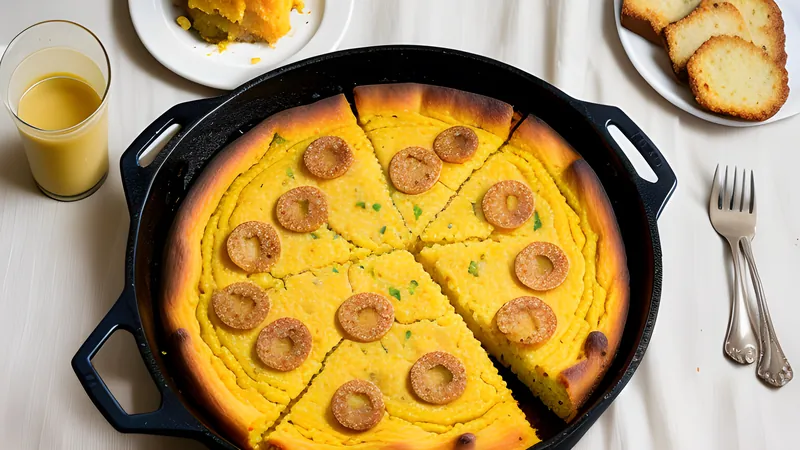
↓ Jump to recipeSopa paraguaya is Paraguay’s national dish, and it is not, in any sense that matters to how you cook or eat it, a soup. It’s a dense, moist, savoury cornbread, baked in a tin and cut into squares, and the confusion over its name is one of the more repeated food-writing anecdotes about it because the story behind that name is genuinely believable and genuinely a little absurd at once.
The most common account traces the dish back to the household of a nineteenth-century Paraguayan president, whose cook, tasked with making a corn soup, accidentally used too much cornmeal and ended up with a batter too thick to remain a liquid — rather than start over, the story goes, the cook baked the thickened mixture instead, and the president liked the result enough that it stuck around under its original name even though it had become, structurally, an entirely different dish. Whether the story is literally true or a tidy legend attached after the fact, it captures something real about the dish: a savoury cornbread that carries the name of the soup it apparently used to be.
Sopa Paraguaya: The Soup That Is a Cake
Ingredients
- 2 tablespoons unsalted butter, plus extra for the tin
- 2 large onions, finely chopped
- 400g fine white cornmeal (masa harina or polenta-style, not coarse grits)
- 1 tablespoon baking powder
- 1 teaspoon salt
- 4 large eggs, separated
- 300ml whole milk
- 150ml sour cream or crème fraîche
- 300g queso fresco or a mild mozzarella, grated or crumbled
- 100g Parmesan-style hard cheese, finely grated
Method
- Preheat the oven to 180°C (fan 160°C). Butter a 20cm x 20cm baking tin and line the base with parchment.
- Melt the butter in a pan and cook the onions over medium-low heat for 10 minutes until soft and translucent, without browning. Set aside to cool slightly.
- In a large bowl, whisk together the cornmeal, baking powder and salt.
- In a separate bowl, whisk the egg yolks with the milk and sour cream until smooth.
- Stir the wet mixture into the dry ingredients until just combined, then fold in the cooked onions, queso fresco and Parmesan-style cheese.
- In a clean, dry bowl, whisk the egg whites to soft peaks.
- Gently fold the egg whites into the batter in two additions, keeping as much air in as possible.
- Pour the batter into the prepared tin and smooth the top.
- Bake for 45-50 minutes until deep golden on top and a skewer inserted in the centre comes out clean.
- Cool in the tin for 10 minutes before turning out and slicing into squares.
Paraguay’s corn and cheese culture
Corn holds a similarly central place in Paraguayan cooking to its role across the wider region, but Paraguay’s specific pairing of corn with cheese — seen in sopa paraguaya and in its close relative chipa, a cassava-and-cheese roll rather than a corn one — reflects a food culture built around Guaraní agricultural staples merged with dairy and cheese-making introduced through Spanish colonial influence. The result is a distinctly Paraguayan combination that shows up across several of the country’s signature dishes: starch (corn or cassava) plus cheese, baked rather than fried or boiled, dense and rich rather than light.
Queso fresco or a similarly fresh, mild, slightly salty cheese is traditional here, chosen for how it holds together in small curds through the batter rather than melting into complete uniformity — you want visible flecks and pockets of cheese through the finished loaf, not an entirely smooth, cheese-flavoured crumb with no textural distinction from the cornmeal around it. A hard, aged cheese like the Parmesan-style option in the ingredient list adds a sharper, more concentrated savoury note that balances the milder queso fresco.
Getting the texture right
The defining technical challenge of sopa paraguaya is achieving a crumb that’s genuinely moist — almost custardy in the best versions — without being underbaked or gummy. This comes down to two separate things working together: the ratio of liquid (milk and sour cream) to cornmeal, and the whipped egg whites folded in at the end, which lighten what would otherwise be a genuinely heavy, dense batter into something with a bit more lift while still staying dense by the standards of an ordinary cornbread.
Whisking the egg whites to soft peaks rather than stiff peaks matters — soft peaks fold into a thick, cheese-and-onion-laden batter far more easily without deflating completely, while stiff peaks tend to clump rather than distribute evenly through a batter this heavy. Fold gently and in stages, adding a third of the whites first to loosen the base batter before folding in the rest, which prevents the whites from simply sitting on top rather than incorporating properly.
Fine cornmeal — the kind sold as masa harina in some markets, or a fine polenta rather than coarse grits — gives you the tight, moist crumb sopa paraguaya is known for. Coarse cornmeal produces a grainier, more crumbly result closer to an American-style cornbread, which isn’t wrong exactly, but it’s a different texture from the traditional Paraguayan version, which should hold together as a cohesive, almost dense-cake-like slice rather than crumbling apart when cut.
The onions
Cooking the onions slowly, without letting them brown, before they go into the batter is a step worth taking seriously rather than rushing. Browned onions carry a different, more caramelised flavour that works against the cleaner, milder profile the rest of the dish is built around — you want the onions soft, sweet and translucent, contributing moisture and a gentle background sweetness rather than any deep, roasted character.
Let the cooked onions cool slightly before folding them into the batter alongside the cheese — adding them straight from the pan, still hot, can start melting the cheese prematurely and affect how evenly everything distributes through the mixture once it’s in the oven.
Baking and doneness
A deep golden top and a skewer that comes out clean from the centre are the two signs to look for, but because this batter is denser and wetter than a standard cornbread or cake batter, it can look done on the surface before the centre has fully set — always check the centre specifically with a skewer rather than judging by colour alone, since colour develops on the surface well before the interior has finished baking through.
If the top is browning too quickly relative to how the centre is progressing, loosely tent the tin with foil for the remaining bake time rather than pulling it early — an underbaked centre will be gummy and unpleasant, a genuinely different problem from a top that’s simply darker than you’d like.
Resting the loaf in the tin for ten minutes before turning it out lets the structure firm up slightly, which makes for cleaner slices — a sopa paraguaya turned out and cut immediately, while still fully hot, is more likely to fall apart or smear rather than holding a clean-edged square.
Serving
Sopa paraguaya is traditionally served alongside grilled meats, as part of a wider asado-style spread, where its rich, cheesy density provides a substantial counterpoint to the meat course rather than functioning as a starter or side salad might. It’s equally at home served on its own, warm, as a light lunch or a hearty breakfast, which is common enough in Paraguayan households that it isn’t treated as an occasion dish exclusively.
It keeps well for two to three days at room temperature, wrapped, and reheats nicely in a low oven for ten minutes to bring back some of the fresh-baked warmth and revive the cheese slightly. It also freezes well, sliced and wrapped individually, for up to two months — a genuinely useful thing to have stashed away given how long the full bake takes from scratch.
What can go wrong
A gummy, underbaked centre despite a golden top is the most common failure, and it happens because this batter’s density means visual cues from the surface lag behind what’s actually happening in the middle of the tin. Always check with a skewer at the centre specifically, and if it comes out with wet batter clinging to it, return the loaf to the oven for another five to ten minutes, tenting with foil if the top is already as dark as you want it.
A crumb that’s dry and crumbly rather than moist and dense usually traces back to either coarse cornmeal in place of fine, or overbaking past the point where the skewer test would have told you to stop. Fine cornmeal is worth seeking out specifically for this recipe rather than substituting whatever’s on hand — the difference in final texture between fine and coarse is more pronounced here than in most cornbread recipes, since sopa paraguaya has no wheat flour in it at all to smooth over a coarser grind.
If the egg whites don’t lift the batter at all and the finished loaf comes out unusually dense and heavy even by this dish’s standards, the whites were likely deflated during folding — overworking them at this stage knocks out the air you just spent time whipping in. Fold with a light hand, in the two additions described, stopping as soon as no visible streaks of white remain rather than continuing to stir past that point.
Cornmeal and cheese substitutions
Masa harina, sold for making tortillas and tamales, works well here because it’s ground fine and has the right starch behaviour for a moist, cohesive crumb, though it carries a very faint lime-treated flavour from the nixtamalization process that’s slightly different from untreated fine cornmeal — most people won’t notice the difference, but it’s worth knowing if you’re comparing batches side by side. A fine polenta, sometimes labelled “quick-cook” or “instant,” is the more neutral substitute if you’d rather avoid that flavour entirely.
Queso fresco can be hard to find outside Latin American grocers; a mild, fresh mozzarella or a young, unaged Monterey Jack both work as reasonable substitutes, chosen for a similar balance of mild flavour and a texture that holds together in small pieces rather than melting into total uniformity. Avoid pre-shredded cheese coated in anti-caking starch if you can, since it tends to clump rather than distribute evenly through a batter this thick.
A dish worth the full bake time
Sopa paraguaya takes the better part of an hour once you count the onion-cooking, the batter assembly and the full bake, and there’s no meaningful way to shortcut it without sacrificing the texture that makes it worth making in the first place. It rewards the same kind of patience porotos granados does — a dish built from simple ingredients that depend entirely on being given the time each stage actually needs, rather than rushed through on the assumption that corn and cheese are forgiving enough to cook however fast you’re in a hurry to eat.
Chipa, the cassava cousin
Anyone who enjoys sopa paraguaya should also know chipa, Paraguay’s other great corn-and-cheese export, though chipa swaps cornmeal for cassava starch and comes out as a small, chewy ring rather than a dense loaf. The two dishes are often served at the same table, particularly around holidays, and together they make a strong case for how central the combination of starch and cheese, baked rather than fried, is to Paraguayan food identity — a pairing that runs through this country’s cooking with a consistency you don’t see repeated quite as strongly anywhere else on the continent.
For a fuller South American cheese-and-corn spread, sopa paraguaya sits naturally alongside pastel de choclo, another dish built around corn’s ability to carry both sweetness and savoury richness at once, and cachapa makes an interesting side-by-side comparison — two entirely different corn techniques, griddled pancake against baked loaf, arrived at independently by two different South American food cultures working from the same base crop.
Related Content