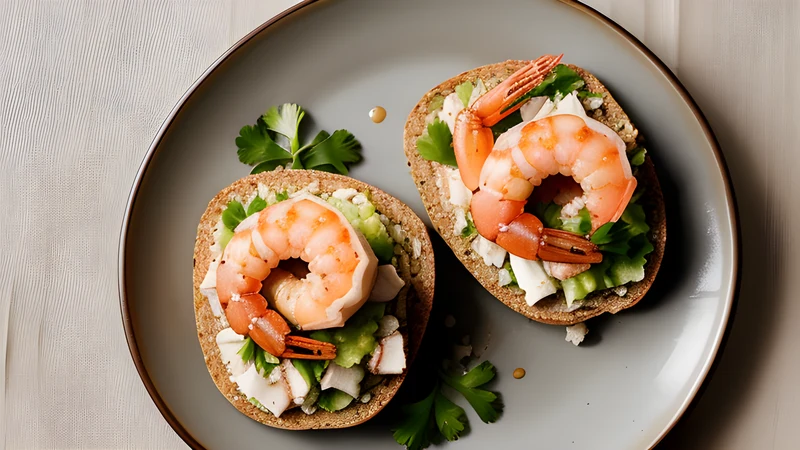
Smørrebrød: Rejemad, Prawns on Buttered Rye
Cold prawns, cold butter, dark rye, and nowhere to hide
Contents
↓ Jump to recipeThere is a rule in Danish kitchens that you can tell a cook’s confidence from the sandwich they hand you. Anything with a warm sauce on it is forgiving. Anything fried is forgiving. Rejemad — prawns on buttered rye — has four ingredients, none of them cooked by you, and every single one of them visible. If the prawns are tired, you will taste it. If the butter is thin, the whole thing collapses on the first cut. It is the sandwich equivalent of a cappella singing.
I make it about once a fortnight through the summer, usually when there are prawns in the freezer and the bread has reached day three, which is when Danish sourdough rye is at its best for smørrebrød. The crumb has firmed up, the sourness has settled, and it will take a heavy topping without going to pulp underneath.
Smørrebrød: Rejemad, Prawns on Buttered Rye
Ingredients
- 4 slices dark rye bread (rugbrød), each about 1 cm thick
- 60 g cold salted butter
- 400 g cooked cold-water prawns, peeled (about 300 g peeled weight)
- 1 lemon, half cut into 4 wedges, half juiced
- 1 tbsp mayonnaise (optional, for the mayo school)
- 8 g fresh dill, fronds picked
- 4 small lettuce leaves (Little Gem or butterhead)
- Flaky sea salt, about 1 g
- Freshly ground white pepper, 2 turns
Method
- Take the butter out of the fridge 20 minutes before you start so it is spreadable but still cool. Never soften it fully.
- Drain the prawns thoroughly in a sieve for 10 minutes, then pat dry between two sheets of kitchen paper. Wet prawns slide off the bread.
- Cut the rye into slices roughly 10 cm by 6 cm, trimming the crust flush on the long sides so the base sits flat.
- Butter each slice edge to edge, about 15 g per slice, in a layer thick enough to see. This is structural, not seasoning.
- Lay one lettuce leaf on each slice, curved side up, and press it lightly into the butter.
- If using mayonnaise, toss the prawns with 1 tbsp mayonnaise and 1 tsp lemon juice. Otherwise dress them with lemon juice alone.
- Pile 75 g of prawns onto each slice, arranging them in overlapping rows rather than dropping them in a heap. Aim for three visible layers.
- Season with flaky salt and white pepper, scatter dill fronds over the top, and set a lemon wedge on the near edge.
- Serve within 15 minutes on a cold plate, with a knife and fork.
What rejemad actually is
Smørrebrød as a formal system dates to the industrial nineteenth century, when Copenhagen’s tradesmen carried a lunch box of buttered rye to work and the city’s restaurants started competing to dress it up. Oskar Davidsen opened his cellar in 1888 and by the 1930s the family menu ran to 178 varieties, printed on a sheet nearly a metre long — a document that turned a packed lunch into a canon with rules.
Rejemad sits near the top of that canon, and it does so for reasons of geography. The prawn in question is Pandalus borealis, the cold-water or northern prawn, which grows slowly in Arctic and North Atlantic water and is fished heavily off Greenland — a Danish connection that matters. Slow growth in cold water means a sweeter, firmer prawn than the warm-water farmed species, and a much smaller one: a good rejemad uses prawns you could fit six of on a teaspoon. The classic restaurant version counts them. At Ida Davidsen’s, the famous “Hans Christian Andersen” and its cousins were built prawn by prawn into a dome, and the price reflected the labour more than the seafood.
The peeling is the whole economic story of this sandwich. Cold-water prawns are too small to peel profitably by hand in Denmark, so from the 1970s onward the trade shipped them to Morocco and later to Poland for hand-peeling, then shipped them back. What you buy in a British supermarket has usually made a similar journey. This is worth knowing because it explains the two things that ruin the ingredient: the brine they are packed in, and the water they absorb during processing. Both are fixable at home with a sieve and ten minutes of patience, and neither is fixable once the sandwich is built.
Buying prawns that are worth this
The label to look for is cold-water prawns or North Atlantic prawns, and the second thing to look for is the ingredients list. A good bag reads: prawns, water, salt. A bad one adds sodium metabisulphite, sodium tripolyphosphate or citric acid, and the phosphate is the one that matters — it makes the prawn hold water, which sells weight and gives you a spongy, faintly soapy texture that no amount of draining fixes.
Frozen beats chilled almost every time, because the chilled ones were frozen first and then thawed by someone whose incentives were not yours. Buy a 400 g bag of frozen peeled prawns, thaw them overnight in the fridge in a sieve over a bowl, and you will have around 300 g of drained prawn and a small puddle of liquid you did not eat. The really good ones, sold in Scandinavia still in the shell with the head on, are worth peeling yourself if you can find them; budget forty minutes and a glass of something for 500 g, and expect roughly half that weight back.
Size grading is given as a count per kilo. For rejemad you want the small end — 250 to 350 per kilo — because the sandwich depends on many small sweet prawns rather than a few large bland ones. A tiger prawn on rye is a different sandwich and a worse one.
The butter argument
Danes reserve most of their sentimentality for the butter layer, and the phrase you will hear is that the butter is tag — a roof. Its job is waterproofing. Rye is a sponge; prawns carry moisture even after draining; butter is the membrane between them. Fifteen grams per slice sounds absurd written down and looks correct on the plate.
The temperature matters as much as the quantity. Butter at fridge temperature tears the crumb. Butter left to go greasy and translucent soaks in and stops being a roof at all. What you want is roughly 16°C, which in a normal kitchen is twenty minutes on the counter, and which you can test by pressing a thumb into the block: it should dent without smearing. Spread it edge to edge, including the corners, because the corners are where a knife will first find the bread.
Salted butter is standard, and the Danish version is cultured, which gives a faint lactic tang that reads as part of the seasoning. If you only have unsalted, add a pinch of fine salt to the block and work it in with the back of a spoon.
Mayonnaise or no mayonnaise
Here is the one genuine controversy. The purist rejemad is prawns, butter, rye, lemon, dill. The everyday rejemad — the one in a Copenhagen bakery window at half past eleven — often has a small spoon of mayonnaise binding the prawns, sometimes a dot of it piped on top with a sprig of dill in it.
I make both and I use the mayonnaise when the prawns are merely good rather than excellent. A tablespoon across 300 g of prawns is not enough to taste as mayonnaise; it coats each one in a thin film that carries the lemon and stops the pile drying out under a fan or a warm lamp. When the prawns are genuinely fresh and sweet, leave it out and let the lemon do the work. Either way the acid goes on the prawns, never on the bread, where it would soften the crust.
The one thing I will argue about is the lemon wedge. It belongs on the sandwich as an instruction, and the eater squeezes it. Pre-dressing everything with lemon and then adding a wedge is doubling the acid and washing out the prawn.
Building it so it survives the knife
Smørrebrød is eaten with a knife and fork, which means the structure has to withstand being cut. Three things decide whether it does.
The bread is cut about 1 cm thick — thinner and it flexes and cracks under the load, thicker and the ratio goes wrong and you are eating bread with a garnish. Trim the long crusts flush so the slab sits flat and the fork has purchase.
The lettuce leaf earns its place. It sits in the butter, curved side up, and acts as a shallow bowl that keeps the prawns from rolling off the near edge when you cut. Little Gem holds its shape better than butterhead; both work.
The prawns go on in overlapping rows rather than a pile. Three visible layers is the target, and 75 g per slice is roughly what that costs. Piling them randomly gives you a mound with air in it that shears sideways the moment a knife arrives.
What goes wrong
The bread goes grey and damp underneath. Insufficient butter, or the prawns went on wet. Ten minutes in a sieve and a proper pat with kitchen paper is not optional.
The prawns taste of nothing. Almost always brine. Rinse them briefly under cold water, drain hard, then dress with lemon. If they came from the freezer, thaw them overnight in the fridge in a sieve set over a bowl — thawing in water leaches what flavour survived.
It falls apart on the plate. Bread too thin, or no lettuce leaf, or the prawns piled instead of laid.
It tastes flat despite good prawns. White pepper and flaky salt go on last, on top of the prawns, where the tongue meets them. Seasoning the butter instead puts the salt where nobody tastes it.
Storage, make-ahead and variations
Rejemad has no make-ahead. You can drain and dress the prawns up to two hours in advance and keep them covered in the fridge; you can slice and trim the bread. Assembly happens within fifteen minutes of eating, on a cold plate, and any leftovers are a bin decision rather than a fridge decision.
For variations, the two I actually make are worth the trouble. The first is a spoonful of stiffly whipped cream folded into the mayonnaise before it meets the prawns, which is an old restaurant trick that lightens the bind without diluting it. The second is a scrape of grated horseradish over the top instead of pepper, about half a teaspoon per sandwich, which is aggressive and very good on a cold day.
If you want the prawns to lead but the sandwich to be softer, swap the rye for white sourdough and you have moved towards Toast Skagen, which is Swedish, richer, and has bleak roe on it. If you want a smørrebrød with more weight for the same effort, leverpostej with bacon and mushrooms is the winter answer to the same question, and it forgives everything rejemad punishes.
And if you have Danish remoulade in the fridge, resist it here. It is a wonderful thing on fried fish and it flattens a cold prawn completely.
What to drink
A cold pilsner and a small glass of aquavit, which in Denmark is a pairing with the force of law. The aquavit is caraway-heavy and it cuts the butter; the beer resets the palate between sandwiches. Serve the sandwich first in a smørrebrød sequence, before anything fried and before anything with cheese, because after those you will not taste a prawn at all.
Related Content