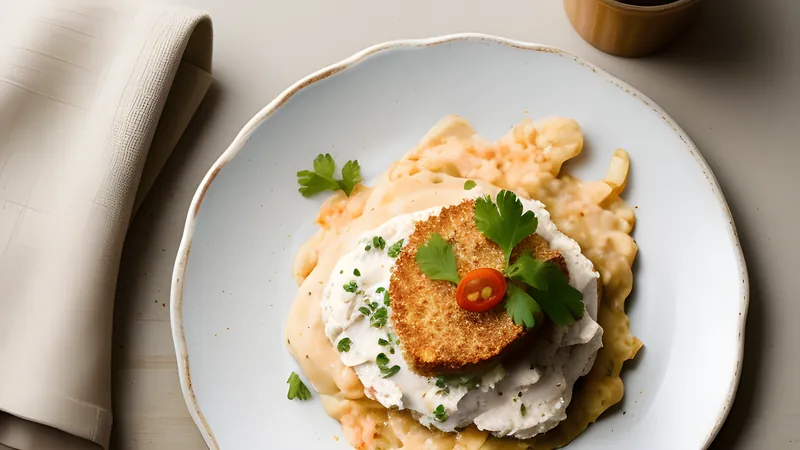
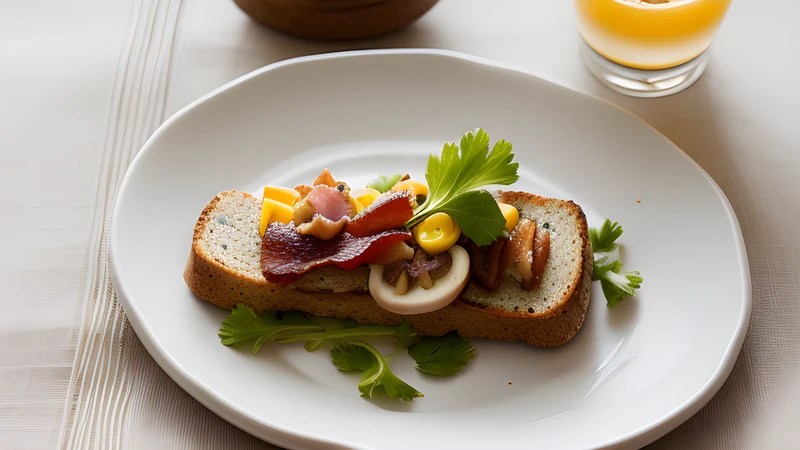
Smørrebrød: Leverpostej With Bacon and Mushrooms
Warm liver pâté on cold rye, under bacon, under mushrooms
Contents
↓ Jump to recipeThere is a hierarchy of Danish open sandwiches and leverpostej med bacon og champignon sits at an interesting point in it. It is not the elegant one. It arrives in canteens, in every Danish workplace, in school lunchboxes in cold flat form, and it is the sandwich a Dane will eat several hundred times before they turn twenty.
It is also, made properly, one of the best things you can put on bread. The trick is the temperature contrast — warm pâté, hot bacon, hot mushrooms, on cold buttered rye that stays firm underneath — and the fact that Danish leverpostej is a genuinely different animal from the French pâté most people are picturing. It is soft. Spreadable-soft, almost custardy, closer to a baked savoury mousse than anything you would slice thin with a knife.
Smørrebrød: Leverpostej With Bacon and Mushrooms
Ingredients
- 500 g pork liver, trimmed of any sinew and cut into rough chunks
- 250 g pork back fat or fatty belly, cut into chunks
- 1 medium onion (about 150 g), roughly chopped
- 6 anchovy fillets in oil, drained
- 2 large eggs
- 60 g plain flour
- 300 ml single cream
- 2 tsp fine sea salt
- 1 tsp ground white pepper
- 0.5 tsp ground allspice
- 0.25 tsp ground cloves
- 0.25 tsp freshly grated nutmeg
- 8 rashers streaky bacon
- 250 g chestnut mushrooms, sliced 5 mm thick
- 25 g unsalted butter
- 4 thick slices dark rye bread
- 40 g salted butter, cold, for the bread
- Pickled cucumber, to serve
Method
- Heat the oven to 170°C fan / 190°C conventional. Butter a 1 litre loaf tin or terrine.
- Blitz the liver, back fat, onion and anchovies in a food processor for 2-3 minutes until completely smooth, scraping down twice. Do not stop early — any texture left here stays in the finished pâté.
- Add the eggs, flour, cream, salt, white pepper, allspice, cloves and nutmeg. Blitz for a further 60 seconds to a loose, pourable batter.
- Pass the mixture through a fine sieve into a jug, pressing with a ladle. Discard whatever will not go through — this step is what separates a silky leverpostej from a grainy one.
- Pour into the prepared tin. Stand the tin in a deep roasting tray and pour boiling water into the tray to come halfway up the sides.
- Bake for 70-80 minutes, until the centre reads 72°C and the surface is set with a faint wobble. Do not let the water bath boil — if it does, add a cup of cold water.
- Lift the tin out of the water and cool for 30 minutes. Serve warm, or cool completely, cover and chill — it keeps 5 days and is better on day two.
- For the sandwiches: fry the bacon in a dry pan over medium heat for 6-8 minutes until crisp, then drain on kitchen paper.
- Pour off all but 1 tbsp of the bacon fat, add the 25 g butter and raise the heat to high. Fry the mushrooms in one layer for 5-6 minutes without stirring for the first 3, until deeply browned. Season with a pinch of salt.
- Butter the rye bread thickly and right to the edges. Spread or slice a generous 1 cm layer of warm leverpostej over each. Top with 2 rashers of bacon and a spoonful of hot mushrooms. Serve at once with pickled cucumber.
The industrial pâté that everybody loves anyway
Leverpostej is the Danish national spread and it is unashamedly a mass-market product. Stryhns, the market leader, sells it in foil trays in every supermarket. Danes eat around 3 kg of it per person per year. There is a real cultural attachment to specific brands, and arguments about whether the good one is the one your mother bought.
The dish arrived from France in the nineteenth century, when French cooking was the aspirational model for the Danish middle class, and Danish kitchens promptly stripped it of everything expensive. French pâté de foie relies on a lot of technique, a terrine mould, a lining of fat, a press and several days. The Danish version replaced most of that with eggs and flour and cream, blitzed everything into a batter, poured it into a tin and baked it in a water bath. What came out was softer, cheaper, faster and spreadable, and it turned out that spreadable was what people actually wanted.
The anchovies are the detail that surprises people and the one you should keep. Traditional Danish recipes call for ansjoser, which in Danish confusingly means spiced-cured sprats rather than anchovies, but the modern reading — six anchovy fillets — does the same job. At this dilution the fishiness is undetectable. What they bring is glutamate and inosinate, which together produce a savoury depth that pork liver on its own does not reach. Leave them out and the pâté tastes flat and slightly metallic, and you will not be able to say why.
Liver, and the two things that go wrong
Grainy texture. Liver is dense with connective tissue and protein, and if you undermix it or skip the sieve you will feel it. Blitz for a full two or three minutes — longer than feels necessary — and then push the batter through a fine sieve. What is left in the sieve is sinew and membrane, and it is the difference between silk and sand. This is the single highest-value step in the recipe and it takes four minutes.
Bitter, metallic flavour. Liver contains a lot of iron and, in older or badly handled animals, a lot of bile compounds. Pork liver is the Danish standard and it is the strongest-tasting of the common livers. Buy it fresh, use it within a day, and trim out anything green, tubular or silvery. Some cooks soak pork liver in milk for two hours to mellow it — the casein binds some of the compounds responsible — and if you are nervous about liver, do it. Drain and pat dry before blitzing.
Calf’s liver makes a milder, sweeter, more expensive pâté. Chicken livers work and produce something closer to a French parfait. Pork is what makes it Danish.
The water bath is not optional
Leverpostej is a savoury custard. Eggs, cream, liver protein — it sets the same way a crème caramel sets, and it fails the same way.
Egg proteins coagulate from around 65°C. Push them much past 80°C and they contract hard, squeeze out the water they were holding, and the custard curdles into a grainy solid sitting in a puddle of liquid. In a dry oven at 190°C the outside of the terrine passes 80°C long before the centre reaches 70°C, and you get a rim of curdled pâté round a raw middle.
Water cannot exceed 100°C, and a bath of it around the tin holds the exterior in a narrow, gentle range while heat conducts slowly inward. Fill it halfway up the tin with boiling water so the oven does not have to spend forty minutes heating it. If the bath starts to boil visibly, splash in a cup of cold water — a rolling bath is nearly as bad as no bath.
Take it to 72°C and stop. The centre should wobble faintly, like a set custard. It firms further as it cools.
Warm, and why that matters
Danes eat leverpostej cold from the fridge on rye, spread with a knife, and that is the everyday version. The canteen version — the one with bacon and mushrooms — is served warm, and warm is better.
Fat carries aroma, and aroma compounds are volatile, which means they need heat to leave the food and reach your nose. A cold pâté is a muted pâté; the same spread at 40°C tastes of about twice as much. Cold also firms the fat into a waxy coating on the palate, which is exactly what you do not want against a dense rye.
So: bake it, cool for half an hour, and eat it warm. Or take a slab of chilled pâté, lay it on the rye and warm the assembled sandwich at 180°C for eight minutes before adding the bacon and mushrooms. Danish canteens do the latter, on a tray, at scale.
The bacon and the mushrooms
Fry the bacon dry, over medium heat, from a cold pan. Streaky bacon has enough fat of its own and a cold start renders it out gradually so the rasher crisps evenly instead of buckling and going leathery at one end.
Then fry the mushrooms in the bacon fat with a knob of butter, on high heat, in one layer, and leave them alone for the first three minutes. Mushrooms are around 90% water and they release nearly all of it. Crowd the pan or stir them early and they boil in that water, going grey and squeaky. Give them room and heat and they drive the water off, hit the fat, and brown properly. Salt at the end — salt draws water out and salting early guarantees the grey version.
Chestnut mushrooms have more flavour than white ones. Danes use champignon, which is whatever the shop has. Slice them at 5 mm — thinner and they disappear into leather, thicker and the centre stays raw while the faces brown.
The bread, the butter, and the assembly
Dense dark rye, and I mean the real thing — a proper Danish rugbrød, sour and close-crumbed and heavy, cut about 1 cm thick. A rye-flavoured wheat loaf from the supermarket will collapse under this. This is structural: the whole sandwich is soft and rich on top and something has to hold it up and cut through it. A Latvian rupjmaize does the same job.
Butter the bread thickly and to the edges. This is a rule in Danish smørrebrød — smør means butter and it is in the name — and the butter is a waterproof layer that stops the rye going soggy. Cold, salted, and generous.
Then build in order: pâté, bacon, mushrooms. Pickled cucumber alongside, because a plate carrying liver, pork fat, bacon fat, butter and mushrooms fried in bacon fat needs acid somewhere.
Eat with a knife and fork. Smørrebrød is not finger food and picking one up marks you out immediately.
Seasoning a pâté you cannot taste
Two teaspoons of salt on roughly a kilo of liver and fat looks like a lot in the jug and works out at about 0.9%, which is on the gentle side for something this rich. The spicing — allspice, cloves, nutmeg, white pepper — is the Danish signature, and the cloves in particular are what makes a leverpostej smell like a leverpostej rather than a generic pâté. A quarter teaspoon is enough; cloves are aggressive and half a teaspoon will take the whole terrine over.
The obvious problem is that you cannot taste raw liver batter. The fix is the same as for a sausage: fry a teaspoonful flat in a hot pan for a minute a side, let it cool for thirty seconds, and eat it. It will taste a little firmer than the finished pâté and the seasoning will read accurately. Adjust the jug and pour.
Remember that this is served cold or barely warm most of the time, and cold food tastes less salty — chilling suppresses the perception of salt and sweetness measurably. Season the batter so it tastes very slightly assertive when you fry your test spoonful.
The flour is worth defending, because it looks like a cheat. Sixty grams of plain flour in a terrine is doing what flour does in any custard-adjacent mixture: the starch granules swell and get in between the egg proteins, physically obstructing them from linking into a tight curdled mesh. It widens the temperature window in which the pâté sets smoothly from a couple of degrees to something a home oven can actually hit. It is why the Danish version is nearly foolproof and the French one is not.
Storage and variations
The terrine makes far more than four sandwiches, which is the point — leverpostej keeps five days covered in the fridge and improves on day two as the spices settle. It freezes well in slabs.
Common Danish variations on the topping: crisp fried onions instead of bacon; a slice of sky (savoury jelly); pickled beetroot; and the classic dyrlægens natmad, the vet’s midnight snack, which puts leverpostej under salt beef, onion rings and cress. For the lighter end of the smørrebrød board, rejemad is the elegant one, and a cold frikadelle with remoulade is the other lunchbox staple worth knowing.
Related Content