Skerpikjøt and Faroese Wind-Dried Lamb
Nine months in a slatted shed, no salt, no smoke, and a smell that arrives before the plate does
Contents
↓ Jump to recipeI need to be honest about what this piece is before you read any further. Real skerpikjøt cannot be made outside the Faroe Islands, and I have never made it. What I have made is a wind-dried leg of lamb that borrows the method, respects the principle and produces something genuinely good, and I am going to tell you how while being clear about the gap between the two. The gap is the interesting part.
Skerpikjøt is what happens when eighteen islands in the middle of the North Atlantic, with no trees for smoke, no sun for drying and — historically — no salt they could afford, need to preserve a sheep through winter. The solution they arrived at is one of the strangest and most technically remarkable preservations in Europe, and it works because of a set of conditions that exist almost nowhere else on earth.
Skerpikjøt and Faroese Wind-Dried Lamb
Ingredients
- 1.5 kg boneless lamb leg, in one piece, from a mature animal if you can get it
- 30 g coarse sea salt (2% of the meat's weight)
- 8 g caster sugar
- 2 tsp coarsely cracked black peppercorns
- 1 tsp juniper berries, lightly crushed
- 2 bay leaves, crumbled
- 2 m of butcher's string
- 1 large square of muslin or a breathable curing bag
Method
- Trim the lamb of any loose flaps and hard silverskin, leaving the fat cap intact. Pat it thoroughly dry. Weigh it and record the weight — every decision from here is based on that number.
- Grind the salt, sugar, pepper, juniper and bay together in a mortar until coarse and evenly mixed.
- Rub the cure over every surface of the lamb, working it into any folds. Put the meat in a non-reactive dish, cover, and refrigerate for 4 days, turning it once a day and pouring off any liquid that collects.
- After 4 days, rinse the cure off under cold water for 30 seconds. Pat completely dry with kitchen paper, then leave uncovered on a rack in the fridge for 12 hours to form a dry skin — the pellicle.
- Tie the meat firmly with butcher's string into a compact, even shape with a loop at one end for hanging. Even thickness matters more than neatness; a thin end will over-dry.
- Wrap in muslin or slide into a curing bag and tie the loop through.
- Hang in a cool, airy, dark place at 6–12°C with 65–75% humidity and steady air movement. A wine fridge, an unheated garage in winter, or a cellar with a small fan all work.
- Weigh it weekly. It is ready when it has lost 35% of its starting weight — for 1.5 kg, that is 975 g. Expect 8–12 weeks for a lightly dried ræst-style result.
- For a fully dried skerpikjøt-style result, continue to 45–50% weight loss, which will take 5–8 months. The meat will be hard, dark and dense.
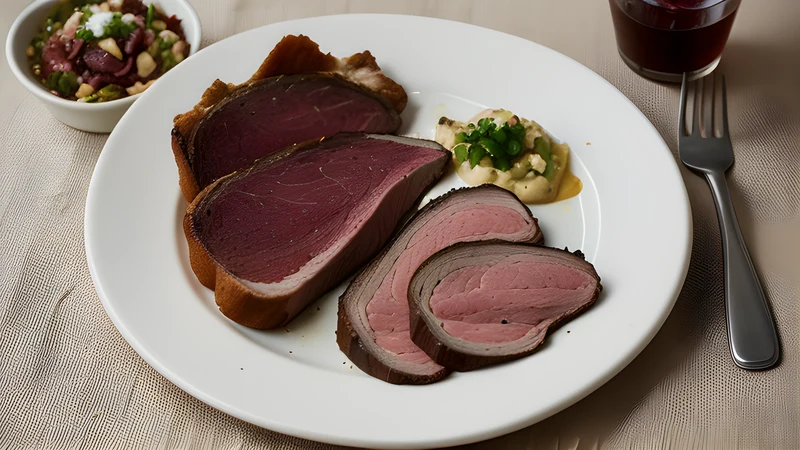
- To serve, slice as thinly as you can with a very sharp knife, across the grain. Serve with buttered dense rye bread and nothing else.
The hjallur, and why the Faroes specifically
A hjallur is a drying shed. It is a wooden structure with slatted walls — gaps of a centimetre or two between vertical boards — built on high ground, oriented into the prevailing wind. There is no heat, no smoke and no salt. The lamb goes in whole, in late autumn, and hangs.
Four conditions make this work, and all four have to hold at once.
The temperature never varies much. The Gulf Stream keeps Faroese air between roughly 3°C and 12°C year-round. Tórshavn’s average is 6.5°C in winter and 11°C in summer. That is a narrower annual range than most places manage in a single week, and it means the meat is held in the safe, slow band for months without ever freezing or warming into danger.
The wind never stops. Average wind speed in the Faroes is around 8 metres per second, and genuinely still days are rare enough to be remarked on. Constant airflow means the meat surface is always drying, which is what keeps it safe: no wet surface, no bacterial bloom.
The humidity is high but stable. Around 85%, which sounds like it should prevent drying entirely. Combined with relentless wind, it produces very slow, very even moisture loss from the interior outward, with no case hardening. A drier climate would seal the outside and rot the inside.
The air is salty. Sea spray carries salt inland across islands that are never more than about five kilometres wide. The meat is salted continuously and gently by the atmosphere over months, at a rate no salting box could reproduce.
Take away any one of these and the method fails. That is why skerpikjøt is Faroese and stays Faroese.
Ræst, and the fermentation people find difficult
There is a stage before skerpikjøt, and it is the one that gets talked about.
Ræst means partly dried and — this is the honest bit — partly fermented. After five to eight weeks in the hjallur, the lamb has lost around 30% of its weight and has developed a substantial microbial population on its surface: yeasts, moulds and lactic bacteria that have moved in from the air. The Faroese eat it at this stage, boiled, and ræstkjøt is a national dish.
It smells strongly. Foreign visitors describe it in terms ranging from blue cheese to ammonia to a farmyard, and a fair number cannot finish it. Faroese people are entirely used to it, and the flavour underneath the smell is deep, savoury and lamb-concentrated in a way nothing else quite reaches.
Continue past ræst — through winter, to nine months or so, at 45–50% weight loss — and you have skerpikjøt. It is hard enough to need a proper knife, dark as walnut, and eaten raw in translucent slices. Ræstur is the intermediate; skerpi means sharp or hard, and it is the finished thing.
The Faroese also do this with fish (ræstur fiskur) and with whale. It is a whole preservation philosophy rather than one recipe.
The home version, and where it diverges
Here is the honest accounting of what changes when you do this in a wine fridge in Britain.
You add salt, because you must. The Faroes get their salt from the air over months. You do not have that air, so you use a 2% dry cure for four days. That gets salt into the outer centimetre of meat fast enough to control the surface while the drying gets going. Skipping it in a domestic environment is genuinely dangerous — this is the one shortcut I will argue with anyone about.
You control the humidity, badly. 65–75% is achievable in a wine fridge with a hygrometer and a tray of water. Faroese 85% with 8 m/s wind is not reproducible. The consequence is that your meat dries faster and slightly less evenly. Wrapping in muslin helps — it slows the surface without stopping it.
You do not get the ræst flora. The moulds and yeasts that colonise a hjallur are specific to that place and that airflow, and they are the reason ræstkjøt tastes the way it does. Your meat will develop some surface flora, and it will be different flora. What you make will be closer to a Nordic version of a bresaola or a Romanian smoked mutton without the smoke.
Weight loss is the only measurement. Ignore time entirely and weigh it. 35% loss is a lightly dried, sliceable result. 45–50% is skerpikjøt territory. Below 30%, the water activity is still high enough to be a real risk. Write the target weight on a label and tie it to the string.
The lamb itself
This is where most home attempts are lost before the cure goes on.
Faroese sheep are a landrace — small, slow-growing, semi-feral animals that spend their lives on steep coastal grass, and they are usually slaughtered at well over a year old. The Faroes have roughly 70,000 sheep against 54,000 people, and the name of the islands most likely derives from Færeyjar, sheep islands. The meat from an animal like that is dark, dense, low in water and heavily flavoured, and it dries beautifully.
British supermarket lamb is five to eight months old, fed on improved pasture and bred for tenderness. It is a different substance. It carries more water, less connective tissue and much less flavour, and dried to 45% weight loss it produces something pale and faintly boring.
Ask your butcher for hogget — an animal between one and two years old — or mutton if they have it. Salt marsh lamb from Wales or Kent is the closest common analogue to the Faroese product, since those animals graze on tidal grass and arrive pre-salted in a small but detectable way. Any of these will cost more per kilo and give you a result several times better.
Take the leg boneless and in one piece, and keep the fat cap on. The fat is a moisture barrier that slows drying on one face, which is exactly what you want in a domestic environment where everything dries too fast. It also carries the branched-chain fatty acids that make lamb smell of lamb, and those concentrate as the water leaves.
Safety, plainly
I am not going to be coy about this, because the internet is full of people who are.
Dry-curing whole muscle at home is a lot safer than dry-curing minced meat, because pathogens live on the surface and the interior of an intact muscle is essentially sterile. That is the whole reason this works. Do not use meat that has been rolled, netted, pierced with a probe or tenderised, because those processes carry surface bacteria inward.
The 2% salt, the 4-day cure and the 35% weight loss together bring the water activity below 0.90, which stops Staphylococcus aureus and Clostridium botulinum growing. Hit all three.
Keep it between 6°C and 12°C. Warmer and you are outside the safe band. Colder and it will barely dry at all.
White, powdery surface mould is fine and is what you want. Green, black or fuzzy grey mould, or any wet, slimy, sour-smelling patch, means bin it. Wipe white mould that gets thick with a cloth dipped in vinegar. If you are uncertain, throw it out; a leg of lamb is worth less than a fortnight in bed.
I would not attempt this without a hygrometer and a set of digital scales. Both cost less than the lamb.
Case hardening, and the one fault that ruins it
The failure mode you will actually meet is case hardening: the outer layer dries into a hard shell before the interior has given up its water, and the shell then stops any further moisture escaping. You end up at week ten with a leg that reads 20% weight loss on the scales, a rind like leather, and a raw wet core that is quietly going off.
It is caused by air that is too dry, too warm, or moving too fast across the surface. In a wine fridge the usual culprit is humidity below 60%. Put a hygrometer inside, and if the reading is low, add a shallow tray of water with a sponge in it and check again after a day. If it is too high — above 80% — the meat will not dry and mould will take hold instead.
The muslin wrap is your main defence. It holds a thin cushion of humid air against the surface and slows the outer millimetre without preventing evaporation. Faroese hjallur drying achieves the same effect with sheer humidity, which is why they need no wrapping at all.
If you catch case hardening early, vacuum-sealing the meat for 48 hours will equalise the moisture — the interior water redistributes outward through the shell with nowhere else to go. Unseal, and resume hanging at a higher humidity. It is a real rescue and it works more often than it deserves to.
Serving, and what to put it on
Thin. Genuinely thin — as close to translucent as your knife allows, across the grain. Skerpikjøt sliced thick is chewing exercise; sliced properly it dissolves and releases everything at once.
Butter and dense dark rye, and nothing else. Icelandic rúgbrauð is an excellent partner because its sweetness works against the salt and the funk, and Danish rugbrød does the same job with more sourness. A slice of dried lamb on buttered rye is the entire North Atlantic on a plate.
If you want the smoked cousin of this idea, hangikjöt is Iceland’s answer — same animal, same preservation problem, sheep dung and birch smoke instead of wind, and a completely different result. Eating the two side by side is a genuine education in how geography writes recipes.
Drink akvavit or a dark beer with it. Faroese people drink both, and after nine months of waiting they have earned the choice.
Related Content