Shakshuka with Feta and Smoked Paprika
Eggs poached in a spiced tomato bath
Contents
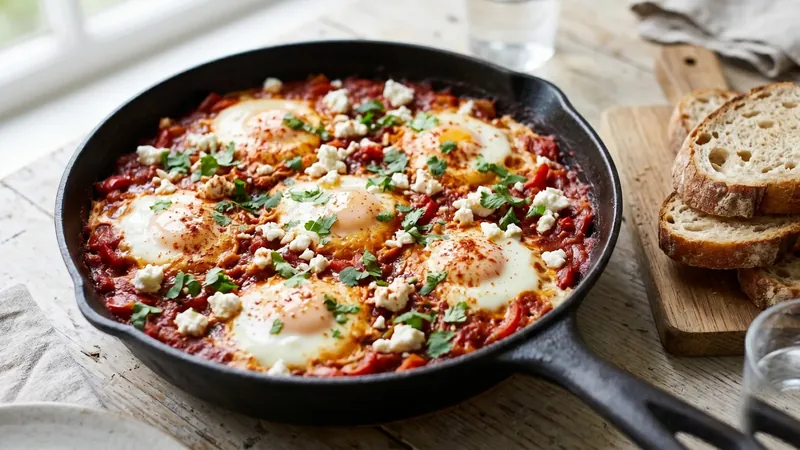
↓ Jump to recipeShakshuka is the ultimate one-pan breakfast: eggs gently poached in a thick, spiced tomato sauce until the whites set and the yolks stay molten. This version leans on smoked paprika for a deep, warming undertone and finishes with crumbled feta, whose salty tang cuts through the richness beautifully. It comes together in half an hour in a single pan, and tastes every bit as good at lunch or supper. Serve it bubbling, with bread to scoop up every last bit.
Shakshuka with Feta and Smoked Paprika
Ingredients
- 2 tbsp olive oil
- 1 onion, finely sliced
- 1 red pepper, sliced
- 3 garlic cloves, thinly sliced
- 1 tsp smoked paprika
- 1 tsp ground cumin
- 1/2 tsp caster sugar
- Pinch of chilli flakes
- 2 x 400g tins chopped tomatoes
- 4 large eggs
- 100g feta, crumbled
- Small handful of coriander or parsley, chopped
- Salt and black pepper
- Crusty bread, to serve
Method
- Heat the olive oil in a wide, deep frying pan over a medium heat. Add the onion and red pepper and cook gently for 10 minutes until soft and beginning to colour.
- Stir in the garlic, smoked paprika, cumin and chilli flakes and cook for another minute until fragrant.
- Tip in the chopped tomatoes and sugar, season well, and simmer for 12-15 minutes until thickened and glossy.
- Taste the sauce and adjust the seasoning; it should be rich and well rounded.
- Use the back of a spoon to make four shallow wells in the sauce.
- Crack an egg into each well, then cover the pan with a lid.
- Cook gently for 6-8 minutes, until the whites are just set but the yolks remain runny.
- Scatter the crumbled feta over the top, along with the chopped herbs and a grind of black pepper.
- Bring the pan straight to the table and serve with plenty of crusty bread for dipping.
Where it comes from
Shakshuka is a dish of eggs poached in a sauce of tomatoes, peppers, onions and spices, and it turns up on café menus from Tel Aviv to London at every hour of the day. Its name is generally understood to come from an Arabic word meaning a mixture or something all jumbled together, which suits a dish where everything cooks down into one fragrant pan. Plenty of British diners first meet it as an Israeli breakfast, but the roots lie further west, in the cooking of North Africa. Tunisia has the strongest claim, and the dish spread eastward across the Mediterranean and the Levant from there, carried in part by Tunisian Jewish communities who brought it with them to Israel in the mid-20th century, where it became a national breakfast staple.
There is a plausible older thread, too. Tomatoes and peppers only reached the Old World from the Americas after the Columbian exchange of the 16th century, so any dish built on them is comparatively young. But the idea of poaching eggs in a spiced, soupy sauce is far older than the tomato: the technique echoes earlier North African egg dishes cooked in tagines and clay pots, with the tomato-and-pepper base slotting in once those ingredients became cheap and common. That is the honest version of the history: the exact origin point is not documented in a single dish or date, but the through-line is clear enough.
Building the sauce
The sauce is the soul of the dish, and it rewards patience. Cooking the onions and peppers slowly for a full 10 minutes until soft and sweet builds a base of flavour, while simmering the tomatoes for 12 to 15 minutes concentrates them into something rich rather than watery. A half-teaspoon of caster sugar balances any sharpness in the tinned tomatoes, which are often more acidic than they taste raw. The eggs then poach directly in this sauce, the gentle heat setting the whites while the yolks stay soft, ready to be broken and stirred through the spiced tomato at the table.
The single mistake that ruins shakshuka is a sauce that is too thin when the eggs go in. Watery sauce means the whites spread and thin out instead of holding together, and you end up boiling the eggs rather than poaching them in a cushion of tomato. Reduce until a spoon dragged across the pan leaves a channel that fills back slowly, then make your wells. Crack each egg into a cup first if you are nervous, and slide it into its well so the yolk sits proud. The lid matters: it traps steam that cooks the tops of the whites without turning the yolks hard. Six to eight minutes over a gentle heat is the window; check at six, because carryover heat keeps cooking them once the pan leaves the hob.
The pan itself earns its place here. A wide, shallow pan with a lid, ideally cast iron or heavy-based, spreads the sauce thin so all four eggs sit in a single layer and cook at the same rate, and it holds heat well enough to carry straight to the table still bubbling. A tall, narrow saucepan works against you: the sauce sits deep, the eggs sink, and the tops steam unevenly. If your only lidded pan is small, cook the dish in two batches rather than crowding six eggs into a space meant for four, or the whites merge into one sheet and you lose the neat, individual portions that make it easy to serve.
Smoked paprika, the twist
Smoked paprika is the defining note in this version. Made from peppers that are dried over oak-wood fires before being ground, the Spanish spice known as pimentón carries a smoky depth quite different from the bright heat of fresh chilli. It comes in sweet (dulce), bittersweet (agridulce) and hot (picante) grades; the sweet one is what you want here, so the smoke leads and the chilli flakes provide any heat. A teaspoon stirred into the aromatics gives the whole pan a warm, almost barbecued undertone that flatters the sweetness of the peppers and the acidity of the tomatoes. Cumin alongside it adds an earthy backbone familiar across North African and Middle Eastern cooking. Toast both spices in the oil with the garlic for a full minute before the tomatoes go in, so they bloom rather than taste raw and dusty.
Feta, herbs and the finish
The feta is the second twist, and a natural one. Crumbled over the eggs in the final moments, the brined sheep’s-milk cheese softens in the residual heat without fully melting, its salty tang a sharp counterpoint to the mellow tomato. Add it after the eggs are nearly set, not before, or it slumps into the sauce and disappears. A scattering of fresh coriander or parsley brightens the whole thing; a drizzle of good olive oil at the table does no harm either. The beauty of shakshuka is its informality: no precise plating, just a hot pan carried straight to the table and plenty of bread for dipping.
The bread is not an afterthought, it is half the point. Because there is no starch in the dish itself, you want something with enough structure to scoop up sauce and soft yolk without falling apart: a sturdy sourdough, a warm flatbread, or the traditional partner, a griddled or oven-warmed pitta torn into pieces. Warm it while the eggs finish so it goes to the table hot. A wedge of lemon on the side is worth having too, as a squeeze over the top just before eating lifts the whole pan and cuts the richness of the yolk and cheese.
Substitutions, storage and variations
If you do not eat sheep’s cheese, a firm goat’s cheese or even a spoonful of thick labneh dolloped on top works in the same salty-tangy register. No smoked paprika? Use ordinary sweet paprika plus a pinch more chilli, or a very small amount of chipotle for smoke, though the latter pushes the dish towards Mexico rather than North Africa. For a green shakshuka, swap the tomatoes for wilted spinach, chard and herbs with a little stock, and poach the eggs in that instead.
The sauce keeps beautifully. Make it up to three days ahead and refrigerate it in a sealed container; it deepens overnight as the spices settle. Reheat it gently, bring it back to a simmer, then poach fresh eggs to order rather than reheating cooked ones, which turn rubbery. It also freezes well for up to three months, sauce only; defrost it overnight in the fridge before reheating. Scaling up is easy, and it is a forgiving dish to cook for a crowd because the sauce can be made well ahead and only the eggs need last-minute attention. This is a natural partner to a lazy brunch spread: serve it alongside smashed avocado with dukkah, feta and chilli flakes on sourdough for a bigger table, or lean into the smoky, tomato-rich theme with a chorizo and white bean stew later in the day.
Related Content