Shakshuka Verde With Green Herbs
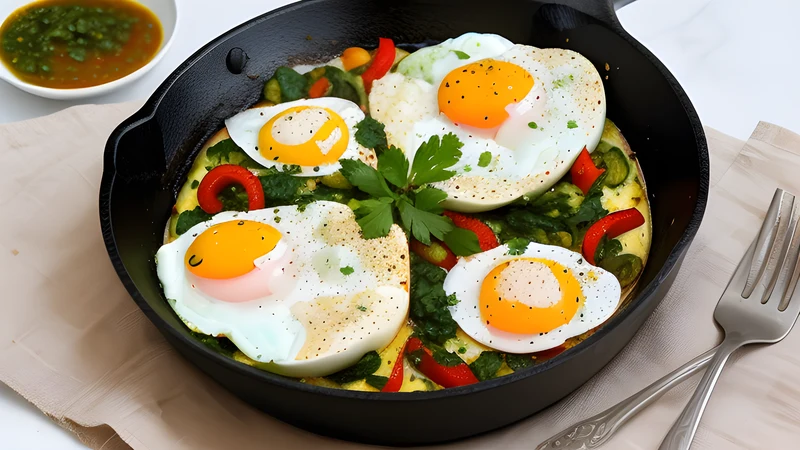
Eggs poached in a green pepper and herb sauce instead of the usual red
Contents
↓ Jump to recipeEveryone knows red shakshuka, the tomato-and-pepper skillet with eggs baked into it that colonised brunch menus a decade ago. Green shakshuka gets far less attention and I think it is the better dish for a lot of the year, because it does not depend on good tomatoes. In February, when a British tomato is a watery disappointment, a pan of green peppers, spinach and a great fistful of soft herbs makes a sauce that tastes of spring when there is no spring outside. The eggs go in exactly the same way. What changes is the base underneath them, and the base is greener, brighter and, to my palate, more interesting.
Shakshuka Verde With Green Herbs
Ingredients
- 3 tbsp olive oil
- 1 leek, sliced, or 1 onion, diced
- 2 green peppers, diced
- 1 green chilli, finely chopped (seeds in for more heat)
- 3 garlic cloves, sliced
- 1 tsp ground cumin
- 1/2 tsp ground coriander
- 200g fresh spinach, chopped
- 1 courgette, coarsely grated (optional)
- Large bunch coriander (about 30g), chopped
- Large bunch flat-leaf parsley (about 30g), chopped
- Small bunch dill (about 15g), chopped
- 100ml vegetable stock or water
- Salt and black pepper
- 4-6 eggs
- 100g feta, crumbled
- Squeeze of lemon, to finish
- Warm flatbread, to serve
Method
- Heat the olive oil in a wide, lidded frying pan over medium heat. Add the leek or onion and cook 5 minutes until soft.
- Add the green peppers and cook 6-7 minutes until they soften and start to collapse. Stir in the chilli, garlic, cumin and ground coriander and cook 1 minute until fragrant.
- Add the spinach and courgette (if using) and cook, stirring, until the spinach has wilted right down, about 3 minutes.
- Stir in most of the chopped herbs (keep a handful back to finish) and the stock. Season well with salt and pepper and simmer 5 minutes to a thick, spoonable green sauce. Taste and adjust.
- Make wells in the sauce with the back of a spoon and crack an egg into each. Season the eggs lightly.
- Cover the pan and cook over low-medium heat for 6-9 minutes, until the whites are just set but the yolks are still runny. Check often, they go from perfect to hard quickly.
- Scatter over the feta, the reserved herbs and a squeeze of lemon. Grind over black pepper.
- Serve straight from the pan with warm flatbread for scooping.
What shakshuka actually is
Shakshuka is a dish of eggs poached in a spiced vegetable sauce, and its roots are North African, specifically the cooking of Tunisia, Libya and the wider Maghreb, where a version of it is a staple. The name is thought to come from a Berber or Arabic word meaning a mixture, a jumble, which suits a dish that is essentially a well-seasoned pan of vegetables with eggs cooked into it. It travelled with Jewish communities from North Africa to Israel, where it became a national breakfast obsession and from where its current global fame spread.
The tomato version is the default because tomato, pepper and egg is a combination that appears independently all over the Mediterranean and Middle East, from the Basque piperade to the Turkish menemen. Green shakshuka, sometimes called shakshuka yeruka in Hebrew, swaps the tomato base for greens: leeks, green peppers, chard or spinach, courgette, and a heavy hand of fresh herbs. It is a real dish in its own right, with its own history, and it is a brilliant way to eat a large quantity of greens without noticing.
Building a green base with real depth
The risk with any green vegetable dish is that it tastes flat and worthy. The way you avoid that is by building flavour in layers before the greens ever go in. Start by properly softening the allium, leek if you have it because its sweetness suits the green palette, onion if you do not, for a full five minutes so it turns silky. Then the green peppers, which need longer than you think, six or seven minutes, until they slump and lose their raw squeak. Garlic, cumin and coriander go in only once the peppers are soft, so the spices bloom in the oil without catching.
Only then do the tender greens arrive. Spinach wilts down to almost nothing, so use more than looks sensible, and grated courgette, if you use it, melts into the sauce and adds body. The herbs are the headline: coriander, parsley and dill, chopped by the fistful. Most of them go in to cook into the sauce; hold a handful back to strew over raw at the end so you get both the deep cooked-herb flavour and the fresh top note.
You want the finished sauce thick and spoonable, not soupy, because a wet sauce will not hold the wells you make for the eggs. If it looks loose, let it bubble another couple of minutes before you crack the eggs in.
A word on the peppers, since they are the backbone. Ordinary green bell peppers are what most recipes call for and they work, but they can carry a slightly bitter, grassy edge when raw, which is exactly why you cook them so long here, the sweetness only emerges once they properly soften. If you can find the paler, thin-walled Turkish or Romano-type green peppers (sometimes sold as sivri or as long green peppers), use them: they are sweeter, cook faster and have more character. Whichever you use, resist the urge to add them raw at the end for crunch, in this dish the peppers are meant to melt.
There is a quiet nutritional bonus to cooking this way, too. A single pan gives you a serious quantity of spinach, herbs, peppers and eggs, which is to say protein, iron and a wall of greens, in a form that people actually want to eat for breakfast. That is a rare and useful thing, and it is why green shakshuka has quietly become a staple in my house through the leaner, greyer months when a fried breakfast feels like too much.
The herbs are the headline, not the garnish
In most savoury cooking herbs are a finishing touch, a scatter of green for freshness at the end. Green shakshuka inverts that: here the soft herbs are a bulk ingredient, measured by the handful and cooked into the base until they lose their raw edge and turn into something deeper and almost jammy. Coriander gives the citric, slightly soapy lift that people either love or need to swap out; parsley brings a clean, grassy backbone; dill adds the aniseed note that ties the dish to its eastern-Mediterranean cousins. Together they make a sauce that tastes green in the fullest sense, herbaceous and layered rather than merely leafy.
Buy them in generous bunches and do not be tightfisted. A supermarket packet of coriander barely registers in a dish built this way; you want the flat-leaf parsley and the coriander in real quantity, stems included, because the stems carry as much flavour as the leaves and soften completely in the pan. Chop them coarsely, since a fine mince bruises and dulls them. And keep a good handful back to strew over raw at the very end, so the finished dish carries both the mellow depth of the cooked herbs and the sharp lift of the fresh, which is the contrast that makes it sing.
Mint is a fine addition in spring, a few leaves torn through at the end, and tarragon in small amounts turns it in a French direction. The one herb to use with restraint is dill, which can dominate; a small bunch is plenty against a large one each of parsley and coriander.
The eggs: the one thing to get right
Poaching eggs in a sauce is easier than poaching them in water, but timing is everything and it is the difference between a lovely dish and a disappointing one. Make proper wells in the sauce with the back of a spoon so the eggs sit in cradles rather than sliding around. Crack them in, season the tops, then cover the pan. The lid traps steam that cooks the tops of the eggs while the sauce cooks the bottoms, so you get evenly set whites and still-liquid yolks.
Six to nine minutes over a low to medium heat is the range, but ovens, pans and egg sizes vary, so watch it. The whites should be just set and no longer translucent, the yolks should still wobble. They tip over from perfect to overcooked in about a minute, so start checking early and pull the pan the moment the whites firm up, they carry on cooking off the heat. A hard yolk in shakshuka is a small tragedy because the runny yolk is meant to enrich the sauce as you scoop.
Finishing and serving
Feta is the classic crown: salty, milky, it melts slightly against the hot sauce and its sharpness lifts everything. Crumble it on generously, add the reserved raw herbs, a good squeeze of lemon and plenty of black pepper. Some cooks add a spoon of labneh or a swirl of tahini, and a little green zhoug-style chilli sauce alongside is wonderful if you like heat.
Serve it straight from the pan, in the middle of the table, with warm flatbread or good sourdough for scooping. It wants no plates, really, just bread and the shared skillet and a spoon each. This is generous, informal food and it should be eaten that way.
There is a knack to the flatbread, too. Warm it properly, until it is soft and pliable and just beginning to blister, because a cold, stiff bread cannot scoop the sauce or mop the yolk and the whole point of the dish is the scooping. If you are serving sourdough instead, char it hard under the grill and rub it with a cut clove of garlic while it is still hot; the roughness of the toast holds the sauce and the garlic echoes what is already in the pan. Either way, put the bread on the table warm and let people tear at it, because green shakshuka is communal food and cools fast once it leaves the heat.
Variations and swaps
The green base is a template. Chard, kale (given a longer cook) and rocket all work in place of or alongside spinach. Peas, broad beans and asparagus turn it into a genuine spring dish. A spoonful of harissa, the green variety especially, deepens it, and a handful of toasted pine nuts or dukkah on top adds crunch. For a dairy-free version, skip the feta and finish with tahini and extra lemon instead, it stays rich and satisfying.
If you want to make it more substantial, a tin of drained white beans or cooked green lentils stirred into the sauce before the eggs turns it into a proper dinner. The same green sauce, made a little thicker and without the eggs, is excellent stirred through rice or piled onto toast with a poached egg on the side.
Getting ahead
The green sauce can be made a day in advance and kept in the fridge; it actually deepens overnight. Reheat it gently in the pan, loosen with a splash of water if it has thickened too much, then crack in the eggs and cook to order. That makes green shakshuka a genuinely fast weekday breakfast or a no-stress dish for feeding people, since all the work is done ahead and only the eggs happen at the last minute.
For a plate that carries the same bright, herb-forward Levantine spirit, the fried aubergine and amba of my sabich makes a natural weekend partner, and if you want to lean further into eggs-and-peppers, the softer, wetter menemen is its Turkish cousin.
Related Content