Schweinshaxe: The Bavarian Roast Pork Knuckle
Three hours, a bottle of dark lager, and skin that shatters like glass
Contents
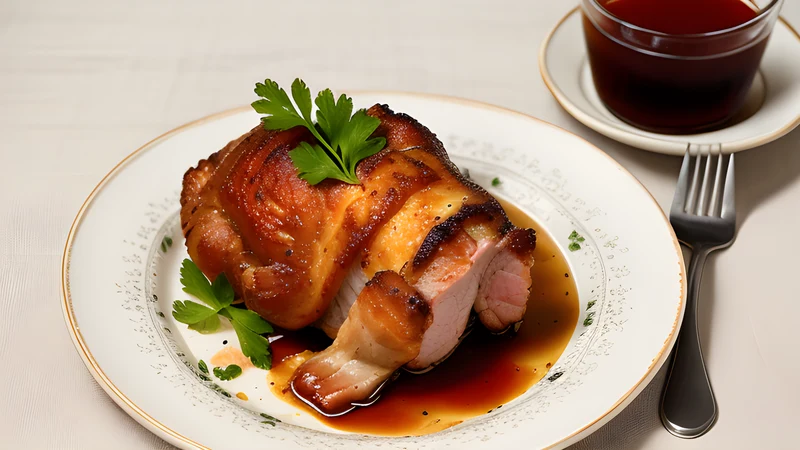
↓ Jump to recipeThere is a moment in a Munich beer hall when the plate arrives and you understand that you have miscalculated. A Schweinshaxe is a whole pork knuckle, standing on its bone, roughly the size and colour of a small polished boot. The skin is the colour of a conker and covered in blisters. The waitress puts down a knife with a serrated edge, because you are going to need it, and a bread dumpling the size of a cricket ball, and half a litre of beer, and leaves.
It is one of the great roasts, and it is one of the easiest things in this entire cuisine to make at home, because a knuckle is nearly indestructible. The muscle is worked, tough and shot through with collagen, and it will sit at 160°C for three hours turning gently into something you can pull apart with a fork. All the skill is in the last twenty minutes.
Schweinshaxe: The Bavarian Roast Pork Knuckle
Ingredients
- 2 fresh (uncured) pork hind knuckles, about 1.1 kg each, skin on and scored by the butcher
- 2 tbsp coarse sea salt
- 1/2 tsp bicarbonate of soda
- 2 tsp caraway seeds
- 1 tsp black peppercorns
- 500 ml dark Bavarian lager (Dunkles or Märzen)
- 2 onions, quartered
- 1 carrot, cut into chunks
- 1/4 celeriac, cut into chunks
- 4 garlic cloves, unpeeled and crushed
- 2 bay leaves
- 300 ml chicken or pork stock
- 1 tsp cornflour, for the gravy
Method
- The day before: check the scoring. The skin should be cut in a 1.5 cm diamond lattice, through the skin and fat but stopping short of the meat. Deepen any shallow cuts with a very sharp blade or a clean craft knife.
- Crush 1 tsp of the caraway with the peppercorns in a mortar. Mix the coarse salt with the bicarbonate of soda and the crushed spice, and rub the mixture hard into the skin, working it into every cut.
- Sit the knuckles on a rack over a tray and refrigerate uncovered for 12-24 hours. The skin will go dry, tight and slightly translucent. Do not cover them.
- Heat the oven to 160°C fan. Brush the loose salt off the skin with a dry pastry brush.
- Scatter the onions, carrot, celeriac, garlic, bay and remaining caraway in a deep roasting tin. Pour in 300 ml of the beer and all the stock. Set a rack over the tin and put the knuckles on it, skin up, so they sit clear of the liquid.
- Roast for 2 hours 30 minutes. Every 40 minutes, brush the skin with beer and top up the tin with water if it looks close to dry. The skin should be pale gold and leathery at this stage, which is correct.
- Check the temperature at the thickest point, avoiding the bone. It needs to reach 85-88°C for the connective tissue to give way. Keep roasting in 20-minute stages until it does.
- Turn the oven up to 230°C fan. Brush the skin once more with beer, then roast for 20-30 minutes, turning the tin every 8 minutes, until the skin has puffed and blistered all over and is deep mahogany. Watch it constantly from minute 15.
- Lift the knuckles onto a board and rest for 15 minutes. Skin does not soften while it rests, so do not tent them with foil.
- Strain the tin juices into a pan, pressing the vegetables hard, and skim the fat. Boil for 5 minutes to reduce, then slake the cornflour in 1 tbsp cold water, whisk it in and simmer for 1 minute. Season.
- Serve whole, with the gravy, and carve at the table with a heavy knife.
Munich, and what the word means
Bavaria distinguishes carefully between three things that all look like a joint of pig and are entirely different dishes. Schweinshaxe is the fresh, uncured knuckle, roasted, with crackling — the Munich beer-hall plate. Berlin’s Eisbein is the same cut, cured in brine and then boiled, so it arrives pale, wobbling and soft-skinned, and Bavarians regard it with open suspicion. Franconia’s Schäufele is the shoulder blade, roasted in the same style, and Franconians will explain at length why theirs is superior.
At Oktoberfest the knuckles go on spits over beechwood in the Ochsenbraterei and the Hofbräu tent, turning for hours, dripping, and the smell reaches a hundred metres down the Wirtsbudenstraße. That rotisserie method is exactly what the oven approach here is imitating: long, gentle, indirect heat with steam in the air, then a final hard scorch.
The beer in the tray is a Bavarian argument in itself. The Reinheitsgebot of 1516, issued at Ingolstadt by Duke Wilhelm IV, restricted beer to barley, hops and water — yeast being unknown at the time and quietly added to the list later — and it is the reason Bavarian dark lager tastes of malt and nothing else. A Dunkles brings Munich malt: bread crust, light chocolate, no sweetness to speak of. Its sugars caramelise on the skin during the basting, and its malt dissolves into the tray to become the gravy. Use a supermarket Munich Dunkel or a Märzen. Avoid anything hoppy — an IPA reduces down into a tray of bitterness that will ruin the sauce.
The knuckle became beer-hall food for the obvious reason. It is the cheapest part of the pig, it takes salt and fat and long heat well, it is dramatic to look at, and it makes people thirsty. Bavarian gastronomy has been engineered around the last of those for five hundred years.
Asking the butcher for the right one
Buy the hind knuckle — Hinterhaxe. It carries noticeably more meat than the front, which is mostly skin, gristle and bone, and which German butchers sell more cheaply for exactly that reason. One knuckle of 1.1 kg feeds one very hungry person or two reasonable ones; the yield of actual meat is around 45% of the raw weight.
It must be fresh, uncured, and skin-on. If it looks pink and slightly translucent, it has been brined for Eisbein and it will never crackle. Ask for it unsmoked.
Get the butcher to score it. A pork knuckle’s skin is thick, and doing a clean 1.5 cm diamond lattice by hand at home is genuinely hard — the skin slips, and the knife slides. A butcher’s band saw or a very sharp scoring blade does it in ten seconds. The critical instruction is through the skin and fat, stopping at the meat. Cut into the muscle and juice weeps up into the scores during roasting, and wet skin never crackles.
Why crackling works, and why it usually doesn’t
Skin is roughly 60% water, with collagen and fat making up most of the rest. Crackling is what happens when you drive out nearly all of that water and render nearly all of that fat, so that the collagen matrix is left dry and empty and can puff and shatter. Everything that goes wrong is a failure to remove water at the right moment.
The uncovered overnight in the fridge is the most important step in the recipe. A fridge is a dehumidifier with a light in it. Twelve hours of moving cold dry air pulls a surprising amount of water out of the surface, and the skin goes tight and papery to the touch. Cover it with foil or clingfilm and you have made a humid box; the skin stays damp and you have wasted a day.
Salt pulls from underneath. Coarse salt rubbed into the scores draws moisture osmotically out of the skin’s deeper layers and up to the surface, where the fridge air removes it. Coarse rather than fine, because fine salt dissolves instantly, penetrates the meat and over-seasons it — you want the salt sitting on the surface doing physical work.
The bicarbonate of soda is my one addition and it is worth arguing about. It does two things. It raises the pH of the skin surface, and Maillard browning runs substantially faster in alkaline conditions, which means better colour in less time and less risk of drying the meat while you wait for it. It also weakens the protein structure slightly, so the skin puffs more readily rather than tightening into leather. Half a teaspoon against two tablespoons of salt is the ratio; go heavier and you will taste it as a faint soapiness.
The two-stage heat. At 160°C, the meat’s collagen converts to gelatine — a process that runs usefully from about 70°C and gets properly going above 80°C — and the skin’s fat renders slowly out. This stage cannot be rushed, and the skin will look disappointing throughout. At 230°C, the last of the water in the skin flashes to steam and blows the dried collagen into blisters. That transformation happens in minutes, and it happens between “perfect” and “burnt” faster than you expect. Stand at the oven from minute fifteen.
Liquid in the tin, meat above it. The steam keeps the meat’s surface from drying and hardening, while the rack keeps the skin out of the wet. A knuckle sitting directly in beer will braise its underside and you will get crackling on precisely one side.
What goes wrong
Leathery skin that bends instead of shattering. Water was still in there when the high heat arrived. Either the fridge stage was skipped or shortened, or the skin was scored into the meat and re-wetted, or the final blast was too short. It can sometimes be saved: cut the skin off, lay it flat on a tray, and give it 10 minutes at 240°C on its own.
Pale patches. Uneven fat under the skin, which is the pig’s fault and not yours. Turn the tin more often.
Dry, stringy meat. Roasted too hot for the middle stage, or pulled at 70°C because that is what a pork chart says. A knuckle is not a loin. It wants 85-88°C and it wants to get there slowly.
A black, smoking tin. Beer sugars catching once the liquid runs dry. Top up with water at every basting; you cannot add too much, since it all reduces into the gravy anyway.
Skin that softens on the plate. Resting under foil. Trapped steam undoes an hour of work in five minutes. Rest it naked on a board — the meat is so collagen-rich that it stays hot for a long time regardless.
Timing it, and the boil-first argument
Three hours of oven plus a day of fridge is a shape that suits a Sunday and defeats a weeknight, and there is an older Bavarian method that shortens the oven considerably. Many beer-hall kitchens simmer the knuckles first — 90 minutes in salted water with caraway, onion and bay — then dry them thoroughly and roast for 45 minutes at 200°C followed by the usual blast.
It works, and it has real advantages. The simmer renders a great deal of fat out early, the meat comes out reliably tender, and the whole thing can be done in an afternoon with the boiling stage the day before. What you lose is flavour: a large part of the pork’s soluble taste ends up in the water rather than in the meat, and the tray never develops the dark malty base that makes the gravy worth having. You also have to be ruthless about drying the skin after the simmer, since you have just soaked the one thing that must stay dry — pat it hard, then give it an hour uncovered in the fridge at minimum.
I do it the long way when there is time. If you use the simmer, keep the cooking liquor: skimmed and reduced by half, it is a better stock than anything in a carton, and it makes the gravy honest again.
The knuckles can be salted and left in the fridge for two full days rather than one, and they improve slightly for it. Beyond that the salt starts to cure the outer centimetre of meat and it goes ham-like and firm — a defensible thing to eat, and no longer a roast.
Leftovers, and there always are, do one excellent thing. Pull the meat off the bone while it is still warm, shred it, pack it into a small dish and pour over enough of the strained skimmed fat to cover. It keeps a week in the fridge and is essentially a rustic rillette; on rye bread with mustard and a pickle it is better than most things you could have made deliberately. The bone goes into a pot of split peas, where it belongs.
What goes beside it
A Laugenbrezel while you wait, torn and dipped in the gravy, is not optional in any beer hall I have eaten in.
The two canonical sides are a dumpling and a cabbage. Semmelknödel is the correct one, because it is engineered to absorb gravy, and it is made from stale rolls, which is very much the spirit of the thing. Blaukraut, the braised red cabbage with apple and clove, brings the acidity that a plate this rich needs. Cold sauerkraut straight from the jar does the same job more aggressively and is what I actually reach for. A warm Schwäbischer Kartoffelsalat, slippery with stock and vinegar, is the Swabian answer and it is very good.
If the whole business appeals but the drama does not, the Danish flæskesteg applies the same crackling logic to a loin, feeds six, and carves into neat slices. The knuckle carves into nothing neat at all, which is rather the point of it.
Related Content