Schwarzwälder Kirschtorte: Black Forest Gateau, Properly Boozy
The cake German law will not let you make without brandy
Contents
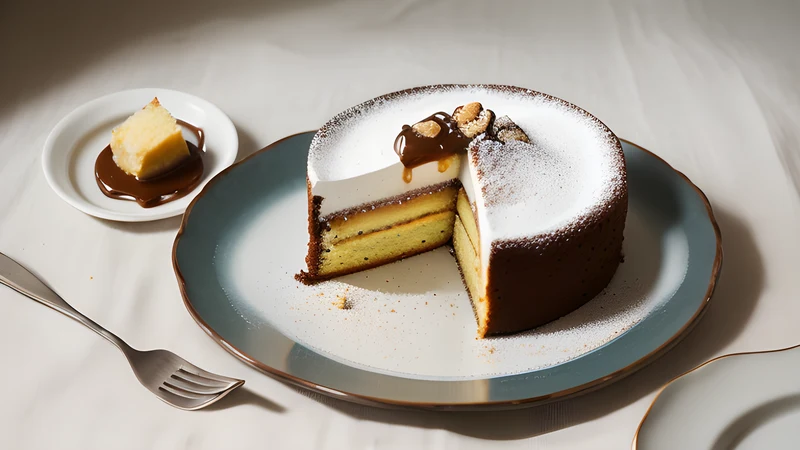
↓ Jump to recipeThe German Food Code — the Deutsches Lebensmittelbuch, which is exactly as thrilling as it sounds — contains a clause that I have grown genuinely fond of. To sell a cake in Germany under the name Schwarzwälder Kirschtorte, the cream filling must contain Kirschwasser — real cherry brandy, in an amount you can taste. Flavouring and syrup will not do. A confectioner who leaves it out is selling something that has to be called by another name.
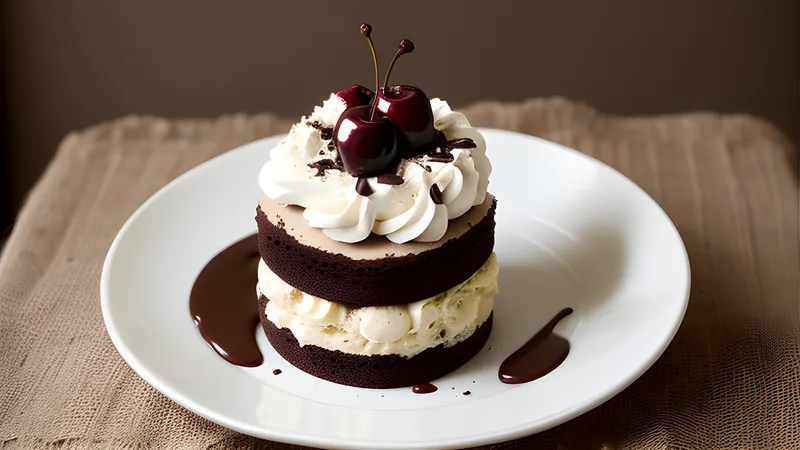
This is the law protecting a cake from the fate that befell it everywhere else. What arrived in Britain in the 1970s under the name Black Forest gateau — the trolley version, chocolate sponge sweating in a chiller cabinet, tinned glacé cherries the colour of a warning sign, aerosol cream, no alcohol whatsoever — has almost nothing to do with the original beyond the colour scheme. A generation grew up thinking they disliked this cake. They disliked something wearing its clothes.
Schwarzwälder Kirschtorte: Black Forest Gateau, Properly Boozy
Ingredients
- 120 g unsalted butter, for browning
- 6 large eggs, at room temperature
- 180 g caster sugar
- 1/4 tsp fine salt
- 120 g plain flour
- 50 g cocoa powder, the darkest you can find
- 1 tsp baking powder
- 680 g jarred sour cherries (Schattenmorellen), drained, juice reserved
- 250 ml reserved cherry juice
- 2 tsp cornflour
- 40 g caster sugar, for the cherries
- 100 ml Kirschwasser (at least 40% abv)
- 800 ml double cream, very cold
- 3 tbsp icing sugar
- 2 tsp powdered gelatine, or 1 tbsp cream stabiliser
- 150 g dark chocolate (60–70%), for shavings
- 12 whole sour cherries, to finish
Method
- Heat the oven to 180°C. Line the base of a 23 cm springform tin and butter the sides. Melt the 120 g butter in a small pan over medium heat and cook for 6 minutes, until it foams, quietens, and turns nut-brown with dark specks. Pour into a bowl, specks included, and cool to lukewarm.
- Whisk the eggs, 180 g sugar and salt in a stand mixer on high for 8 minutes, until tripled in volume and thick enough that a drizzle sits on the surface for 3 seconds.
- Sift the flour, cocoa and baking powder over the eggs in three additions, folding with a large spatula and stopping the moment each disappears.
- Fold 3 tbsp of the batter into the brown butter to slacken it, then fold that back into the main bowl in two goes. Scrape into the tin and bake for 32–35 minutes, until a skewer comes out clean. Cool 10 minutes in the tin, then turn out and cool completely — at least 3 hours, ideally overnight.
- Simmer the 250 ml cherry juice with the 40 g sugar for 5 minutes. Slake the cornflour in 2 tbsp cold water, whisk it in, and simmer 1 minute until it thickens and clears. Off the heat, stir in the drained cherries and 40 ml of the Kirschwasser. Cool completely.
- Split the cold sponge horizontally into three even layers with a long serrated knife. Brush each cut face with the remaining 60 ml Kirschwasser — 20 ml per layer, all of it, no negotiation.
- Bloom the gelatine in 2 tbsp cold water for 5 minutes, then melt it over a pan of hot water and cool to blood temperature. Whip the cream with the icing sugar to soft peaks, pour the gelatine in with the mixer running, and whip to firm peaks.
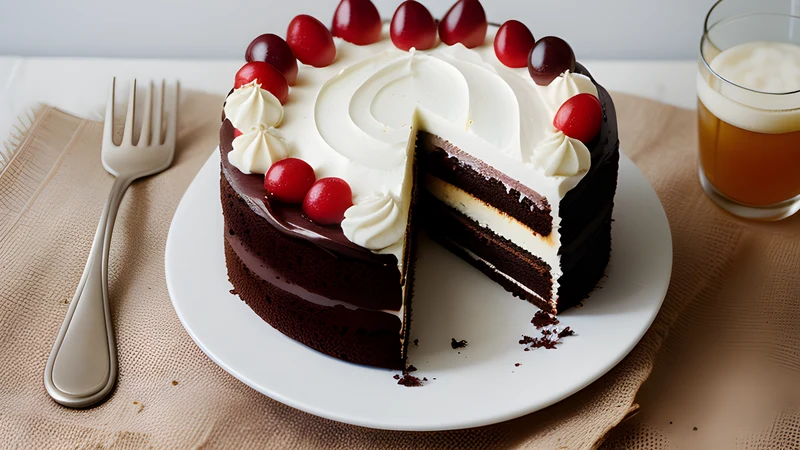
- Set the bottom layer on a plate. Pipe a ring of cream around the rim, fill inside it with half the cherry mixture, then spread a 1 cm layer of cream over. Repeat with the middle layer. Top with the third sponge, cut side down.
- Cover the top and sides with the remaining cream, keeping about 200 ml back for piping. Shave the chocolate with a peeler and press the shavings onto the sides and scatter over the top.
- Pipe 12 rosettes around the rim and sit a whole cherry on each. Chill for at least 4 hours, and take it out 30 minutes before serving.
Where it came from, roughly
The tidiest claim belongs to Josef Keller, a confectioner who said he assembled the first one in 1915 at the Café Agner in Bad Godesberg — which is on the Rhine, some 300 km from the Black Forest. The name, on this reading, refers to the Kirschwasser rather than to the landscape: the Black Forest is where the cherry brandy comes from, and the brandy is what makes the cake.
The competing story credits Erwin Hildenbrand at the Café Walz in Tübingen in 1930. The likelier truth is that neither invented it from nothing. The region already had a dessert of stewed cherries, cream and Kirsch, sometimes over a pastry base; the innovation was putting it into the tall layered Torte format that German confectionery had been perfecting since the nineteenth century. By 1949 it was recorded as the thirteenth most famous cake in Germany. By 1970 it was on every trolley in Europe and getting worse annually.
The cherries decide everything
Sour cherries. Schattenmorellen, Morello, Amarelle — a jar of them, in their own juice, with the pH low enough to make your jaw twitch if you eat one on its own.
The reasoning is arithmetic. This cake carries 800 ml of sweetened cream, 220 g of sugar and a chocolate sponge. Without a serious acid to push against, all of that collapses into one flat sweet note somewhere around the third mouthful, and the reason the trolley version was so tiring to eat was that sweet glacé cherries gave it nothing to push against. Sour cherries have a titratable acidity roughly two to three times that of a sweet cherry, and that acid is doing structural work across the whole cake.
Fresh sour cherries are excellent and available for about four weeks a year. Jarred ones are the year-round answer and they are genuinely good, because the variety matters far more than the processing. Frozen sour cherries work if you thaw and drain them properly. Sweet cherries — Bing, Rainier, anything you would happily eat from a bowl — produce a cake that tastes of nothing but cream.
Keep the juice. It becomes the filling and it is a large part of the flavour.
The Kirschwasser, and how much is enough
One hundred millilitres across a 23 cm cake. Sixty in the soak, forty in the cherries. This will feel like a lot when you are measuring it and it is roughly what a Freiburg Konditorei uses.
Kirschwasser is a clear, unaged, unsweetened eau de vie distilled from whole sour cherries, stones included. The stones are the point: during fermentation the amygdalin in the crushed kernels breaks down to benzaldehyde, which is the compound behind the marzipan-and-almond note that runs underneath the fruit. A good Kirsch tastes almost nothing like a cherry liqueur. It is bone dry, it is 40–45% abv, and it smells of stone fruit and almond blossom.
Do not substitute cherry brandy, which is sweetened and syrupy and will make the cake cloying. If you want the cake alcohol-free, brush the layers with the reserved cherry juice reduced by half with a strip of lemon zest and accept that you are making a different and less interesting cake. The gap that the Kirsch fills is real: it cuts the fat of the cream, it lifts the aroma of everything else, and it is the only ingredient providing bitterness.
Brush it onto the cut faces of a fully cold sponge. Warm sponge steams off the alcohol and takes the aroma with it.
Brown butter in the sponge
The traditional Boden here is a plain chocolate genoise, and my one deviation is to brown the butter first.
A genoise gets its butter folded in at the end, melted, in a small quantity — it is there for tenderness and mouthfeel rather than flavour, and in a plain sponge it contributes very little you can name. Cook it to nut-brown instead and its milk solids Maillard, delivering the pyrazines and lactones that give brown butter its hazelnut character. Against 50 g of dark cocoa, that reads as a deeper, rounder, faintly nutty chocolate. It is the difference between a chocolate sponge that tastes of cocoa powder and one that tastes of chocolate.
Cool it to lukewarm before it goes near the batter, and slacken it with three spoonfuls of the foam first. Hot butter poured into a whisked genoise deflates it on contact — fat destabilises the protein films holding the air bubbles — and a deflated genoise is a biscuit.
Assembly, in the order that works
The build is where home versions go wrong, and the fix is sequence rather than skill.
Work on the plate you intend to serve from, because a finished Kirschtorte weighs close to two kilograms and moving it is how it cracks. Anchor the bottom sponge with a teaspoon of cream underneath so it cannot slide while you spread.
Pipe before you spread. A ring of cream around the outer 2 cm of each layer, about 1.5 cm tall, gives you a wall; the cherry filling goes inside it and cannot reach the edge. Without the dam, the weight of the upper layers pushes the filling sideways and it emerges from the sides of the cake into the outer coat, where it turns the white cream pink and looks exactly like the mistake it is.
Divide by eye and then check. Half the cherry mixture per layer, half the fillable cream per layer. It is very easy to be generous with the first layer and then discover you are rationing the second, which leaves the cake visibly lopsided in cross-section — and cross-section is the entire point of this cake.
The third sponge goes on cut side down. The baked top surface is the flattest thing you have and it gives you a clean plane to coat.
Then chill the assembled cake for 30 minutes before the outer coat goes on. A cold, set interior stops the sponge shifting under a palette knife, and the crumb coat behaves.
Chocolate shavings, properly
The chocolate on the outside is a third of the cake’s surface area and most people make it badly.
The bar must be at room temperature — around 20°C. Cold chocolate straight from the fridge fractures into powder under a peeler, because below about 16°C cocoa butter is brittle and shatters rather than curling. Warm chocolate smears. At 20°C, a vegetable peeler drawn firmly along the flat back of the bar throws off wide, loose curls that hold their shape.
Use a 60–70% bar. Milk chocolate has too much sugar for a cake already carrying this much, and anything above 75% goes chalky and brittle at the thickness a peeler produces.
Handle the curls with a fork or a chilled spoon. Fingers melt them within seconds and leave fingerprints in the cream underneath. Press them onto the sides while the outer coat is still soft — once the cream firms in the fridge, nothing sticks to it, and you will be reduced to arranging them on top.
Grated chocolate is the acceptable fallback, and it reads as dust from a metre away. The curls are what make the cake look like it came from a Konditorei.
The failure modes
The sponge tears when you split it. It was warm, or it was fresh. A genoise needs at least three hours to cool and it is considerably easier to cut the next day, once the crumb has set. Use a long serrated knife, score a guideline all the way round first, and let the blade do the work.
The cream weeps. Whipped cream at 4°C holds for an hour; after four hours in a fridge under the weight of two sponge layers it begins to release water, and it will pool at the base of the cake. The gelatine solves it permanently. Two teaspoons across 800 ml is undetectable in texture and buys you two days. Melt it, cool it to blood heat, and pour it into moving cream — dropped into cold cream it seizes into rubbery threads instantly.
The cherry filling bleeds. It went on warm, or it was too loose. Cool it fully, and pipe a dam of cream around the rim of each layer to hold it in. This is why professionals pipe the ring first.
The whole thing slides. Chill it before you attempt to slice it, and slice with a hot dry knife, wiped between cuts.
Storage, and the day-after argument
This cake improves overnight and there is no ambiguity about it. The Kirsch redistributes from the cut faces through the crumb, the cherry acid migrates into the cream, and the sponge — which is slightly dry on day one, as a genoise always is — reaches exactly the right density. Made on Saturday for Sunday is correct.
Three days in the fridge, covered, is its useful life; after that the cream starts to taste of the fridge. It does not freeze assembled, though the sponge layers freeze perfectly for a month, wrapped tight, which is how you spread the work.
The case against, honestly
It is a project. Six eggs, a genoise you must not deflate, three layers to split evenly, a cooled filling, stabilised cream and 150 g of chocolate to shave, spread across two days. Every stage is straightforward and there are a lot of them.
It is also enormous. Twelve slices, each carrying about 65 ml of cream. This is a cake for a table of people, and a Kirschtorte made for four is a Kirschtorte you will be eating on Thursday.
And the Kirsch is a genuine gate. A bottle of decent Schwarzwälder Kirschwasser costs real money and it has few other uses in a British kitchen. It is what the cake is named after, so there is no way around it — you either buy the bottle or make something else.
Where it sits
Bienenstich is the other German cake worth this much effort, and it makes the opposite argument: yeast dough, almond caramel, custard, no alcohol anywhere. Linzer torte shows what the same region does with spice and redcurrant instead of cream and cherry, and Dobos torta is the Hungarian answer to the layered Torte problem, solved with buttercream and a sheet of burnt sugar.
If the assembly puts you off, Apfelstrudel gives you a comparable amount of drama for a fraction of the equipment.
Chocolate shavings with a vegetable peeler and a room-temperature bar. Every other method makes dust.
Related Content