Schwäbischer Kartoffelsalat: Potato Salad With Warm Stock and Vinegar
No mayonnaise, no apology, and a word for the texture you are aiming at
Contents
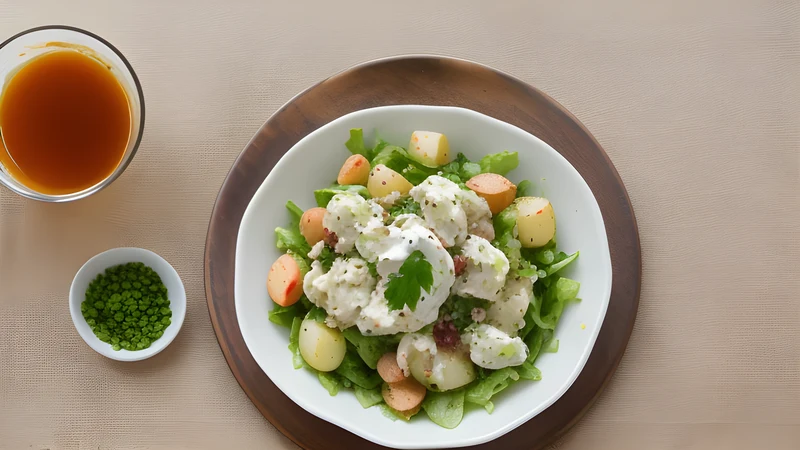
↓ Jump to recipeThere is a word for what this salad is supposed to be, and Swabians will use it before they will describe any of the ingredients. Schlotzig. It has no clean English equivalent — slippery, glossy, loose, faintly creamy, with a sauce that pools slightly in the bottom of the bowl and coats every slice without any dairy or egg involved anywhere. If your potato salad is a heap of dry discs in a dressing, you have made something else. If a spoonful sags and slides, you have made Kartoffelsalat.
The mayonnaise version exists across most of Germany and it is a perfectly reasonable dish. In Baden-Württemberg it is regarded as roughly what a Yorkshireman thinks of gravy from a jar. The Swabian version is older, cheaper, sharper, and it goes with the food it grew up next to — Maultaschen, Saitenwürstle, a schnitzel the size of the plate — in a way that a mayonnaise salad simply cannot, because you need the acid to cut all that fried fat.
Schwäbischer Kartoffelsalat: Potato Salad With Warm Stock and Vinegar
Ingredients
- 1 kg waxy potatoes, similar sizes (Charlotte, Anya or Sieglinde)
- 300 ml beef stock, or a good vegetable stock
- 1 medium onion (about 120 g), very finely diced
- 2 tsp medium German mustard
- 4 tbsp white wine vinegar
- 5 tbsp sunflower or rapeseed oil
- 1 tsp yellow mustard seeds
- 1 tsp caster sugar
- 1 1/4 tsp fine salt
- 1/2 tsp ground white pepper
- 3 tbsp finely snipped chives
Method
- Put the unpeeled potatoes in cold salted water, bring to the boil and simmer for 20–25 minutes until a knife slides in with slight resistance still at the centre. Drain.
- While the potatoes cook, put the stock and diced onion in a small pan and simmer gently for 5 minutes, until the onion loses its raw edge. Whisk in the mustard, vinegar, sugar, salt and white pepper. Keep it hot.
- Toast the mustard seeds in a dry pan over medium heat for 90 seconds, until they begin to pop and smell nutty. Tip them into the hot stock.
- Peel the potatoes as soon as you can bear to hold them, using a small knife and a tea towel. Work fast — they must stay hot.
- Slice the hot potatoes 4 mm thick straight into a wide bowl.
- Pour the hot stock mixture over the hot slices. Do not stir. Cover the bowl and leave for 20 minutes, so the potatoes drink the stock.
- Pour the oil over and fold gently with a wide spoon, 6 or 7 turns only, until the liquid turns glossy and slightly thickened and clings to the slices.
- Leave at room temperature for a further 30 minutes. Fold in the chives, taste, and add more vinegar or salt. Serve barely warm, never chilled.
Where the sauce comes from
The remarkable thing about this recipe is that the sauce has no thickener in it. There is stock, vinegar, mustard and oil, and those things want to separate. What holds them together is potato starch, extracted from the potatoes themselves at the one moment they will give it up.
When you slice a potato hot, straight off the boil, the surface of every slice is covered in gelatinised starch granules that have swollen with water and burst. Pour hot, salted, acidic liquid over that surface and two things happen simultaneously: the slices absorb the stock like a sponge, because a hot potato’s cell structure is open and its own water is actively steaming off, and free starch washes into the liquid. When you then add oil and fold, that dissolved starch acts as the emulsifier, suspending the oil in the stock the way egg yolk would in a mayonnaise. The gloss is starch. That is the entire trick.
Every rule in this recipe is downstream of that one fact.
Peel and slice hot. A cold potato has retrograded — the starch has recrystallised, the cells have closed, and it will absorb almost nothing. Pour stock over cold slices and it will sit in the bottom of the bowl until Tuesday. Peel them at the point where you can just about hold one in a tea towel, and accept that you will burn your fingers slightly. Swabian grandmothers have asbestos hands and a superior salad; the two facts are related.
Pour hot on hot. Cold dressing on hot potatoes drops the temperature immediately and stops the absorption dead. The stock should be steaming when it goes in.
Waxy potatoes only. Festkochend, as a German bag will say. A floury potato has more starch and larger cells that rupture completely, so it disintegrates into the stock and gives you warm potato soup with onions in it. Waxy varieties hold their shape while still shedding enough surface starch to build the emulsion. Charlotte and Anya are widely available in the UK and both work. Maris Piper and King Edward will fail.
Slightly underdone. Pull them while the very centre still resists a knife. They carry on cooking as they sit in hot stock for twenty minutes, and a potato cooked to perfection in the pan is a potato that collapses in the bowl.
Fold, do not stir. Six or seven turns with a wide spoon. Every extra turn breaks more slices and moves you towards mash. The oil emulsifies within a few seconds of contact.
The toasted mustard seed
My one addition to the Stuttgart original is a teaspoon of yellow mustard seeds, toasted dry until they pop and dropped straight into the hot stock.
The reasoning is that mustard is already here doing two separate jobs — the paste is the traditional emulsifier and it is a large part of the flavour — but jarred mustard is a one-note ingredient by the time it reaches you. Its pungency comes from allyl isothiocyanate, which is volatile and has been leaking out of the jar since it was opened, and the vinegar in the jar locks the enzyme reaction where it is. Toasting whole seeds does something the paste cannot: dry heat drives Maillard browning in the seed coat and produces nutty, slightly bitter notes that sit underneath the sharp ones. You get a second mustard register, and you get the small pops of texture against the soft slices.
Ninety seconds, medium heat, moving the pan. Take them off when the first few jump. Burnt mustard seed is acrid and there is no rescuing the stock afterwards.
Getting the balance right
This salad lives or dies on acid, and the amount is genuinely variable because vinegars are not standardised. Four tablespoons of a 6% white wine vinegar is my starting point for a kilo of potatoes, and it will taste aggressive when you first mix the stock — correctly so. The potatoes absorb a great deal of it over the next fifty minutes and the finished salad lands somewhere much gentler than the dressing tasted.
Season at the end as well as the beginning. Potatoes are salt sinks and a bowl that tasted right at the pour will taste flat once they have drunk it. The sugar sits below most people’s detection threshold at a teaspoon in a kilo, and its job is to round off the vinegar’s hard edge.
Stock quality matters more than anything else in the ingredient list. This is four ingredients and one of them is stock, so a cube will taste exactly like a cube. A good beef stock is traditional and gives the deepest result. A well-made vegetable stock is the honest substitute; water with mustard in it is not.
Storage, and the temperature rule
Never refrigerate this if you can avoid it. Below about 8°C the starch retrogrades, the emulsion breaks and the sauce goes from glossy to grainy, and the potatoes turn waxy and dull. Made in the morning and left covered on the counter, it is at its best around four hours later, when the vinegar has fully penetrated and the onion has softened into the background.
If you must keep it overnight, take it out of the fridge two hours before serving and fold in a tablespoon of hot stock to loosen it. It will be perhaps eighty per cent of what it was. It will still be better than the mayonnaise version.
It does not freeze. Nothing about a potato survives freezing.
The case against, honestly
Two real objections.
First, it is fussy about timing in a way that most side dishes are not. The peeling window is maybe four minutes wide, and it lands exactly when you are trying to do something else. There is no way around this — the recipe depends on it — which is why the mayonnaise version won everywhere the cook was busy.
Second, it is sharp, and people raised on the creamy version often find the first mouthful startling. It is designed as a counterweight, so eaten alone from a bowl it can read as thin and one-dimensional. Put it next to something fried and it makes sense instantly.
The onion question, which Swabians take seriously
Onion is the third ingredient by weight and there are three defensible ways to handle it, each producing a different salad.
Raw, diced fine, folded in at the end: sharpest, crunchiest, and the version you get in a lot of Stuttgart pubs. It fades over a few hours as the vinegar cures it, so a salad made this way at noon is a different thing by six.
Simmered in the stock for five minutes, which is what I have specified: the alliinase enzymes that generate the harsh sulphur compounds are denatured above roughly 60°C, so what remains is the sweetness with the aggression stripped out. The onion also releases its own sugars into the stock and disappears into the background instead of announcing itself. This is the most reliable version and the one that holds its character overnight.
Softened in a little fat first, then added: sweeter still, rounder, and a step towards the Bavarian style. It is good, and it does move the salad away from the clean, sharp thing it is meant to be.
The dice matters as much as the method. Three millimetres. Anything larger and you get discrete lumps of onion in a salad whose entire texture argument is smoothness; anything smaller and it dissolves entirely and you have lost it. Use the sharpest knife in the drawer, because a blunt blade crushes onion cells and floods the board with the exact compounds you are trying to keep out.
Variations that are actually Swabian
Speck. A hundred grams of streaky bacon, diced and rendered until crisp, with the fat used in place of two of the five tablespoons of oil. Common around Tübingen, and it turns a side dish into something that can carry a meal on its own.
Cucumber. A peeled, deseeded and thinly sliced cucumber folded in at the very end, salted separately for ten minutes and squeezed first. It adds water and crunch and it is divisive; half of Baden-Württemberg considers it standard and the other half considers it vandalism.
Lamb’s lettuce. Feldsalat, tumbled through just before serving. This is the one I would defend hardest — the nutty, slightly bitter leaves against the sharp glossy potato are genuinely excellent, and it is what turns the salad into a first course.
Pumpkin seed oil. A Styrian import rather than a Swabian one, and a tablespoon of it swapped into the oil is startling: dark green, intensely nutty, and it dominates if you use more.
What you will not find, anywhere in the region, is a version with dill or with sour cream. Both belong to different potato salads with different logic behind them, and both fight the stock.
What it belongs beside
Maultaschen is the canonical pairing and the two dishes come from the same forty miles of countryside. Pan-fried Maultaschen with this salad is the Swabian Sunday, and the vinegar does for the buttery pasta pockets exactly what a squeeze of lemon does for a fried fish.
Wiener schnitzel is the other obvious partner, and in Vienna the near-identical Erdäpfelsalat turns up beside it as a matter of course. Frikadellen work just as well, hot or cold. And if you want the full Swabian carbohydrate argument, put a bowl of this next to Käsespätzle and watch a region reveal its priorities.
Chives at the end, snipped over the bowl at the table.
Related Content