Sauerbraten: The Rhineland Roast That Marinates for Four Days
Beef, vinegar, time, and a gravy thickened with gingerbread
Contents
↓ Jump to recipeFour days. That is the part everyone reacts to, and it is the part that is genuinely non-negotiable, because what happens to a piece of topside sitting in vinegar for four days is a chemical process with a schedule and no shortcut.
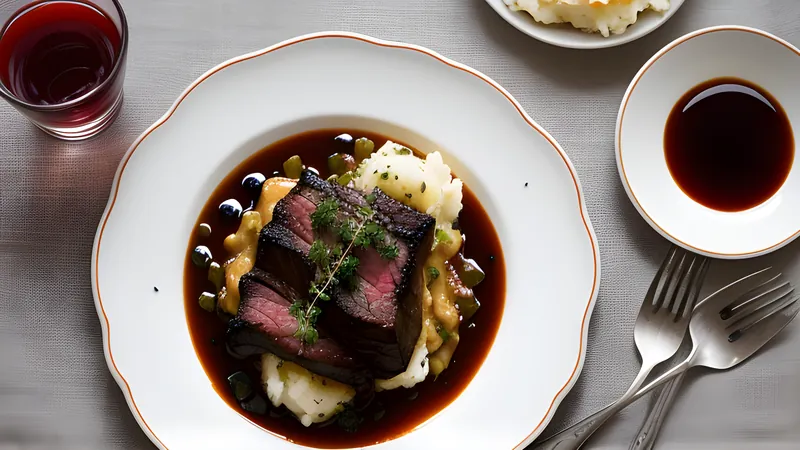
Sauerbraten is Germany’s most famous roast and one of the oldest continuously cooked dishes in Europe. The Rhineland claims it hardest — Cologne and Düsseldorf both serve it as a civic dish — and the Rhineland version is the one with raisins in the gravy and gingerbread thickening it, which sounds like a mistake and is the entire reason to make it.
Sauerbraten: The Rhineland Roast That Marinates for Four Days
Ingredients
- 1.6 kg beef topside, silverside or brisket, in one piece
- 500 ml red wine vinegar
- 500 ml dry red wine
- 250 ml water
- 2 onions (about 350 g), sliced
- 1 carrot (about 100 g), sliced
- 1 stick celery (about 80 g), sliced
- 3 bay leaves
- 10 juniper berries, lightly crushed
- 1 tbsp black peppercorns
- 6 whole cloves
- 2 tsp mustard seeds
- 1 tsp caster sugar, for the marinade
- 2 tbsp lard or neutral oil
- 2 tsp fine salt
- 1 tbsp tomato puree
- 80 g Lebkuchen or Pumpernickel, crumbled
- 60 g raisins
- 2 tbsp sugar beet syrup (Zuckerrubensirup) or dark treacle
- 100 ml soured cream
- Black pepper, to finish
Method
- Bring the vinegar, wine, water, onions, carrot, celery, bay, juniper, peppercorns, cloves, mustard seeds and 1 tsp sugar to the boil in a large non-reactive pan. Simmer 5 minutes, then cool completely to room temperature.
- Put the beef in a deep non-reactive container or a large freezer bag and pour the cold marinade over. The meat must be fully submerged; weigh it down with a plate if needed. Cover and refrigerate for 4 days, turning the meat once a day.
- Lift the beef out and dry it thoroughly with kitchen paper — really dry, or it will not brown. Strain the marinade, keeping both the liquid and the vegetables. Discard the whole spices.
- Season the beef all over with the 2 tsp salt. Heat the lard in a heavy casserole over high heat and brown the beef on every surface, 10-12 minutes total, until dark. Lift it out.
- Add the strained marinade vegetables to the pot and cook 8 minutes over medium heat until browning. Stir in the tomato puree and cook 2 minutes until it darkens.
- Pour in 600 ml of the strained marinade liquid, bring to the boil and scrape the base clean. Return the beef and any juices.
- Cover and cook at the barest simmer — or in a 150C oven — for 2 hours 45 minutes to 3 hours, turning the beef every 45 minutes, until a skewer meets no resistance in the centre.
- Lift the beef onto a board, cover loosely with foil and rest 20 minutes.
- Strain the sauce into a clean pan, pressing the vegetables hard through the sieve. Skim off the fat. You should have about 700 ml; boil to reduce if you have more.
- Whisk in the crumbled Lebkuchen and simmer 8-10 minutes, whisking, until it dissolves and the sauce coats a spoon. Add the raisins and the syrup and simmer 3 minutes more.
- Off the heat, stir in the soured cream. Taste: it should land sweet-sour with the sour slightly ahead. Adjust with a splash of the reserved marinade or more syrup. Season with black pepper.
- Carve the beef across the grain into 1 cm slices and serve in the sauce.
A dish older than the country that eats it
Sauerbraten’s origin story usually credits Charlemagne, which is the kind of claim that should make you suspicious and which in this case is at least chronologically plausible without being provable. What is documented is that soaking meat in wine and vinegar before roasting appears in German cookery manuscripts by the fifteenth century, and that the technique arrived from the Roman world, where it had been standard practice for the same reason: no refrigeration, tough animals, and vinegar as the only reliable preservative that also improved the eating.
The word itself is unhelpfully literal — sauer (sour) plus Braten (roast) — and it describes a category rather than a recipe. Every German region has one and they disagree about almost everything. Swabia marinates in wine and thickens with flour. Franconia leans on soured cream and skips the sweetness. Saxony uses more beer. Silesia goes hard on the raisins. The Rhineland version, sweetened and thickened with gingerbread, is the one that has travelled furthest, partly because it emigrated: German-American sauerbraten is essentially a Rhineland recipe with gingersnaps standing in for Lebkuchen, and it is on the menu at every Milwaukee supper club that has survived.
The four-day marinade is also the reason the dish is a Sunday dish. It cannot be decided on. You commit on a Wednesday to what you will eat on a Sunday, and the meat sits in the fridge as a promise all week. There are not many dishes left with that shape, and the shape is part of why it tastes the way it does — by day four the household has been thinking about it for three days already.
What the marinade is doing
Understand this and the rest of the recipe explains itself.
An acidic marinade at pH around 3.5 does three things to beef over several days. It denatures the surface proteins, unwinding them so they hold water differently — this is why marinated beef stays moist through a long braise where the same cut, braised unmarinated, goes dry and fibrous. It slowly weakens the connective tissue, giving the collagen a head start on its conversion to gelatine. And it penetrates, slowly, carrying the juniper and clove and bay with it.
Penetration is the reason for the four days. Acid moves into muscle at roughly 3-5 mm a day. A 1.6 kg piece of topside is perhaps 90 mm through at its thickest. Marinate it for one day and the outer centimetre is sauerbraten and the middle is roast beef with an odd rim. Four days gets the acid meaningfully into the centre. Historic Rhineland recipes ran to seven or ten days, and Germans who own a cellar still do it that way; four is the point where the effect is unambiguous and the meat has not yet turned to mush.
Longer is not automatically better. Past about a week the surface proteins break down far enough that the outer layer goes soft and slightly mealy on cooking. Four to five days is the practical window.
The marinade must be cold when it meets the meat. Boiling it first extracts the spices properly and drives off some vinegar harshness; pouring it on hot part-cooks the surface and starts a food-safety clock you do not want to run for four days.
Use non-reactive containers throughout — glass, ceramic, stainless, or a freezer bag. Aluminium or cast iron in contact with this much vinegar for four days will pit, and the sauce will taste metallic.
The horse in the room
Traditional Rhineland Sauerbraten was made with horse, and in Cologne and Düsseldorf you can still order Pferdesauerbraten today in a handful of Brauhäuser that make a point of it. Horse butchers operated in the Rhineland well into living memory, and the meat is leaner, sweeter and considerably darker than beef.
The reasoning was economic. Horse was the cheap meat, worked to exhaustion and slaughtered old, which meant it was tough beyond the reach of any ordinary cooking. A long acid soak was the only thing that would make it edible. The dish is a technique invented for a difficult ingredient, and it survived the ingredient’s disappearance because it turned out to work just as well on a cheap cut of beef.
That history explains why the cut matters less than people think. Topside, silverside, brisket, even shoulder clod — the marinade and the braise are engineered for tough, lean, collagen-rich meat. Buying an expensive cut for sauerbraten wastes the money; the technique has nothing to do for a well-marbled sirloin except ruin it.
Gingerbread in the gravy
Here is where the Rhineland separates itself from every other regional version. Swabian sauerbraten uses a plain flour thickening. Franconian versions lean on soured cream. The Rhineland thickens the gravy with crumbled Lebkuchen — spiced honey gingerbread — and sweetens it with raisins and sugar beet syrup.
It works for a structural reason. Lebkuchen is honey, rye or wheat flour, and a spice mix that is already carrying clove, cinnamon, allspice and ginger. Whisked into a hot sauce it does three jobs at once: the starch thickens, the honey sweetens against the vinegar, and the spice slots in behind the juniper and clove already in the marinade. One ingredient replaces a roux, a sweetener and a spice blend, and it does so because the spices were chosen centuries ago to sit exactly there.
If Lebkuchen is unavailable, dark pumpernickel is the standard substitute and gives a maltier, less sweet result — bump the syrup by a tablespoon to compensate. The Belgian trick of thickening a beer braise with mustard-smeared gingerbread, as in zuurvlees across the border in Limburg, is the same idea in a different accent, and the two dishes are almost certainly cousins.
Zuckerrübensirup — sugar beet syrup, sold in the Rhineland in tins as Rübenkraut — is the authentic sweetener and tastes like treacle with the bitterness taken out. Black treacle works with a slightly heavier hand on the soured cream.
Getting the balance right
The dish is named for its sourness and the sourness has to lead. A sauerbraten that tastes like a sweet gravy with beef in it has failed, and this is by far the commonest failure, because raisins and syrup and gingerbread all pull in one direction and it is easy to overshoot.
Taste the finished sauce properly, off the heat, with a clean spoon, and expect a fight between the vinegar and the sweetness that the vinegar wins narrowly. If it has gone too sweet, add reserved marinade a tablespoon at a time. If it is punishingly sour, more syrup and more soured cream.
Add the soured cream off the heat and stir rather than boil. Soured cream splits at a simmer, and once split there is no bringing it back.
The 600 ml of marinade going into the braise, rather than all 1.25 litres, is deliberate. The full quantity produces a braising liquid so acidic that the meat firms up instead of relaxing — acid tenderises over days at fridge temperature and toughens in an hour at braising temperature, which is one of the genuine counterintuitive facts of cooking. Keep the rest for adjusting the sauce at the end.
What goes wrong
The meat will not brown. It came out of a litre of liquid and it is soaked. Dry it hard with kitchen paper, then leave it on a rack for ten minutes and dry it again. Wet meat steams, and a sauerbraten that never browned has a pale, thin, sour gravy with no depth behind the acid.
The beef is tough after three hours. The pot was boiling. This is the same failure as every braise: hold it at 80-85C, and if your hob will not go that low, use the oven at 150C with the lid on.
The gravy is gritty. The Lebkuchen has not dissolved. It needs a proper whisk and eight to ten minutes at a simmer; crumbling it finer before it goes in helps considerably. A stick blender through the sauce fixes it in five seconds.
The sauce split into oil and grains. The soured cream boiled. Off the heat, always.
Everything tastes of clove. Six whole cloves in 1.25 litres is already at the top of the range, and cloves keep extracting for four days. If you are sensitive to them, drop to four.
Serving, storage and variations
Kartoffelklöße — potato dumplings — are the Rhineland pairing, because the gravy is the whole point and dumplings hold more of it than anything else on earth. Semmelknödel do the same job. Rotkohl with apple and clove is the other fixture, and buttered spätzle are what a Swabian would put underneath it. Apple sauce on the side is a Cologne habit and it is good.
Sauerbraten keeps 4 days in its sauce and is better on day two, when the slices have soaked. Freeze it sliced, in sauce, for 3 months. Reheat gently in a covered pan; microwaving will squeeze the moisture straight back out of the meat and undo the four days.
Carve across the grain, always, and in slices about 1 cm thick. Thin slices fall apart, thick ones eat like a wall.
For a version with more backbone, swap 100 ml of the wine for dark beer and cut the raisins to 30 g. For a Franconian-leaning result, drop the Lebkuchen entirely, thicken with a flour-and-butter paste whisked in at the end, and double the soured cream. Both are good. The Rhineland one, with the raisins bobbing about in a gravy that tastes faintly of Christmas, is the one worth the four days.
Related Content