Satsivi: Chicken in Cold Walnut Sauce
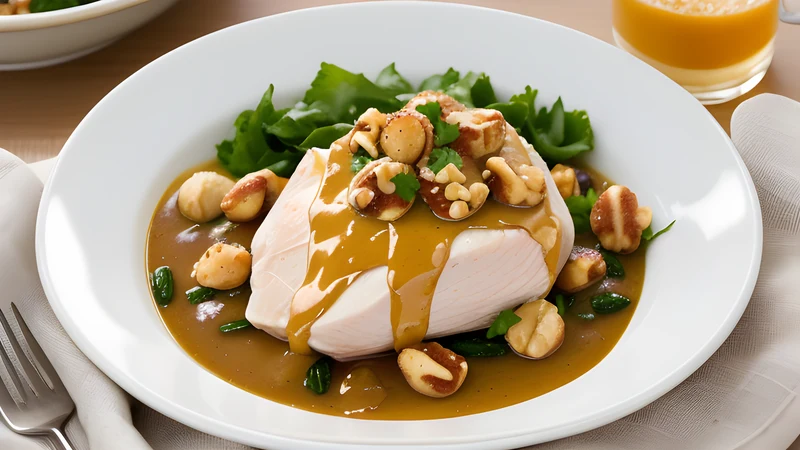
Poached chicken under a pale golden walnut sauce, served cold, with the oil pooling on top
Contents
↓ Jump to recipeThe name gives the game away. Tsivi means cold in Georgian, and satsivi means, roughly, “the cold thing”. It is a dish defined by its temperature, which sounds like a strange organising principle for a chicken in a nut sauce until you eat it: cold, the walnut sauce goes dense and silky, the clove and cinnamon come forward, and a thin slick of walnut oil rises to the top and sits there, gold and glossy. Warm, it is a fine chicken stew. Cold, it is something else.
Satsivi: Chicken in Cold Walnut Sauce
Ingredients
- 1 free-range chicken, about 1.6kg
- 1 onion, halved, plus 2 medium onions (about 300g), very finely diced
- 1 bay leaf
- 1 tsp black peppercorns
- 2 tsp fine salt, plus more to finish
- 40g unsalted butter
- 300g shelled walnut halves
- 6 fat garlic cloves, peeled
- 2 tsp dried marigold petals (Imeretian saffron), or 1/2 tsp turmeric
- 2 tsp dried blue fenugreek (utskho suneli)
- 2 tsp coriander seed
- 1/2 tsp fennel seed
- 3/4 tsp ground cinnamon
- 1/4 tsp ground cloves
- 1/4 tsp freshly grated nutmeg
- 1/2 tsp dried chilli flakes
- 3 tbsp white wine vinegar
- 1 tsp plain flour
- Seeds of 1/2 pomegranate, to serve
Method
- Put the chicken in a pot that fits it snugly. Add the halved onion, bay leaf, peppercorns and 2 tsp salt, and pour in enough cold water to come three-quarters of the way up the bird, about 1.5 litres.
- Bring slowly to a bare simmer, skim the scum, then cover and poach on the lowest heat for 50-60 minutes, until a thigh reads 74C. Never let it boil.
- Lift the chicken out onto a tray to cool. Strain the stock, skim off the fat, and boil the stock hard until reduced to 800ml. Cool it to lukewarm.
- Meanwhile toast the coriander and fennel seeds in a dry pan over a medium heat for 60-90 seconds until they smell nutty. Grind to a powder.
- Melt the butter in a wide pan over a low heat. Add the diced onions and 1/2 tsp salt and cook very gently for 20 minutes, stirring often, until completely soft and still pale. Take care not to colour them.
- Blitz the walnuts and garlic in a food processor in short pulses to a coarse, damp meal. Add 200ml of the lukewarm stock and blitz again for 2 minutes to a smooth, thick, pale paste.
- Stir the ground toasted spices, marigold, blue fenugreek, cinnamon, cloves, nutmeg, chilli flakes and the flour into the softened onions. Cook for 1 minute.
- Whisk in the remaining 600ml of lukewarm stock, a little at a time. Bring to a gentle simmer and cook for 5 minutes until very slightly thickened.
- Take the pan off the heat and let it stop bubbling. Whisk in the walnut paste. Return to the lowest possible heat and cook for 10-12 minutes at a bare tremble, stirring constantly. The sauce must never boil.
- Stir in the vinegar. Taste and add salt, usually about 1 tsp. The sauce should be nutty, sharp and faintly sweet with clove. Take it off the heat.
- Pull the chicken into large pieces, discarding skin and bones. Arrange in a shallow dish and pour the warm sauce over so everything is submerged.
- Cool to room temperature, then chill for at least 6 hours and ideally overnight. Bring back to cool room temperature, about 30 minutes out of the fridge, scatter with pomegranate seeds and serve.
The New Year bird
Satsivi is what Georgians eat at New Year, and at Christmas, which in the Georgian Orthodox calendar falls on 7 January. The house makes it on the 30th or 31st, it goes into a cold room or onto a balcony, and it sits there getting better while everyone else deals with the rest of the supra — the feast, run by a tamada whose job is to keep a sequence of formal toasts going for as long as the evening lasts.
The proper bird is turkey — indauri in Georgian, which is a loan from the Turkish hindi, itself from “India”, part of the long and confused history of a bird from Mexico being named after everywhere except Mexico. Turkey satsivi is the celebration version, and a turkey is a great deal of chicken. Chicken satsivi is what most Georgian households actually make most of the time, and it is what I make, because the sauce is the dish and the bird is a delivery mechanism.
The sauce is the same base that runs through half of Georgian cooking — walnut, garlic, coriander, marigold, blue fenugreek — appearing here in its richest and most heavily spiced form. It is the same logic as pkhali and the same thickening technique as lobio, pushed towards cinnamon and clove until it lands somewhere between a savoury sauce and a mole.
Bazhe, and the oil that tells you it worked
There is a simpler cousin worth knowing: bazhe, the plain walnut sauce, made from walnuts, garlic, spices and water or stock, no onion, no cooking. It goes on cold fish, on aubergine, on anything. Satsivi is bazhe with onions, more spice and more time.
Georgian cooks judge a satsivi by whether the walnut oil separates and pools on the surface. A good one has a visible amber film on top when it comes out of the cold. This is not a broken sauce, which is the confusing part — the emulsion of ground walnut and stock is deliberately pushed until a fraction of the oil comes free, and that free oil is a mark of quality. The traditional method squeezes the pounded walnuts in a cloth to extract oil, then stirs that oil in at the end. My version gets there by grinding the nuts fine and holding the sauce at a bare tremble for ten minutes, which frees enough oil to slick the surface without breaking the body.
Why the sauce must never boil
This is the one rule that matters, and almost every failed satsivi has broken it.
Ground walnut in stock is an emulsion: oil droplets held in suspension by the nut’s own protein and the fine particles of nut meal. It is a fragile arrangement. Boiling does two things to it, both bad. The agitation drives droplets into each other so they coalesce into a greasy slick, and the heat denatures the walnut protein that was holding the emulsion together in the first place. What you get is a grainy, curdled sauce with a lake of oil on top and a gritty sediment beneath, and no amount of whisking brings it back.
So: the stock goes in lukewarm rather than hot. The walnut paste goes into a pan that has stopped bubbling. The ten minutes of cooking happens at the lowest setting your hob will hold, with the sauce moving but never breaking the surface, and with you stirring. A heat diffuser helps if your smallest burner is still fierce.
The teaspoon of flour is my own insurance, and Georgian purists would raise an eyebrow. It gelatinises in the onion base before the walnuts arrive and gives the sauce a starch scaffold, which makes the emulsion considerably harder to break. It is a small hedge on the one step that ruins the dish.
Poaching, and the stock you get for free
The chicken is poached rather than roasted, and the reason is arithmetic: you need 800ml of concentrated chicken stock for the sauce, and poaching the bird gives you exactly that while cooking it. Roast the chicken and you have to make stock separately, which is an extra afternoon.
Poach it at a bare tremble. Water at a rolling boil hits 100C and drives the muscle fibres of the breast into contracting hard and squeezing out their moisture, which is how you get chicken with the texture of loft insulation. Held just below a simmer, somewhere around 85C, the bird comes up to 74C in the thigh over an hour and the breast stays juicy. Skim the grey scum in the first ten minutes and the stock stays clear.
Then reduce. Straight poaching liquid from a 1.6kg bird in 1.5 litres of water comes out weak and thin, pleasant enough and lacking authority. Boiling it down to 800ml roughly doubles its concentration and, more importantly, concentrates the gelatine that came out of the bones and skin. That gelatine gives the finished sauce body and is part of why satsivi sets to a soft, sliceable density in the fridge.
Cool the reduced stock to lukewarm before it meets the walnuts. Hot stock hitting ground walnut starts the emulsion off at exactly the temperature where it is most likely to break.
Pulling the bird
Pull the meat into large pieces with your hands while the carcass is still warm — around three centimetres, roughly bite-and-a-half sized. Shredding it into threads is a mistake: fine strands go stringy in the fridge and disappear into the sauce, and half the pleasure of satsivi is a proper piece of chicken with sauce clinging to it.
Discard the skin. Poached chicken skin is flabby, and it contributes nothing under a cold sauce. Keep the carcass and any bits of gristle, throw them back into the stock while it reduces, then strain them out.
Submerge the meat completely. Any chicken standing proud of the sauce dries out and darkens overnight in the fridge, and it will taste of the fridge as well.
Grinding: fine, this time
For lobio you stop the food processor early, at coarse crumb. Satsivi is the opposite: here you want the walnuts as fine as the machine will take them. Pulse them dry with the garlic to a damp meal first, then add 200ml of lukewarm stock and let it run for a full two minutes. The liquid changes everything — it stops the nuts seizing into butter and instead lets them grind down into a smooth, pourable, pale paste with the texture of thick cream. That fineness is what gives the finished sauce its silk.
A high-powered blender does this better than a food processor. If you have one, use it, and give it three minutes.
The onions have to stay pale
Twenty minutes on a low heat with a pinch of salt, and no colour. This runs against every instinct — most sauces want browned onions — and there is a reason for it here. Satsivi is a pale gold dish. The colour comes from marigold petals and from walnut, and browned onions would drag it towards beige and bring roasted, caramelised notes that fight with the clove and cinnamon. Sweat them, do not fry them. If they start taking colour, add a splash of water and drop the heat.
The spices
Marigold petals (kartsakhura, sold as Imeretian saffron) are ground Tagetes florets. They give satsivi its yellow and a mild resinous perfume. Turmeric at a quarter of the quantity substitutes for the colour alone.
Blue fenugreek (utskho suneli) is Trigonella caerulea, ground pod and seed, tasting of hay and maple with none of common fenugreek’s bitterness. Half quantity of ordinary ground fenugreek stands in.
Cinnamon, clove and nutmeg are what separate satsivi from every other walnut sauce in the country. The quantities look timid and they are correct — a quarter-teaspoon of clove in 800ml of sauce reads as a warm background hum, and half a teaspoon reads as a Christmas pudding.
Toast the coriander and fennel whole and grind them yourself. Ninety seconds in a dry pan, until they smell of nut and orange peel rather than dust.
What can go wrong
Grainy, split sauce with an oil slick. It boiled. There is no proper fix, though blitzing the whole thing with a stick blender and 50g more ground walnut will rescue it into something edible.
Bitter. Old walnuts. Walnut oil turns rancid quickly on a warm shop shelf. Taste one before you commit 300g, and store them in the freezer.
Thin. The stock was not reduced to 800ml, or the walnuts were not ground fine enough. It thickens substantially on chilling, so judge it cold.
Flat. Under-salted and under-soured. It needs 3 tbsp of vinegar and more salt than seems right, because cold food tastes blunter than warm food. Season it warm, taste it cold, correct it warm again.
Make ahead, storage and the table
This is a make-ahead dish in its bones. Six hours minimum in the fridge, and it is genuinely better after twenty-four. Bring it out half an hour before serving — fridge-cold mutes everything, and room temperature is where the clove and the walnut oil reappear.
It keeps four days covered and does not freeze; the emulsion breaks on thawing and the sauce goes to grit and oil.
Serve it with bread, cold, as part of a spread. Pomegranate over the top is standard and welcome, for the sourness against all that fat. On the same table, chikhirtma offers the hot, sharp, egg-thickened counterpoint, and a plate of pkhali keeps the cold end of the table honest. If you want to understand what walnut can do when it is thinned right out and pushed towards heat instead of clove, muhammara-style roasted red pepper and walnut soup runs the same chemistry a few hundred miles south.
Related Content