Šaltnosiukai: Lithuanian Blueberry Dumplings
Cold-nosed dumplings, whole berries, browned butter crumbs
Contents
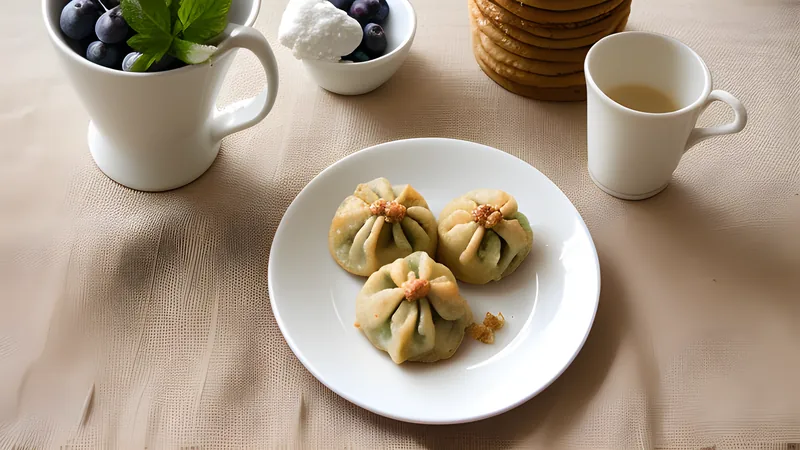
↓ Jump to recipeŠaltnosiukai means “little cold noses”, and once someone tells you that you cannot unsee it. Boil these dumplings and the blueberries inside burst and stain the dough purple in patches, most reliably right at the sealed nose of the half-moon. A bowl of them looks like a litter of something small and damp looking up at you.
They are one of the great Lithuanian summer dishes and a genuinely clever piece of cooking, for a reason that is easy to miss: the berries go in raw. There is no jam, no cooked compote, no reduction. You seal whole fresh fruit in a thin sheet of dough and boil it for five minutes, and the fruit cooks inside its own sealed pocket, in its own juice, in a package that lets none of it escape. Every dumpling is a little pressure vessel of hot blueberry.
Šaltnosiukai: Lithuanian Blueberry Dumplings
Ingredients
- 400 g plain flour, plus extra for dusting
- 0.5 tsp fine sea salt
- 1 large egg
- 180 ml warm water, at 40°C
- 1 tbsp sunflower oil
- 500 g fresh blueberries (or frozen, kept frozen)
- 60 g caster sugar, for the filling
- 2 tsp potato starch or cornflour
- 80 g unsalted butter
- 60 g coarse dry breadcrumbs
- 200 g soured cream, to serve
- 2 tbsp caster sugar, to serve
Method
- Whisk the flour and salt in a bowl. Beat the egg with the warm water and oil, pour in, and mix to a rough dough.
- Knead on an unfloured surface for 8-10 minutes until smooth and elastic. It will be firm and slightly resistant — that is correct. Wrap and rest at room temperature for 30 minutes.
- Toss the blueberries with the 60 g sugar and the potato starch in a bowl. Do this no more than 5 minutes before filling, or the sugar will draw out juice.
- Cut the dough in half and keep one half wrapped. Roll the other as thin as you can manage — 1.5-2 mm, thin enough to see the shadow of your hand through it. Cut out 8 cm rounds.
- Put 6-8 blueberries in the centre of each round. Fold into a half-moon and press the edges firmly together, working from the middle outward and pushing out all the air. Crimp the sealed edge between finger and thumb, or roll it over into a rope.
- Set the finished dumplings on a floured tray without touching each other. Repeat with the second half of the dough and any offcuts, re-rolled once.
- Bring a wide pan of water to a gentle boil and salt it lightly. Melt the butter in a frying pan over medium heat, add the breadcrumbs, and fry for 4-5 minutes until deep gold and nutty. Set aside.
- Boil the dumplings in batches of 8-10 — the pan must not be crowded. They will sink, then float after 2-3 minutes. Cook for a further 3 minutes after they float, so 5-6 minutes total.
- Lift out with a slotted spoon, draining well, and toss gently in the buttered crumbs.
- Serve immediately with soured cream and the remaining 2 tbsp sugar scattered over.
The forest, and the licence to pick it
The dish makes sense once you know the volume of blueberries involved.
Lithuania is roughly a third forest, most of it pine and spruce on sandy, acidic soil — which is exactly what Vaccinium myrtillus, the European bilberry, wants. The bilberry is the wild ancestor-adjacent cousin of the cultivated American blueberry, smaller, darker, and stained right through to the centre rather than green-fleshed. Lithuanians call them mėlynės and they carpet the forest floor in July and August.
Crucially, Lithuania has a right of public access to forests for picking berries and mushrooms, and it is exercised seriously. Berry picking is a family expedition with a scheduled date, a car boot full of buckets, and a competitive edge. People come home with kilos, and kilos of soft fruit that will not keep more than a few days force the question of what to do with them by Thursday. Some go into jam. Some are frozen. Some get sealed in dough and boiled.
The dumpling itself is Slavic and Baltic common property — Ukrainian varenyky, Polish pierogi, Lithuanian virtiniai, all of them thin unleavened dough folded round a filling and boiled. The Lithuanian summer contribution is the insistence on whole raw fruit and the cold-nose joke.
Why raw berries and not jam
Cooked fruit fillings leak. That is the practical answer.
Jam is already a syrup, and a syrup is a liquid; put it in a dumpling and it finds the smallest weakness in the seam, escapes into the water, and you are left with an empty pouch in a pan of purple broth. Raw berries are structurally intact. Their juice is inside their own skins until heat ruptures them, and by the time that happens — a couple of minutes into the boil — the dough has set into a barrier.
The flavour argument is better still. Cooking fruit twice flattens it. Blueberry aroma is carried by volatile esters and aldehydes that boil off readily, which is why jam tastes of “cooked fruit” as a category rather than of blueberry specifically. Five minutes of steaming inside a sealed pocket, where nothing evaporates away because nothing can get out, gives you fruit that still tastes like it did on the bush, just hot.
The potato starch is the small insurance policy. Two teaspoons tossed with the berries thickens the juice the instant it releases, converting a thin liquid into a light syrup that clings inside the dumpling and does not go looking for the exit.
The dough, and the two things that break it
This is a lean water dough — flour, egg, water, a spoon of oil — and it needs gluten, because gluten is the only thing holding the seam shut against hot fruit juice.
Knead it properly. Eight to ten minutes, and knead it on a dry surface with no extra flour. It starts stiff and shaggy and unpromising. It ends smooth, elastic and slightly springy. Underkneaded dough tears when you roll it thin and splits in the pan.
Rest it properly. Thirty minutes minimum. During the knead you have stretched the gluten network into tension, and a taut dough will fight the rolling pin and spring back every time you release it. Resting lets the protein bonds rearrange and the dough relax. Skip it and you will physically be unable to get to 2 mm.
The oil is there to keep the dough supple enough to roll thin without a lot of extra flour. The egg adds a little richness and, more usefully, protein structure.
Roll thinner than you think. Thin enough to see your hand as a shadow beneath it. Thick dumpling dough is the difference between a delicacy and a mouthful of boiled paste, and this is the single most common failure of home-made dumplings anywhere in Europe.
Sealing, honestly
The seal is where these go wrong, and there is no clever trick — only care.
Press out every trace of air. An air pocket expands in boiling water and pops the seam from the inside; this is basic gas law and it will find your weakest point every time. Fold the half-moon over the fruit and work your fingers from the centre of the curve outward, pushing air ahead of you.
Do not wet the edges. A water dough at this hydration is tacky enough to weld to itself, and added water makes the edge slippery and creates a lubricated layer that will not bond. If your dough has dried out on the tray and refuses to stick, you rolled too far ahead — work in smaller batches and keep the reserve wrapped.
Then crimp. Pinch a firm flute along the sealed edge, or roll the edge over on itself into a rope. Either doubles the thickness at the seam, which is exactly where you want it.
Six to eight berries per dumpling. Overfilling is the temptation and it is how you get a pan of purple water.
Bilberries versus blueberries
Worth being honest about this, because it changes the dish.
The Lithuanian original uses wild bilberries. They are small — a third the size of a supermarket blueberry — intensely purple all the way through, sharply acidic, and they release a lot of juice. They stain your fingers for two days. That staining pigment is anthocyanin, and the bilberry carries several times as much of it as the cultivated blueberry, concentrated in the flesh rather than just the skin.
Cultivated blueberries, which is what most of us will use, are larger, sweeter, milder and green inside. They give a good dumpling. They give a paler one, because the juice that leaks out of a blueberry is a light violet rather than an ink, and the cold-nose effect is subtle instead of comic.
If you can get wild bilberries — frozen ones turn up in Polish and Baltic shops, sold as jagody or mellene — use them, cut the filling sugar to 40 g, and be prepared for the mess. If you are using cultivated blueberries, a teaspoon of lemon juice tossed in with the sugar restores some of the acidity that the wild berry brings for free.
Rolling thin without losing your temper
Two rounds of dough, rolled one at a time, second half wrapped. This is not fussiness — exposed dough dries within ten minutes and dry dough will not seal.
Roll from the centre outward, turning the sheet a quarter turn every few strokes so it thins evenly. If it fights back and shrinks, walk away for five minutes and let the gluten relax; forcing it produces a sheet that is thin where you pushed and thick everywhere else.
Use as little dusting flour as you can. Excess flour on the surface is loose powder between two dough faces, and it will stop the seam bonding as effectively as water would. A dry, clean worktop and a well-kneaded dough need almost none.
Re-roll the offcuts once and once only. The second re-roll has absorbed too much dusting flour and been worked too hard, and those dumplings will be tough.
Cooking, tips and variations
Boil gently and in small batches. A rolling boil batters the dumplings against each other and against the pan, and a crowded pan drops the water temperature, so they sit around getting soggy before they cook. Eight to ten at a time in a wide pan.
They float after two to three minutes as the trapped air and steam inside expand. Floating means the dough is nearly cooked; give it three more minutes so the berries burst and the starch thickens.
Frozen berries work well and are better than out-of-season fresh. Use them straight from the freezer, toss with the sugar and starch while still frozen, and add a minute to the boil. Frozen berries actually seal more easily because they are hard.
Serving. Soured cream and sugar is the standard, and the acidity of the cream against hot sweet fruit is the whole balance. Browned buttered breadcrumbs are my addition, borrowed from the way Lithuanians finish cepelinai and virtiniai, and they give the crunch the dish otherwise lacks entirely. Some households use melted butter alone. Some pour over cold single cream.
Other fruit. Cherries — stoned, and this is what Ukrainians do — are excellent. Blackcurrants need more sugar. Strawberries collapse to nothing and are a waste of good strawberries.
Numbers. Five hundred grams of berries and 400 g of flour makes about 32 dumplings, which is eight each for four people. That is a dessert portion. Lithuanians eat them as a main course in summer, sixteen or more per person, with nothing before and nothing after, and having tried it that way I can report it is a fine way to spend an August evening.
Make-ahead. Freeze them raw on a tray, then bag them, and boil from frozen with three extra minutes. Do not refrigerate them raw: the fruit juices soften the dough overnight and you will have a tray of purple sludge.
If you like this shape of thing, the same dough logic drives potato and cheese pierogi and Ukrainian varenyky, which does the cherry version properly. For the savoury Lithuanian heavyweight, cepelinai is the other dish the country would defend in a fight.
Related Content