Šaltibarščiai: Lithuania's Neon Summer Soup
The cold beetroot-and-kefir soup that turns Lithuania pink every June
Contents
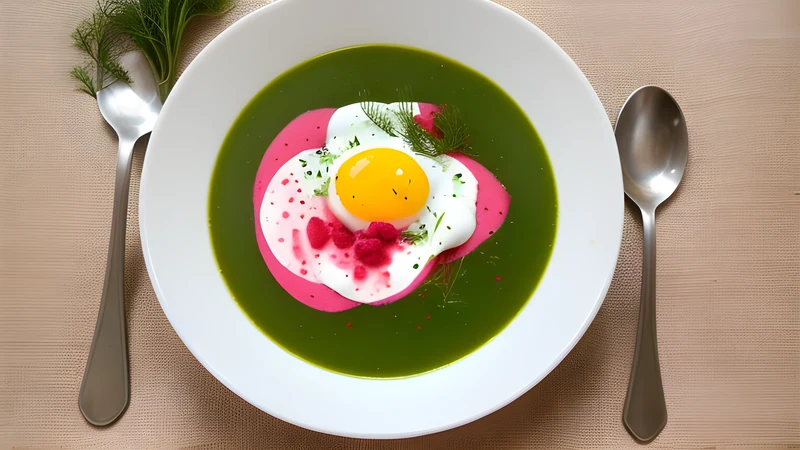
↓ Jump to recipeThe first time you see šaltibarščiai you assume something has gone wrong. No natural food is this pink. It glows. It looks like a photograph that has been pushed too far in editing, or a novelty drink aimed at children. Then you taste it — sour, cold, faintly sweet, laced with dill — and you understand why Lithuania builds an entire summer around it, right down to a national holiday in its honour.
Šaltibarščiai: Lithuania's Neon Summer Soup
Ingredients
- 500g cooked beetroot (boiled or roasted whole, then peeled), or 2 x 250g vacuum-packed
- 1 litre kefir, well chilled
- 200ml soured cream (grietinė)
- 1 large cucumber (about 300g)
- 5 spring onions
- 1 large handful fresh dill (about 20g)
- 3 eggs, hard-boiled
- 1 tsp fine salt, plus more to taste
- ½ tsp caster sugar
- 1 tbsp lemon juice, or to taste
- 600g waxy potatoes, to serve
- A little cold water or sparkling water, to loosen
Method
- Coarsely grate the cooked, peeled beetroot into a large bowl, or dice it into 5mm cubes if you prefer more texture.
- Pour in the chilled kefir and whisk in the soured cream until the soup is uniformly bright pink.
- Deseed and dice the cucumber into 5mm cubes. Slice the spring onions thinly, using the green tops too. Chop the dill finely, stems included.
- Peel and dice 2 of the hard-boiled eggs. Halve the third egg for garnish.
- Stir the cucumber, spring onion, dill and diced egg into the soup with the salt, sugar and lemon juice.
- Loosen to a pourable consistency with a splash of cold water if needed, then cover and chill for at least 2 hours.
- Meanwhile, boil the potatoes whole in salted water for 20–25 minutes until tender, then drain and keep warm.
- Taste the cold soup and adjust salt and lemon. Ladle into bowls, top each with a halved egg and extra dill, and serve with the hot potatoes on the side.
A soup with its own festival
Lithuanians take this soup seriously enough to celebrate it. Every June the country marks a šaltibarščiai day; the capital, Vilnius, has staged mass gatherings where thousands turn out dressed in pink to eat it together in the streets, part food festival and part civic in-joke, and the soup has become a genuine emblem of national summer identity. That is a lot of weight for a bowl of cold beetroot and soured milk, and it tells you how deep the dish runs. It appears on restaurant menus and home tables alike from the first warm week of spring until the last of the autumn heat, and asking a Lithuanian how their family makes it is a reliable way to start a long and passionate conversation.
The name means “cold borscht,” and šaltibarščiai belongs to the same broad family of cold soured-milk soups that spread across the old Polish-Lithuanian Commonwealth and the lands around it. Its close Polish relative, the cold pink chłodnik, is built on the same principle of beetroot suspended in cultured dairy. The Lithuanian version distinguishes itself two ways: it leans almost entirely on kefir for its liquid, which gives it that particular effervescent tang, and it is nearly always served with a plate of hot boiled potatoes on the side rather than bread.
That hot-and-cold pairing is the signature move. You eat a forkful of steaming, buttery potato, then a spoonful of icy sour soup, and the contrast wakes up your whole mouth. It is deeply satisfying in a way that is hard to explain until you have done it on a hot day. It is also, quietly, a very good thing to eat when it is too hot to cook: a bowl of protein from the egg and the cultured milk, a pile of vegetables, all of it prepared cold, with only the potatoes needing the stove.
Why kefir is the whole point
Kefir is a fermented milk drink, thinner and tangier than yoghurt, cultured with a symbiotic community of bacteria and yeasts. Those yeasts give it a very slight fizz and a sourness that is sharper and more complex than plain soured cream. In šaltibarščiai the kefir supplies the body, the acidity and the character of the soup all at once, so it earns its place as the headline ingredient rather than a supporting one. Buy the best you can, keep it fridge-cold, and taste it first — a good, lively kefir makes the dish, and a dull, over-sweetened one will drag it down no matter what you add.
The soured cream (grietinė in Lithuanian) rounds off the kefir’s edge and adds richness. Whisk them together with grated cooked beetroot and the colour arrives instantly: a pink so vivid it seems lit from within. If your soup comes out a muddy maroon rather than fluorescent pink, your beetroot was overcooked or your kefir-to-beetroot ratio is too heavy on the beet. Keep the beetroot generous but not dominant, and the pink stays electric. Some cooks add a splash of the beet’s cooking liquid, or a little brine from pickled beetroot, to intensify both the colour and the sour edge, which is a good trick if your beets are on the pale side.
A soup with deep roots
Cold soured-milk soups are old across this part of Europe, older than the modern borders that now divide them. Cookbooks of the Grand Duchy of Lithuania and the wider Commonwealth describe chilled beetroot and sorrel soups thickened with cultured dairy, eaten by nobility and peasantry alike through the short, intense northern summer. The beetroot itself was a relative latecomer, spreading as a field crop only over the last few centuries, but it fitted the template perfectly: cheap, storable, richly coloured and sweet enough to balance the sourness of fermented milk. What we now call šaltibarščiai is the Lithuanian settling of that long tradition into a fixed, beloved form.
The dish also makes complete sense of its climate. Lithuanian summers are brief and can be surprisingly hot, and before refrigeration a soup that needed no long cooking, kept well in a cold cellar, and cooled the body as you ate it was a genuinely clever piece of domestic engineering. The kefir supplied protein and probiotics, the beetroot and cucumber supplied vegetables, and the whole thing could be assembled in the cool of the morning and eaten at the hottest hour of the day. That practicality is why it survived, and why it is one of the few traditional dishes that a modern Lithuanian summer would feel incomplete without.
Cooked beetroot, and how to prepare it
The one job that needs the hob is cooking the beetroot, and you have two good options. Boiling whole unpeeled beets in salted water takes 40 to 50 minutes for medium roots and keeps them juicy. Roasting them wrapped in foil at 200°C concentrates their sweetness over about an hour. Either way, cook them whole and unpeeled so they do not bleed away their colour and flavour into the water, then slip off the skins under a running tap once cool. Wear gloves or accept pink fingers for the rest of the day; beetroot stains everything it touches, which is part of the fun and part of the mess.
For a genuinely quick soup, vacuum-packed cooked beetroot (the plain kind, not the vinegared sort) works perfectly well and is what many Lithuanian households now use on a weeknight. Avoid pickled beetroot in sharp vinegar, which throws the balance off. Raw grated beetroot has its champions too, giving a fresher, earthier soup with more bite, though it needs a longer sit in the kefir to soften and mellow.
Grate the beetroot coarsely for a smoother soup, or dice it small if you like more to chew. I usually grate, because I want the beetroot to melt into the kefir and the crunch to come from cucumber and radish instead.
Building the bowl
Once your pink base is whisked and glowing, everything else is cold prep. Deseed and finely dice a cucumber for crunch and freshness. Slice spring onions thinly, greens and all. Chop a big handful of dill — this is a dill-forward soup and you should be generous, because dill and beetroot are one of the great pairings and the soup tastes thin without it. Hard-boil the eggs, dice a couple into the soup and save halves for the top.
Season carefully, and season cold. Beetroot brings sweetness, kefir brings sour, and the soup needs salt and a squeeze of lemon to pull it into focus. Because chilling mutes flavour, a soup that tastes perfect at room temperature will taste flat straight from the fridge, so season it after it has been cold for a while. The teaspoon of sugar is there to support the beetroot’s own sweetness and balance the tang; you should not be able to taste it as sweetness on its own.
Then chill it hard. Two hours minimum; the soup is meant to be genuinely cold, almost aching, on a hot day. Some cooks drop an ice cube into each bowl at the table to keep it that way, and on the hottest afternoons a handful of crushed ice stirred through just before serving is entirely in keeping.
Getting it right, and fixing it when it goes wrong
It is too thick. Kefir varies in consistency. Loosen with a splash of cold water or, for a little lift, chilled sparkling water, until it pours easily from the ladle.
It tastes dull. Under-seasoned, almost always. Add salt and lemon in small increments until it comes alive. The sourness and the salt should both be present; a bland šaltibarščiai is usually short on both.
The colour is disappointing. Use more beetroot relative to kefir, and make sure it is fully cooked and tender. Well-cooked beetroot releases far more pigment than under-done, and a spoonful of beet brine pushes it back to neon.
Make it your own. Some families add finely diced radish for extra bite, a grating of cucumber for body, or a little chopped fresh chive. Keep the trinity of beetroot, kefir and dill intact and the rest is yours.
Storage. It keeps two days in the fridge, though the cucumber softens and the colour deepens. Stir well before serving. Do not freeze — the kefir splits on thawing.
The potatoes are the other half of the dish
Do not skip the hot boiled potatoes, and do not put them in the soup. They are served alongside, steaming, tossed in a little butter and dill, so you can alternate hot potato and cold soup. Waxy potatoes hold their shape best. This is the part that turns a refreshing bowl into an actual lunch, and it is the detail that most sets the Lithuanian version apart from its neighbours: the interplay of temperatures is the whole experience, and eating the soup on its own, however good, only tells you half the story.
Šaltibarščiai sits happily next to other soured-dairy dishes of the region — the crisp Belarusian potato pancakes draniki with their spoonful of soured cream come from the same flavour world, as do the hearty potato-zeppelin cepelinai if you want to build a full Baltic table. But šaltibarščiai needs no help to justify itself. Make it the day before, chill it until it hurts, boil the potatoes fresh, and serve the most improbable, most refreshing pink thing you will eat all summer.
Related Content