Salteñas: Bolivia's Soup in a Pastry
A juicy, gelatine-set stew baked inside a sweet, saffron-coloured dough
Contents
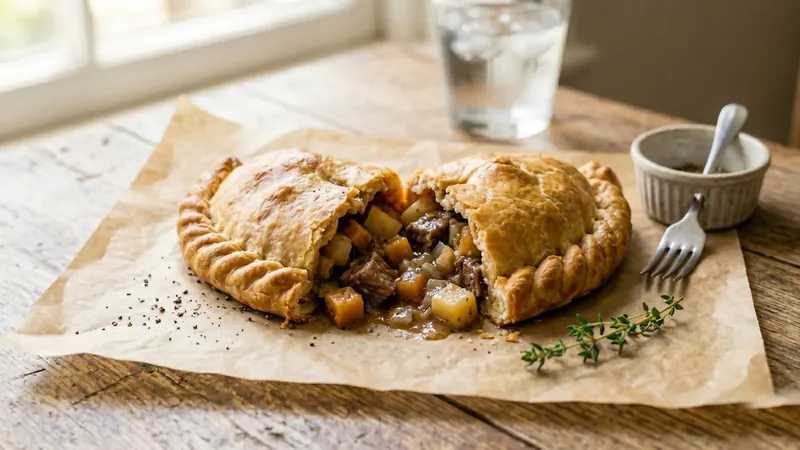
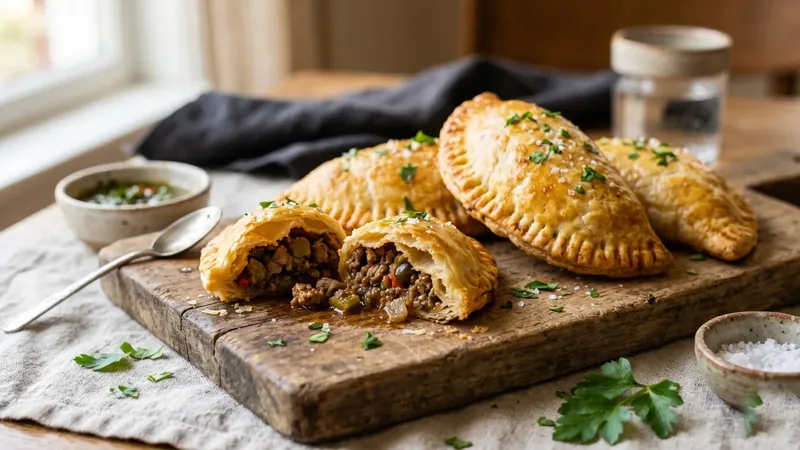
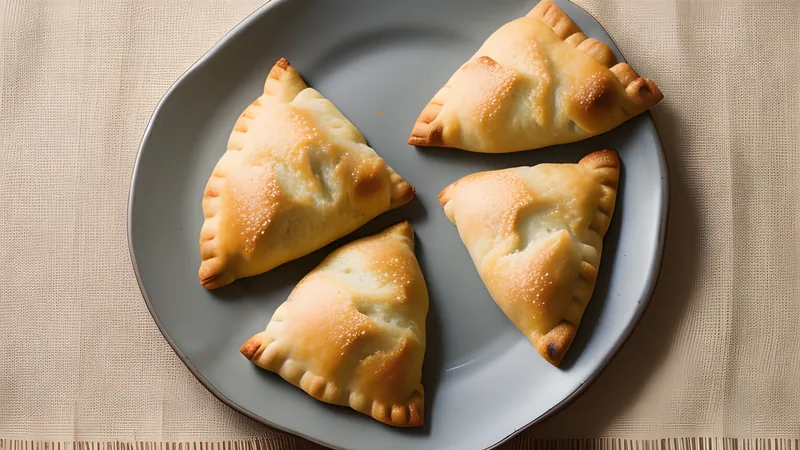
↓ Jump to recipeA salteña looks like a small, plump empanada until you bite into it and juice runs down your wrist, because what’s sealed inside is an actual stew, thickened with gelatine so it sets solid in the fridge and turns back to liquid the moment it hits the oven’s heat. The dough itself carries a faint sweetness and an achiote-gold colour that marks it apart from its Argentinian cousin, and eating one properly, tipped back to keep the juice from escaping, is a specific skill every Bolivian learns as a child.
Salteñas: Bolivia's Soup in a Pastry
Ingredients
- 500g plain flour, plus extra for dusting
- 1 tbsp caster sugar
- 1 tsp salt
- 1 tbsp achiote (annatto) oil, or 2 tsp sweet paprika mixed into 1 tbsp oil
- 150g cold lard or unsalted butter, diced
- 180ml warm water
- 2 gelatine leaves, or 1 tsp powdered gelatine
- 500ml beef stock
- 2 tbsp vegetable oil
- 1 onion, finely diced
- 3 garlic cloves, crushed
- 500g beef chuck, cut into 1cm cubes
- 1 tbsp ají amarillo paste
- 1 tsp ground cumin
- 2 potatoes, peeled and cut into 1cm cubes
- 100g fresh or frozen peas
- 2 hard-boiled eggs, chopped
- 1 tbsp chopped fresh parsley
- 1 egg, beaten, to glaze
- Salt and black pepper
Method
- Soak the gelatine leaves in cold water for 5 minutes until soft (or sprinkle powdered gelatine over 2 tbsp cold water and leave to bloom).
- Mix the flour, sugar and salt in a large bowl. Rub in the lard and achiote oil until the mixture resembles coarse breadcrumbs.
- Add the warm water gradually, bringing the dough together into a smooth ball. Wrap and rest at room temperature for 30 minutes.
- Heat the vegetable oil in a pan and soften the onion for 5 minutes.
- Add the garlic, ají amarillo paste and cumin, and cook for 1 minute.
- Add the beef and brown well on all sides, about 6-8 minutes.
- Pour in the beef stock, bring to a simmer, and cook for 20 minutes until the beef is tender and the liquid has reduced by half.
- Stir the soaked gelatine into the hot stew until fully dissolved.
- Add the potatoes and peas, and cook for a further 8 minutes until the potato is just tender.
- Season well, stir in the hard-boiled egg and parsley, then spread the filling on a tray and chill in the fridge for at least 4 hours, or overnight, until firmly set and jelly-like.
- Divide the dough into 10 pieces and roll each into a circle about 15cm across.
- Spoon a generous portion of the cold, set filling onto one half of each circle, leaving a border.
- Fold the dough over into a half-moon and seal firmly, then crimp the edge into a tight rope pattern by pleating and folding the border over itself.
- Arrange on a lined baking tray, brush with beaten egg, and bake at 220C (200C fan) for 20-25 minutes until deep golden.
- Cool for 10 minutes before eating; the filling stays scalding hot far longer than the pastry suggests.
The story
Salteñas take their name, most Bolivians will tell you, from Salta in northern Argentina, the supposed home of a woman named Juana Manuela Gorriti, a 19th-century writer exiled to Bolivia, who is said to have sold these pastries to support herself and given them the name of her home province. The story has the neat shape of legend more than documented history, but it sticks because it captures something true about the dish: it arrived from outside and was thoroughly remade into something distinctly Bolivian, sweeter in the dough and juicier in the filling than the empanadas found elsewhere in the region.
The defining feature, the liquid stew set with gelatine, is what separates a salteña from every other hand pie in Latin America and is also what makes it a genuinely tricky thing to bake well. Get the ratio of stock to gelatine wrong and the filling either leaks through the pastry seams in the oven, ruining the tray, or sets too firm and never turns properly juicy when reheated by the oven’s heat. Street vendors and dedicated salteña shops, salteñerías, have generations of practice behind their version; home cooks rebuilding the dish need to trust the chilling time and resist the urge to fill the pastries before the stew has properly set.
Salteñas are eaten mid-morning across Bolivia, between about ten and noon, rarely later, and the ritual of eating one is almost as well known as the pastry itself: hold it upright in one hand, bite a small opening in the top corner, and sip the juice before eating the rest, because biting straight through the middle sends hot stew down your front. Cities across Bolivia claim regional differences, La Paz favouring a spicier filling, Cochabamba a sweeter dough, and the debate over whose salteña is the true version runs about as deep as any regional food argument in the country.
Why the gelatine step actually matters
The stew needs to be genuinely liquid when it goes into the pot and genuinely solid, almost like a firm jelly, by the time it’s spooned into the pastry. This is the entire trick of the salteña, and skipping the gelatine, or scrimping on the chilling time, is the single most common reason a homemade batch turns out to be a fairly ordinary empanada rather than the real thing. Two gelatine leaves per 500ml of stock gives a set firm enough to hold its shape at room temperature for the twenty minutes it takes to fill and shape the pastries, while still turning back to a rich, spoonable gravy once baked.
Chill the filling flat on a tray rather than in a deep bowl, since a thin, even layer sets in four hours where a deep pile might still be soft in the centre after the same time. If you’re short on patience, an overnight chill is the safer bet and makes the whole process considerably less fiddly, since a fully set filling is far easier to portion neatly onto the dough without it sliding around or oozing over the edge before you’ve even started folding.
Sealing without a leak
A salteña that leaks in the oven is a lost cause, so the seal deserves real attention. Leave a wider border of bare dough than you think you need, at least 2cm, and press the two edges together firmly with your fingers before you start the rope crimp, squeezing out any trapped air as you go. The traditional repulgue crimp, folding small pleats of dough over themselves along the seam, does more than look attractive: each fold reinforces the seal at a slightly different angle, so a stray gap in one section doesn’t run the length of the pastry.
Keep your work surface and the filling cold throughout assembly, working quickly so the dough doesn’t warm and turn soft in your hands, since a softened dough is much more likely to tear at the seam under the weight of the filling. If a batch does spring a small leak in the oven regardless, don’t panic; a little escaped juice caramelises on the tray and doesn’t ruin the pastries, though it’s worth checking the seal on the next batch a little more carefully. This same discipline around cold fillings and firm sealing runs through beef empanadas, a good companion bake if you want a spread of hand pies with different fillings on the same table, and the sweeter, saffron-tinted dough here shares its Andean roots with pique macho, Bolivia’s other great handheld export.
The colour and sweetness of the dough
The achiote-tinted, faintly sweet dough is as much a signature of the salteña as the liquid filling, and it’s easy to underestimate how much it changes the eating experience. A tablespoon of sugar in the dough sounds like very little against 500g of flour, but it’s enough to caramelise slightly at the crimped edges during baking, giving the crust a faint toffee note that plays against the savoury, cumin-warmed filling inside. Skip the sugar and the pastry reads as a fairly plain empanada shell; include it and the contrast becomes part of the point.
Achiote oil does double duty, colouring the dough a warm gold and adding a faint earthiness that echoes the colour and flavour running through the filling itself, since the same achiote or paprika base often seasons the beef stew too. If you’re making your own achiote oil rather than buying it ready-made, warm annatto seeds gently in oil until the colour releases, then strain before it goes into the dough; seeds left in the mixture turn gritty once baked and are worth the extra few minutes to filter out properly.
Serving and the etiquette of eating one
A salteña is designed to be eaten standing at a counter, not seated at a table with cutlery, and the shape and crimp exist specifically to make that possible. Hold it in a napkin, tip it slightly with the crimped seam uppermost, and bite a small corner near the top rather than diving in through the centre; this gives the juice somewhere controlled to escape rather than spilling everywhere at once. Bolivians sip the liquid first through the opening, sometimes adding a dash of llajwa, a fiery tomato and locoto chilli salsa, directly into the hole before finishing the rest by hand.
Serve them warm rather than piping hot, since the filling holds heat for a surprisingly long time after baking and a fresh-from-the-oven salteña can genuinely scald an unsuspecting mouth. Ten minutes of resting on a rack is usually enough to bring the filling down to a safe, still-warm temperature without losing the appeal of a pastry eaten shortly after baking, which is really the whole point of the dish.
Substitutions, storage and make-ahead
Lard gives the most authentic texture and flavour, closest to what a Bolivian salteñería would use, but butter works well if that’s what you have and produces a slightly flakier result. Ají amarillo paste can be swapped for a mild chilli paste with a pinch of turmeric for colour if you can’t source it, though the flavour will lean a little less fruity. A vegetarian filling, built from mushrooms, potato and peas in the same gelatine-set stock, is a legitimate variation you’ll find in some salteñerías rather than a modern substitution.
The unbaked, filled pastries freeze extremely well, which makes them one of the most practical make-ahead recipes in this whole repertoire: freeze on a tray until solid, then bag them up, and bake straight from frozen at the same temperature, adding around 8-10 minutes to the time. Baked salteñas are best eaten the same day, since the pastry softens once the filling’s steam has nowhere to escape in storage, but they’ll keep a day in the fridge and reheat reasonably in a hot oven, even if the truly juicy centre never quite returns to its first-bake glory.
Related Content