Salmorejo Cordobés: Córdoba's Thicker Answer to Gazpacho
Four ingredients, an emulsion, and bread toasted before it soaks
Contents
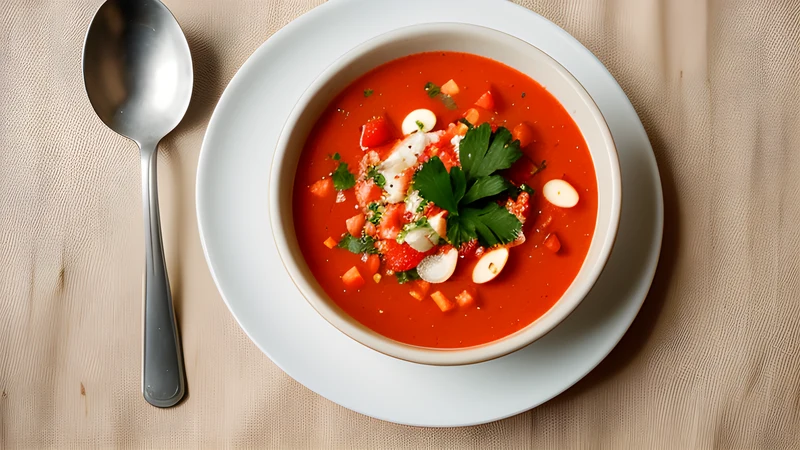
↓ Jump to recipeSalmorejo is a cold tomato cream from Córdoba and it is a different dish from gazpacho, despite a century of menus insisting otherwise. There is no cucumber in it, no green pepper, no onion. There is no vinegar in the blender if the tomatoes are any good. It is thicker — properly made, it coats the back of a spoon and holds a ridge — and it is a coral-orange colour rather than red.
The colour is the tell. Gazpacho is red because it is a suspension of vegetables in water. Salmorejo is orange because it is an emulsion: 150ml of olive oil broken into droplets small enough to scatter light, held there by the starch and pectin from bread and tomato. The pale orange is the physical evidence that you did it right, and if your salmorejo comes out red, the oil never went in properly.
Salmorejo Cordobés: Córdoba's Thicker Answer to Gazpacho
Ingredients
- 1kg very ripe tomatoes (ideally pera or plum), at room temperature
- 200g stale white bread with a firm, open crumb, crusts removed (telera, ciabatta or a country sourdough)
- 150ml Spanish extra virgin olive oil, mild and fruity
- 1 small garlic clove, peeled and green germ removed
- 1½ tsp fine salt
- 1 tsp sherry vinegar, only if the tomatoes need it
- 2 hard-boiled eggs, peeled and chopped
- 60g jamón serrano or ibérico, torn into small pieces
- 1 tbsp Spanish extra virgin olive oil, to finish
Method
- Tear the bread into rough 3cm pieces. Spread them on a baking tray and toast at 180°C (fan 160°C) for 5 minutes, until the surfaces are dry and pale gold with no colour at the edges. Cool completely.
- Quarter the tomatoes. Do not peel or deseed them. Put them in a blender and blitz on high for 90 seconds until completely smooth.
- Pass the tomato purée through a fine sieve into a bowl, pushing it through with the back of a ladle. Discard the skins and seeds left behind. You should have about 800ml.
- Return the sieved purée to the blender. Add the toasted bread and the garlic. Leave to stand for 10 minutes so the bread hydrates fully.
- Blend on high for 2 minutes until completely smooth and slightly aerated. Add 1½ tsp fine salt and blend for 10 seconds more.
- With the blender running on a medium speed, pour the 150ml of olive oil in a slow, steady thread through the hole in the lid. Take a full 60 seconds to add it all.
- The salmorejo will pale from red to a coral orange and thicken visibly as the oil emulsifies. Stop as soon as the oil is in — over-blending past this point can split it.
- Taste. It should be thick enough to coat a spoon and hold a faint ridge. Add the sherry vinegar only if the tomatoes taste flat, and more salt if needed.
- Chill for at least 2 hours, and up to 24. It thickens further in the fridge.
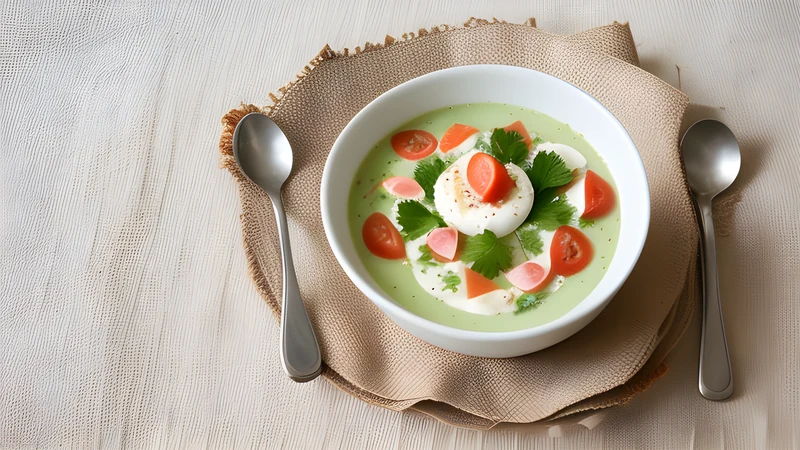
- Serve in shallow bowls, topped with chopped hard-boiled egg, torn jamón and a swirl of olive oil.
Córdoba, the Romans, and a soup that predates the tomato
Andalusia’s family of cold breadcrumb soups is old, and the tomato is the newcomer.
The ancestor is a Roman thing — bread, olive oil, garlic, vinegar and water, pounded in a mortar, a labourer’s food that turns stale bread and a bad ration into lunch. Ajoblanco, still made in Málaga with almonds and grapes, is essentially that dish with nuts in it and no tomato at all, and it is what Andalusians ate before 1492. The Spanish word salmorejo comes from salmuera, brine, which tells you the preservation logic underneath.
The tomato arrived from the Americas in the sixteenth century and Spain treated it with deep suspicion for roughly two hundred years — it was grown as an ornamental, considered poisonous, and did not get into Andalusian kitchens in any quantity until the eighteenth century. Salmorejo as we know it is therefore a modern dish wearing a Roman name, and the version with the emulsion technique and the mandatory garnish only really settles in the twentieth century.
Córdoba takes it seriously enough to have written it down. In 2015 a group of researchers at the University of Córdoba, working with the city’s cooks, published a formal reference recipe for salmorejo cordobés: 1kg tomato, 200g bread, 100g olive oil, 1g garlic, 10g salt. It is one of the few dishes anywhere with a peer-reviewed baseline. My ratios are close to theirs, with more oil, because the university was optimising for reproducibility and I am optimising for how it tastes.
The tomatoes, and the sieve
A kilo of tomatoes carries this dish and there is nowhere for a bad one to hide. Buy them ripe to the point of being slightly alarming — soft at the shoulders, heavy, smelling of tomato at the stalk end. Pera or plum varieties have denser flesh and less water than a round salad tomato, which means more flavour per kilo and a thicker result. Vine-ripened tomatoes in midsummer make salmorejo you will remember; February greenhouse tomatoes make a pink, sweetish disappointment that no amount of technique fixes.
Have them at room temperature. A fridge-cold tomato has its aromatic compounds shut down, and chilling below about 12°C permanently damages them — a tomato that has spent three days in a fridge will never taste of much again, no matter how long you leave it on the counter afterwards.
Do not peel them and do not deseed them. This surprises people who have read the older Spanish recipes, which call for blanching and skinning. Blitz the tomatoes whole and sieve the purée afterwards instead: the blender extracts far more from the skins than blanching leaves behind, and the skins carry a good deal of the colour and a fair share of the flavour. You get the extraction and then you take the fibre out.
The sieve is the step that produces restaurant texture at home. Blitz the tomatoes for ninety seconds on high, then push the purée through a fine sieve with the back of a ladle — it takes about three minutes of steady work and leaves you with a tablespoon of pale seeds and skin fragments to throw away. What comes through is silk.
Skipping it gives you a soup with a faint grain that you will notice on the third spoonful and then be unable to stop noticing. Tomato seeds also carry a distinct bitterness that concentrates once the mixture is blended hard, and it comes forward as the soup sits in the fridge. Three minutes with a sieve is the best return on effort in the whole recipe.
The bread does everything
Two hundred grams of bread to a kilo of tomatoes sounds like a great deal and it is the whole architecture.
The bread is there as an emulsifier and a thickener. Wheat starch granules, hydrated and blitzed, form a colloid that suspends oil droplets and stops them coalescing — the same mechanism that lets a panade hold a meatball together and lets panzanella turn stale bread into the point of the salad. Without it you have tomato juice with oil floating on top.
Use stale bread with a firm, open crumb. Fresh bread is gluey. Soft supermarket sliced white has too little structure and too much sugar, and it makes a salmorejo that tastes faintly of nothing and has the texture of wallpaper paste. A day-old ciabatta, a country sourdough, or the Cordoban telera if you are lucky enough to be in Córdoba. Cut the crusts off; they colour the soup grey and never fully break down.
Let the bread sit in the tomato purée for ten full minutes before blending. Dry starch does not emulsify. Hydrated starch does. That ten minutes is free and it is the difference between a smooth soup and a grainy one.
Toasting the bread first
Here is my departure from Córdoba, and it is a small one that I would defend in an argument.
I spread the torn bread on a tray and dry it in a 180°C oven for five minutes before it goes anywhere near the tomato. Pale gold, no colour at the edges.
Salmorejo is four ingredients and three of them are raw. It is fresh, sharp and clean, and it can also come out slightly flat and one-note, particularly late in the tomato season when the fruit has more water than flavour. Five minutes of dry heat starts the Maillard reaction on the crumb surface and lays down a faint toasted, nutty note underneath the tomato — you will not taste bread, you will taste a floor beneath the acidity that was not there before.
It also improves the emulsion. Drier bread absorbs more purée and swells further, which means more hydrated starch in the blender and a thicker, more stable result. The one rule is to stop at pale gold and to cool it completely. Browned bread makes a beige, bitter salmorejo, and warm bread starts cooking the tomato purée the moment it hits it, which flattens the fresh note you were trying to preserve.
The oil goes in like a mayonnaise
This is the step that separates salmorejo from tomato soup with oil in it.
Blend the tomato, bread and garlic to complete smoothness first. Then, with the machine running at medium speed, pour the 150ml of olive oil in a thin, steady thread through the hole in the lid, and take a full minute over it. Dumping it in all at once gives the starch no chance to coat the droplets and you get a slick on the surface.
Watch the colour. Somewhere around the halfway mark the soup shifts from tomato red to a pale coral and visibly thickens — that is the emulsion forming, and it is one of the more satisfying things to watch in a kitchen.
Then stop. Over-blending after the oil is in warms the mixture through friction, and a warm emulsion is a fragile one; blitz it for another two minutes and you can watch it break and weep oil. Traditionalists insist on a mortar or an old-fashioned metal-jug blender for the same reason — modern high-speed machines heat the contents fast.
Use a mild, ripe oil. A fierce Picual has a peppery bitterness that a hot blender amplifies into something genuinely unpleasant; the polyphenols responsible get more aggressive under shear. Save the good Picual for the swirl on top, where you actually taste it.
The garnish, the fixes and the rest of it
The topping is fixed: chopped hard-boiled egg and torn jamón, with a swirl of oil. Both are there for fat and salt against the acid, and both give texture to a bowl that is otherwise entirely smooth. It is the same instinct that puts crisp garlic on top of anything soft. A version without jamón wants an extra half teaspoon of salt and a scatter of toasted almonds.
Thin, watery salmorejo. Not enough bread, or watery tomatoes. Blitz in another 30g of toasted bread and give it ten minutes.
Red rather than orange. The oil went in too fast. Pour the lot back into the blender and start the thread again slowly.
Split, with oil weeping out. Over-blended or too warm. Chill it hard for an hour, then blend 100ml of the split soup with a fresh 20g of soaked bread and dribble the rest back in.
Harsh, hot garlic. One small clove for a kilo of tomatoes, germ removed. Raw garlic gets stronger as the soup sits, and a salmorejo that was pleasant at lunchtime can be aggressive by supper. Under-garlic it deliberately.
Grainy. Sieve the tomato purée before the bread goes in — skins and seeds never fully break down, and the seeds are bitter.
Salmorejo keeps for three days in the fridge and is arguably best on day two, once the garlic has settled and the emulsion has firmed. It does not freeze; the emulsion breaks and there is no recovering it.
Serve it very cold in shallow bowls, as a starter or a summer lunch with bread. It sits well next to migas with tortilla, egg and chorizo or a plate of romesco, which shares its logic — bread, oil, and something red, emulsified into more than the sum of them.
Related Content