Sai Ua: Chiang Mai's Herb-Packed Sausage
A coiled grilled sausage stuffed with more lemongrass and kaffir lime than meat
Contents
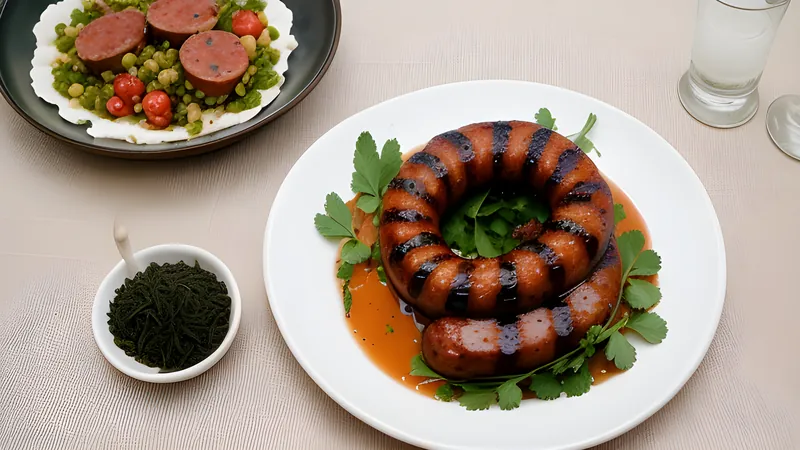
↓ Jump to recipeWalk through Chiang Mai’s Warorot Market in the early evening and you’ll see coils of sai ua stacked on charcoal grills like snail shells, hissing gently as fat renders through the casing. Vendors slice it to order into thick rounds, the cut face flecked green and yellow from the herbs packed inside, and hand it over with a twist of sticky rice and a few slivers of raw cabbage to cut the heat. It’s northern Thailand’s answer to the question of what a sausage can be when the filling matters more than the meat.
Sai Ua: Chiang Mai's Herb-Packed Sausage
Ingredients
- 600g pork shoulder, fat and lean, roughly chopped
- 150g pork back fat, chopped (or extra fatty shoulder)
- 4 stalks lemongrass, tough outer leaves removed, finely sliced
- 8 kaffir lime leaves, very finely shredded (stem removed)
- 6 red shallots, roughly chopped
- 6 garlic cloves
- 4 dried long red chillies, soaked in warm water and drained
- 3 fresh green bird's eye chillies (optional, to taste)
- 1 tbsp galangal, finely chopped
- 1 tsp ground turmeric
- 2 tbsp fish sauce
- 1 tsp salt
- 1 tsp shrimp paste (kapi)
- 1 hog casing (about 1.5m), rinsed and soaked, or a sausage-maker's casing of choice
- vegetable oil, for the grill grate
Method
- Pound the lemongrass, shallots, garlic, dried chillies, galangal and shrimp paste into a rough, wet paste using a mortar and pestle or a food processor pulsed in short bursts.
- Pulse the pork shoulder and back fat with the paste until combined but still coarse-textured, not a smooth emulsion.
- Fold in the kaffir lime leaves, turmeric, fresh chillies if using, fish sauce and salt by hand until evenly distributed.
- Fry a small spoonful of the mixture to taste for seasoning, and adjust fish sauce or chilli before stuffing.
- Fit a sausage funnel or wide piping bag with the casing, and stuff the mixture in firmly, working out any air pockets as you go.
- Twist or tie the filled casing into a coil, securing the ends, and prick the sausage all over with a fine skewer.
- Grill over medium charcoal heat, turning frequently, for 20-25 minutes until the casing is deeply browned and crackling and the filling is cooked through.
- Rest for 5 minutes before slicing into rounds and serving with sticky rice, raw cabbage and fresh chillies.
A sausage built from a curry paste
Most Western sausages are built around fat ratios and a light seasoning of herbs, salt and maybe fennel. Sai ua inverts that logic entirely. The base is a wet curry paste — lemongrass, galangal, shallot, garlic, dried chilli, shrimp paste — pounded first and then worked through the meat almost as a marinade that happens to be solid. The pork itself is nearly a vehicle for carrying the paste’s flavour and providing enough fat to keep the sausage from drying out over the grill. Northern Thai cooks will tell you the test of a good sai ua isn’t how meaty it tastes, but how much lemongrass and kaffir lime you can smell before you’ve even bitten into it.
This puts sai ua closer in spirit to a larb than to a European charcuterie sausage — both are pork dishes where a pounded aromatic base does most of the talking, and both come from Lanna, the old northern Thai kingdom centred on Chiang Mai, whose cuisine draws more on Shan and Burmese influence than the coconut-and-sugar-forward cooking of central and southern Thailand. Where Bangkok’s food leans sweet, Lanna cooking leans bitter, herbal and intensely aromatic, and sai ua is one of its clearest expressions.
Getting the texture right
The mistake most home cooks make is over-processing the pork into a smooth paste, chasing the texture of a commercial sausage. Sai ua wants a coarse, almost rustic bite — pulse the meat with the paste only until it holds together, not until it emulsifies. A food processor run too long will also warm the fat and start to smear it through the mixture, which makes for a greasy, dense sausage rather than one with distinct pockets of fat that render out as small, satisfying bursts on the grill.
Back fat matters here in a way lean shoulder alone can’t replace. If your pork shoulder is already well marbled, you can reduce the added fat slightly, but don’t skip it entirely — a too-lean sai ua turns dry and crumbly the moment it hits real heat, since there’s nothing left to baste the meat from inside as it cooks, the same principle that makes coconut milk essential in moo ping’s marinade.
The herbs, one at a time
Lemongrass provides the citrus backbone, but only the tender, pale inner stalk — the tough, fibrous outer leaves should be discarded rather than chopped in, since they never soften even after twenty-five minutes on the grill and will catch in your teeth. Kaffir lime leaf is shredded as fine as you can manage, almost to a chiffonade, because whole or roughly torn pieces turn leathery and bitter once cooked; a fine shred releases the oil without the toughness. Galangal, not ginger, gives the paste its particular peppery, piney warmth — ginger is a poor substitute here and will read as simply wrong to anyone who has eaten the dish in Chiang Mai.
Shrimp paste is the ingredient home cooks are most tempted to skip, put off by its smell straight from the jar. Resist that instinct. Cooked into the paste and then grilled, it disappears as a distinct flavour and instead deepens everything else, the same way anchovy vanishes into a good Bolognese. A version made without it tastes thinner and less savoury, even if every other ingredient is identical.
Casings, and what to do without one
A hog casing gives the authentic snap and the ability to coil the sausage into the traditional spiral, but if sourcing one feels like too much effort for a first attempt, you can shape the mixture into flat patties or small logs wrapped tightly in a double layer of foil, twisted at both ends like a Christmas cracker, and grilled the same way. You lose the crackling casing but keep every bit of the flavour, and it’s a reasonable place to start before committing to sausage-making equipment.
If you do use a casing, don’t overstuff it — a tightly packed sausage will split its skin over direct heat as the filling expands, losing juices into the fire. Pack it firmly but leave a little give, and prick the finished coil all over with a fine skewer or pin before grilling so steam has somewhere to escape.
Grilling slowly, not hot and fast
Sai ua wants a longer, gentler cook than a thin skewer of pork does, because the casing needs time to render and crisp without the interior scorching first. Medium coals, not high heat, and frequent turning over twenty to twenty-five minutes gets you a sausage that’s evenly browned end to end rather than blackened on one side and pale on the other. Check doneness by piercing the thickest part with a skewer — the juices should run clear, not pink, and an instant-read thermometer should show at least 71°C at the centre.
Resting the sausage for a few minutes before slicing lets the juices settle back through the meat rather than spilling out onto the board the moment you cut in.
What can go wrong
The most frequent problem is a sausage that tastes flat despite the long ingredient list, usually because the paste wasn’t pounded finely enough before it went in with the meat. A rough, undressed chop of lemongrass and galangal releases far less oil and flavour than a properly worked paste; give the mortar and pestle real effort, or run the food processor in enough short bursts that the fibrous stalks actually break down rather than just getting chopped into splinters. A second common fault is splitting casings, almost always from overstuffing or from grilling over flames that are too aggressive — medium, steady heat with frequent turning is kinder to the skin than a hot, flaring fire.
Bitterness is the third failure worth watching for, and it usually traces back to the kaffir lime leaf. The leaf’s central rib is tough and intensely bitter compared to the leaf itself, so strip it out before shredding rather than chopping the whole leaf indiscriminately. Too much fresh green chilli seed can push the same way, so deseed at least some of the chillies if you’re cooking for anyone who hasn’t built up a tolerance for northern Thai heat, which runs hotter and more herbal than the sweeter chilli heat of central Thai food.
Regional variations
Versions from Mae Hong Son, further west towards the Burmese border, often include a touch of nam prik noom — a roasted green chilli relish — worked directly into the paste, giving a smokier, more bitter edge than the Chiang Mai version here. Some cooks add a handful of cooked glutinous rice to the mixture as a binder and to soften the texture slightly, a technique borrowed from the region’s other sausage traditions and useful if your mixture feels too loose to hold together in the casing.
A leaner, everyday version swaps some of the pork for minced chicken thigh, though the resulting sausage loses some of the rendered-fat richness that makes the classic version so satisfying straight off the grill. If you’re making sai ua for a crowd unused to shrimp paste’s assertive flavour, halve the quantity rather than omitting it outright — even a small amount does real work binding the other flavours together, and the finished sausage tastes noticeably thinner without any at all.
Serving and storage
Traditionally sai ua is sliced into rounds and served alongside sticky rice, a wedge of raw cabbage, cucumber and fresh chillies for dipping into the fat that pools underneath. It’s built to be shared from a single board rather than plated individually, torn into pieces with the fingers, the same easy, communal manner as most northern Thai food.
Cooked sai ua keeps for up to three days refrigerated and reheats well sliced and pan-fried for a couple of minutes, though the crackling casing never quite returns to its first-grill crispness. The raw, unstuffed paste-and-pork mixture also freezes for up to two months; thaw fully before stuffing and grilling.
Sai ua also freezes well once cooked, sliced and wrapped tightly, for up to a month — useful if a single batch of paste has made more sausage than one meal needs, since the pounding is the most labour-intensive part of the whole process and doubling it costs little extra effort. Thaw slices in the fridge overnight and reheat in a dry pan rather than a microwave, which leaves the fat rubbery rather than rendered.
Leftover paste on its own, before it meets the pork, keeps in the fridge for a few days and works well stirred through stir-fried vegetables or rubbed onto chicken thighs before grilling — it’s essentially a northern Thai marinade in its own right, useful well beyond this one sausage.
For a full Lanna-style spread, sai ua pairs naturally with larb with toasted rice powder and lime, which shares much of its aromatic base, and with a bowl of khao soi with crackling egg noodles to round out a proper northern Thai table. Both use the same shelf of galangal, lemongrass and kaffir lime you’ll already have open for this one.
Chiang Mai’s older markets still sell sai ua from vendors who have run the same stall for decades, each with a slightly different ratio of chilli to herb, and regulars tend to have a favourite the way Londoners have a favourite chippy. Buying it on the street means pointing rather than ordering, since the coils are simply sliced to order and weighed, no menu required — one of the small pleasures of a dish that predates the idea of a printed menu entirely.
Related Content