Rúgbrauð: Icelandic Steamed Rye
Twelve hours at 100°C, no crust, and a loaf the colour of wet peat
Contents
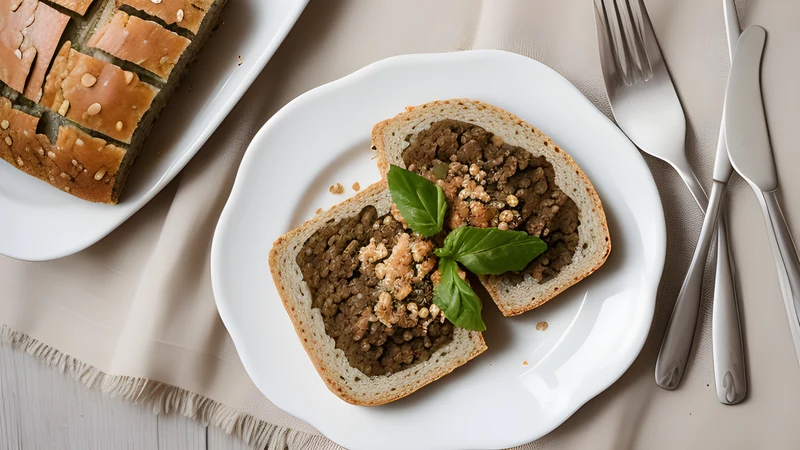
↓ Jump to recipeIcelanders talk about cooking this bread rather than baking it, and the verb is doing real work: nothing in the tin ever exceeds 100°C, which is the boiling point of water and about 40°C short of where the Maillard reaction starts producing crust. So there is no crust. There is no oven spring, no crackle, no golden anything. What comes out is a dense, moist, almost black slab with a soft skin, sweet enough to eat with jam and savoury enough to eat with smoked lamb.
It is also, by a distance, the least demanding bread I know. There is no starter, no kneading, no proving and no shaping. You whisk two bowls together, pour, seal and forget about it for twelve hours. The only skill required is owning a thermometer and being willing to leave the oven on overnight.
Rúgbrauð: Icelandic Steamed Rye
Ingredients
- 400 g wholegrain rye flour
- 150 g plain flour
- 100 g medium oatmeal or fine porridge oats
- 2 tsp bicarbonate of soda
- 1.5 tsp fine sea salt
- 120 g dark muscovado sugar
- 100 g black treacle
- 500 ml buttermilk
- 150 ml whole milk
- 30 g unsalted butter, melted, plus more for the tin
- 1 tsp ground caraway seed (optional)
Method
- Heat the oven to 100°C (100°C fan, gas mark 0.5). Use an oven thermometer to confirm — this temperature is the entire method and domestic ovens are routinely 15°C out at the low end.
- Butter a 1-litre loaf tin generously, including the rim, and cut a strip of baking parchment to line the base and long sides.
- Whisk the rye flour, plain flour, oatmeal, bicarbonate of soda, salt and caraway (if using) together in a large bowl until evenly combined with no lumps of bicarb.
- In a jug, whisk the muscovado, treacle, buttermilk, milk and melted butter until the treacle has fully dissolved. This takes a minute of proper whisking.
- Pour the wet into the dry and stir with a wooden spoon for 30 seconds, until no dry flour remains. Stop there. The batter will be thick, dark and pourable, like a heavy gingerbread batter.
- Pour into the tin — it should come no more than two thirds up the sides. Level the top with a wet spoon.
- Cover the tin tightly with a double layer of foil, crimped hard around the rim. This traps the steam and is what stops a crust forming.
- Sit the tin inside a deep roasting tray. Pour boiling water into the tray to come halfway up the sides of the tin.
- Cook for 12 hours. Check the water level at hours 4 and 8 and top up with boiling water if it has dropped below a third.
- Lift the tin out, remove the foil and let it stand for 20 minutes. Run a knife around the edge and turn the loaf out onto a rack.
- Cool completely — at least 6 hours, ideally overnight, wrapped in a cloth. Slice as thinly as you can manage.
Hverabrauð, and the ground it was cooked in
The traditional Icelandic name for this is hverabrauð — hot-spring bread — and the traditional method involves burying it.
At Laugarvatn, on the Golden Circle route, and around Lake Mývatn in the north, people have for generations put a sealed pot of rye batter into a hole dug in the geothermally heated ground, covered it over, and come back twenty-four hours later. The ground temperature at half a metre down in those areas sits reliably around 100°C. Nobody had to build or fuel an oven, and the loaf cooked itself while everyone got on with the day. Laugarvatn Fontana still does this as a daily demonstration, and the loaf they dig up is the same loaf described here.
The economics behind that are worth pausing on. Iceland has essentially no native trees left — the settlement-era birch forests were felled and grazed away within a few centuries of landnám in 874 — and firewood was scarce and precious for most of the island’s history. Baking bread properly, at 220°C for forty minutes, was a genuine expense. Geothermal ground was free. So Icelandic bread evolved around a heat source that tops out at boiling point, and every characteristic of rúgbrauð follows from that constraint.
The sweetness follows from something else: the Danish trade monopoly, which ran from 1602 to 1855 and controlled everything Iceland could buy. Sugar, treacle and imported rye flour came through Danish merchants, and the loaf that emerged is noticeably sweeter than mainland Nordic rye. That sweetness stuck. Modern Icelandic rúgbrauð is sweet enough that visiting Danes find it strange.
Bicarbonate rather than sourdough, and why
Every other rye bread in this part of the world is sour. Finnish ruisleipä and Danish rugbrød both need a long acid fermentation to knock out rye’s amylase before it digests the starch structure. Rúgbrauð skips all of that. Here is why it can.
Amylase is temperature-sensitive as well as pH-sensitive. Rye amylase is most destructive between about 60°C and 75°C — hot enough to be very active, cool enough to survive. In a normal bake, the dough passes slowly through that band while the crust is still setting, and that transit is where the damage happens; acidity is the defence.
A steamed loaf never gets above 100°C, and it climbs through the danger band slowly, which sounds worse. What saves it is the bicarbonate. Two teaspoons of bicarb in this batter pushes the pH up to around 8, which is well outside amylase’s working range in the other direction — the enzyme is inhibited by alkalinity just as it is by acid. The bicarb is doing double duty: raising the loaf, and disabling the enzyme that would otherwise wreck it.
That alkalinity also explains the colour. At high pH, the reducing sugars in the treacle and muscovado darken dramatically even at low temperatures — the same chemistry that makes pretzels brown, run in reverse conditions. Twelve hours at pH 8 turns this batter from mid-brown to near-black through browning chemistry alone — nothing in the tin was ever hot enough to burn.
The twelve hours, and what they buy
Six hours will cook it through. Twelve makes it good.
What happens between hour six and hour twelve is starch conversion and slow, low-temperature browning. Even inhibited, some enzymatic activity continues, and residual amylase plus the long hold converts starch to maltose. The loaf gets sweeter as it cooks without any additional sugar, and it gets darker. A six-hour loaf is brown and pleasant. A twelve-hour loaf is black and complex.
Twenty-four hours, the traditional buried-in-the-ground timing, goes further still and is genuinely worth trying once if you can stand leaving the oven on that long. The loaf turns almost fudgy.
The water bath is the mechanism. Its job is to hold the tin at exactly 100°C by physics rather than by trusting your oven. Water cannot exceed its boiling point at atmospheric pressure, so as long as there is liquid water in the roasting tray, the tin is at 100°C regardless of what the oven dial claims. Let the tray boil dry and the tin starts climbing towards the oven’s actual set temperature, which is when things go wrong. Check it twice.
The foil must be tight. Steam escaping means the surface dries, and a dried surface at 100°C over twelve hours becomes a leathery skin you have to cut off. Crimp it hard around the rim.
The tin, the oven and the overnight question
A 1-litre loaf tin is the right size for this quantity. Icelandic households often use a cylindrical tin or an old coffee tin, which gives you round slices and a slightly faster cook because the batter is shallower relative to its surface. Either works. What matters is that the batter sits no more than two thirds up the sides, because it rises by about a third and a lidded tin with batter creeping under the foil is a mess you will be chiselling out for an hour.
Butter the tin properly, including the rim, and line the base and long sides with parchment. This loaf is sticky and it has no crust to release cleanly; an unlined tin means turning out half a loaf and scraping the rest.
On leaving the oven on overnight: a domestic oven at 100°C draws roughly 400 to 600 watts once it has reached temperature and is only cycling to hold, which over twelve hours is something like five to seven kilowatt hours — less than most people assume, and considerably less than an hour of a 220°C bake plus preheat, repeated across four loaves. If it still bothers you, a slow cooker on low does this job well. Put a trivet in the base, sit the covered tin on it, pour boiling water halfway up, put the slow cooker lid on and leave it. The temperature profile is nearly identical and the appliance is designed to run unattended.
An oven thermometer is worth the four pounds. Most domestic ovens are calibrated somewhere in the middle of their range and drift badly at the extremes; a dial set to 100°C might actually deliver 85°C, which will never cook this loaf, or 120°C, which will boil the water tray away by hour six.
Tips, faults and variations
It is wet in the middle. Almost always a water-bath problem — the tray boiled dry, the loaf’s temperature climbed, and the outside set before the centre cooked. Or your tin was too deep and the batter more than two thirds up. Use a wider, shallower tin.
It is dry and crumbly. Too much flour, or you measured the buttermilk short. This batter is meant to pour, and it should look alarmingly loose.
It tastes soapy. Too much bicarb, or the bicarb was not whisked evenly through the dry ingredients and you hit a pocket. Two teaspoons in 650 g of flour is the ceiling; the treacle’s acidity partly neutralises it, which is why treacle rather than golden syrup matters.
Buttermilk substitution. Whole milk soured with 1 tbsp of lemon juice per 250 ml, left ten minutes, works. Natural yoghurt thinned with milk to a pouring consistency works better. You need the acid to react with the bicarb for the initial lift.
Slicing. Thin, and with a long serrated knife, and only when completely cold. A warm rúgbrauð smears rather than slices. If it crumbles, it is either too warm or it needs another few hours in a cloth to even out its moisture.
Variations. Caraway is optional and divides opinion; a teaspoon of ground seed gives the loaf a faint aniseed hum that suits the smoked-lamb pairing and fights with jam. Some Icelandic recipes add 50 g of dark chocolate or a tablespoon of instant coffee for depth, which sounds like a stunt and works — both bring bitter compounds that balance the 120 g of muscovado.
For a less sweet loaf, drop the muscovado to 70 g and keep the treacle at 100 g. The treacle is load-bearing: it supplies the acidity that partly neutralises the bicarb, the reducing sugars that darken the loaf, and the mineral bitterness that stops the whole thing reading as cake. Golden syrup has none of those properties and produces a pale, cloying loaf.
It keeps for a week wrapped in a cloth and it improves for three days. It freezes very well sliced, with parchment between the slices.
What to eat it with
Butter, thickly. Then either jam or fish, and the loaf is happy with both, which is unusual.
The classic Icelandic pairing is butter and smoked lamb — a slice of hangikjöt on buttered rúgbrauð is the national open sandwich, and the sweetness of the bread against the birch smoke of the lamb is the whole argument for this loaf. Plokkfiskur, the fish and potato mash, is traditionally served with it too, and in that context the bread’s sweetness does what a chutney would do elsewhere.
Beyond Iceland, it goes with anything that would sit on Danish rye. Pickled herring works. Blue cheese works alarmingly well. And if you want to understand what Nordic rye is capable of at the other end of the spectrum, make the Finnish sour rounds next and eat them side by side. Same grain, opposite philosophy, both correct.
Related Content