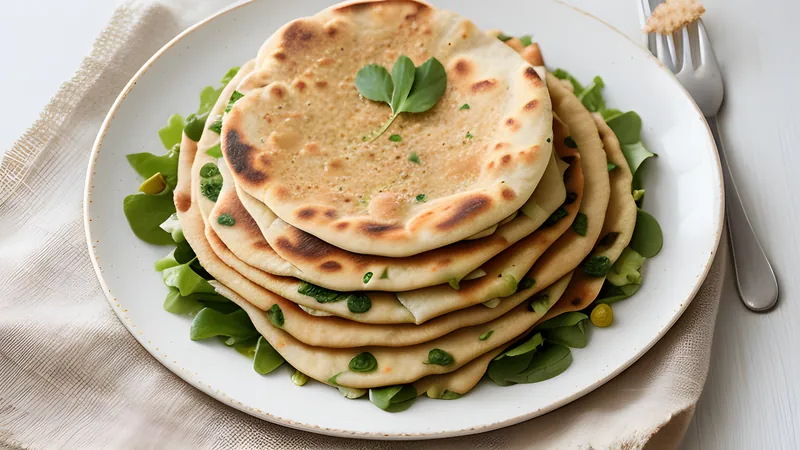
Roti: Trinidad's Buss Up Shut
The paratha-style flatbread beaten apart into flaky ribbons for scooping up curry
Contents
↓ Jump to recipeBuss up shut takes its name from its own finished shape: “bust-up shirt,” a torn, ragged pile of flaky dough that looks, once it’s been properly clapped apart between two paddles, like a shirt that’s been through a fight. It’s Trinidad’s most distinctive contribution to the island’s Indo-Caribbean roti tradition, a cousin of Indian paratha built the same way — layered with fat, folded, rolled, cooked, then physically beaten apart — but pushed further into shreds specifically designed to scoop up curry rather than wrap around it, the way a plainer dhalpuri or sada roti might.
Roti: Trinidad's Buss Up Shut
Ingredients
- 500g plain flour, plus more for dusting
- 2 tsp baking powder
- 1 tsp fine salt
- 1 tbsp vegetable oil, plus more for the dough
- 300ml warm water
- 150g ghee, melted, plus more for cooking
- Extra flour, for dusting between folds
Method
- Whisk the flour, baking powder and salt together in a large bowl. Make a well, add the tablespoon of oil and the warm water gradually, mixing with your hand until a soft, slightly sticky dough forms.
- Knead on a lightly oiled surface for 8-10 minutes until smooth and elastic. Coat lightly with oil, cover, and rest for 30 minutes.
- Divide the dough into 4 equal balls. Working with one at a time (keep the rest covered), roll each ball out thinly on a floured surface into a rough circle about 30cm across.
- Brush the rolled-out circle generously with melted ghee and dust lightly with flour. Make one straight cut from the centre to the edge, then roll the dough into a cone shape starting from one side of the cut, and press the cone down into a flattish coil. Roll this coil out again into a circle about 20cm across.
- Repeat with the remaining dough balls, keeping finished rounds covered so they don't dry out.
- Heat a flat tawa or heavy frying pan over medium-high heat and brush with ghee. Cook one roti at a time for 1-2 minutes a side, brushing more ghee onto the surface and around the edges as it cooks, until golden-brown patches appear and the dough is cooked through and still soft.
- As soon as each roti comes off the heat, use two spatulas, wooden paddles, or clean hands protected with a tea towel to clap and shred it vigorously between them for 20-30 seconds, tearing the layered dough into loose, flaky ribbons.
- Pile the shredded roti onto a plate and serve immediately, warm, alongside curry.
Roti’s journey to Trinidad
Roti arrived in Trinidad with indentured labourers brought from India, mostly from Uttar Pradesh and Bihar, between 1845 and 1917 to work the sugar plantations after the abolition of slavery left estate owners searching for a new labour supply. Those labourers carried their foodways with them, and over the following century and a half, Indian flatbread and curry cooking fused with local Trinidadian ingredients and the wider Caribbean pantry — scotch bonnet in place of the chillies grown at home, local root vegetables, Caribbean curry powder blends distinct from the garam masalas of North India — into something recognisably its own. Buss up shut, alongside dhalpuri (a roti stuffed with ground split peas before rolling) and sada roti (a simpler, unlayered daily bread), became one of the pillars of that fusion cuisine, sold today from roti shops across Trinidad and the wider Trinidadian diaspora in Toronto, New York and London.
The layering technique itself — rolling dough thin, brushing with fat, folding or coiling it back on itself, then rolling out again — is the same basic method behind Indian paratha and Malaysian roti canai, both of which also rely on repeated lamination to build the flaky layers that later separate under heat. What sets buss up shut apart isn’t the lamination itself but what happens the moment it comes off the tawa: rather than serving the roti whole, the cook (or a second pair of hands) claps it hard between two paddles, or simply beats it with cupped hands, deliberately tearing the cooked layers into a loose, ragged pile of shreds. This isn’t a shortcut or a presentation flourish; it’s what turns a smooth flatbread into something with dozens of exposed, curry-catching edges and surfaces.
The dish’s other name, paratha roti, points directly at that Indian ancestry, and older Trinidadians still often call it “paratha” in everyday speech, with “buss up shut” functioning more as the descriptive, slightly irreverent nickname that eventually became the name printed on roti shop menus. The two names travelling together, one earnest and one a joke about a torn shirt, says something about how the dish sits in Trinidadian food culture: taken seriously as a craft in the kitchen, described lightly at the table.
Roti shops became a defining feature of Trinidadian street food from the mid-twentieth century onward, small counter operations, often family-run, where a single roti maker could turn out dozens of buss up shut an hour during a lunchtime rush, paired with curries kept warm in steel pots along the counter. Customers order roti “with” a specific curry rather than the roti and curry as separate items, and the shredding itself became something of a performance in busier shops, the rhythmic clap of paddles against dough part of the ambient soundtrack of a Trinidadian counter. That performative clapping travelled with the diaspora too, and roti shops in Toronto’s Little India still run the same two-person system of one cook frying while another claps.
Why the clapping actually matters
The lamination during rolling creates thin, distinct layers of dough separated by ghee, and those layers are what allow the roti to be torn apart cleanly rather than just crushed into a flat mush once it’s cooked. Ghee, unlike butter, has had its milk solids and water removed, which means it can be worked into very thin layers without making the dough soggy or causing steam pockets to form unevenly during cooking, both of which would otherwise weaken the structure the clapping depends on. A roti made with too little fat between the folds, or rolled too thick to begin with, doesn’t shred properly when beaten — it tears in a few large clumps instead of the fine, flaky ribbons that make buss up shut recognisable, and it will taste noticeably drier and less rich as a result.
Timing the clap is just as important as the folding technique that sets it up. The roti needs to be beaten the moment it comes off the heat, while it’s still hot and pliable; wait even a couple of minutes and the layers begin to set and cool, and the same dough that would have torn into soft ribbons instead cracks into stiff, awkward shards. In a roti shop, this is usually a two-person job — one cook rolling and frying in a steady rhythm, another standing by specifically to clap each roti apart the instant it’s lifted from the tawa — because the window to do it properly is short and the next roti is usually already going down onto the heat.
What can go wrong
A roti that won’t shred, tearing into a few stiff clumps instead of fine ribbons, is nearly always a fat or timing problem rather than a dough problem. Check first how generously the ghee was brushed on during the coiling stage; skimping there is the single most common reason buss up shut comes out dense rather than flaky, since it’s the fat between the layers that lets them separate rather than fuse back together under heat. If the fat was generous but the roti still won’t tear cleanly, the clap likely came too late: once the roti has cooled for even a minute or two off the tawa, the layers set and the dough behaves like a cooked flatbread rather than a stack of separate sheets, cracking into shards instead of pulling apart into ribbons. A roti that’s tough and chewy rather than tender usually means the dough was under-kneaded or the rest was skipped, since both develop and then relax the gluten that would otherwise fight the thin rolling the recipe demands. Rolling too thick at either stage shows up as a roti that’s fine to eat but never gets properly flaky: aim for the first circle thin enough to see the worktop’s grain through it.
The recipe
Makes 4 roti.
Ingredients
- 500g plain flour, plus more for dusting
- 2 tsp baking powder
- 1 tsp salt
- 1 tbsp vegetable oil, plus more for the dough
- 300ml warm water
- 150g ghee, melted, plus more for cooking
Method
- Mix flour, baking powder and salt with oil and warm water into a soft dough.
- Knead 8-10 minutes until smooth. Oil, cover, rest 30 minutes.
- Divide into 4 balls. Roll each thinly into a 30cm circle.
- Brush with ghee, dust with flour, cut from centre to edge, roll into a cone, flatten into a coil, then re-roll to a 20cm circle.
- Cook on a hot, ghee-brushed tawa, 1-2 minutes a side, brushing more ghee on as it cooks, until golden patches appear.
- Immediately clap and shred the hot roti between two paddles or hands for 20-30 seconds.
- Pile and serve at once with curry.
Tips, substitutions and storage
Ghee is worth sourcing properly rather than substituting with butter, since butter’s water content works against the thin, dry layers the clapping depends on; if ghee genuinely isn’t available, clarified butter is the closer stand-in of the two. Roti dough tolerates a short rest in the fridge, up to a few hours, wrapped well so it doesn’t dry out, though it should come back to room temperature before rolling, since cold dough resists stretching and tears rather than laminating cleanly. Buss up shut is very much a made-to-order food — it doesn’t keep or reheat well once shredded, since the whole appeal is the just-off-the-tawa texture, so cook it in the same session it’s eaten in rather than trying to make it ahead. A rolling pin isn’t strictly necessary if you’re used to hand-stretching dough the way roti cooks traditionally do, working the ball out from the centre with the heel of the hand, though a pin gets a beginner to an even thinness much faster and more consistently. If a proper tawa isn’t available, the flattest, heaviest frying pan in the kitchen is a workable substitute, since what matters is even, direct contact across the whole surface rather than any specific material; a pan with a slight dome or hot spots will cook the roti unevenly and make the clapping stage harder to judge. Unshredded, uncooked dough balls freeze reasonably well wrapped individually, though they need a full thaw and a short rest at room temperature before rolling, and the finished texture is very slightly less flaky than roti made from fresh dough on the day.
Serve it with any curry that has enough sauce to soak into the torn layers: curry channa and potato, curry duck, or the colombo-style curry from Martinique and Guadeloupe, a distant cousin from another corner of the Caribbean’s Indian-influenced cooking, makes an interesting comparison eaten side by side. A pile of buss up shut also holds its own next to a braise as rich as brown stew chicken, even outside its native Trinidad, since the torn layers are built to soak up any thick, well-seasoned gravy rather than one specific curry alone.
Variations
Dhalpuri, the split-pea-stuffed version of Trinidadian roti, uses the same basic dough but skips the clapping entirely in favour of a filling of ground, spiced split peas rolled inside before cooking, giving a soft, whole roti rather than shreds. Sada roti drops the lamination altogether, cooked as a plain, single-layer daily bread eaten with butter or a simple curry, closer to the roti most North Indian households would recognise. Paratha roti, sometimes just called “buss up” for short in some households, is essentially this same recipe under a slightly different regional name.
A double-fold version, coiling the dough twice before the final roll rather than once, produces even finer layers and a shreddier result, though it takes noticeably more practice to roll out evenly without tearing the dough prematurely, and it’s worth mastering the single-fold method first. Whichever version ends up on the table, the technique that actually defines the dish, more than any specific list of ingredients, is the repeated fat-and-fold lamination during rolling, since that’s what determines whether the finished bread has the flaky, tearable structure the name itself is built around. Coconut bake, a griddled coconut-milk bread eaten at breakfast across Trinidad and Tobago, shares roti’s basic method of a simple dough cooked on a hot dry surface, but skips the lamination and clapping entirely, landing much closer to a simple flatbread than to buss up shut’s shredded pile. Some home cooks work a small amount of finely chopped fresh herbs, usually chadon beni (culantro) or coriander, into the dough itself before the first roll, giving the finished shreds a faint green fleck and a herbal note that plays well against a mild curry but can overwhelm a heavily spiced one. However the dough is flavoured, the clapping stays non-negotiable; a buss up shut that’s been rolled thin, layered generously with ghee, and cooked properly but never actually clapped apart is, at that point, simply a very good paratha, and the two are judged by different standards.
Related Content