Rødgrød med Fløde: Danish Red Berry Pudding
The shibboleth pudding — three berries, a little starch, cold cream
Contents
↓ Jump to recipeAsk a Dane to teach you one phrase and you will get this one. Rødgrød med fløde is the standard test of whether a foreigner has any hope with Danish, because it contains three soft d’s, a rounded ø, and a rhythm that collapses in the mouth of anyone who learned their vowels elsewhere. It is delivered with enormous good humour and no expectation of success. I have been corrected on it by a four-year-old.
Underneath the joke is a genuinely good pudding, and one that is easy to make badly. It is red berries cooked down, sieved, thickened with a little starch, and served cold with cold cream poured over. That is all. The difficulty is entirely in the thickening, which has a temperature window about ten degrees wide and no mercy at either end.
Rødgrød med Fløde: Danish Red Berry Pudding
Ingredients
- 400 g redcurrants, stripped from their stalks (frozen is fine)
- 300 g raspberries
- 300 g strawberries, hulled and halved
- 200 ml water
- 120 g caster sugar, plus 1 tbsp for the surface
- 35 g potato starch (or 30 g cornflour)
- 1 vanilla pod, split and seeds scraped, or 1 tsp vanilla bean paste
- 1 strip of lemon zest, about 4 cm
- Pinch of fine sea salt
- 300 ml cold single cream, to serve
Method
- Put the redcurrants, water, lemon zest and the vanilla pod and seeds into a non-reactive saucepan. Bring to a simmer over a medium heat and cook for 6 minutes, until the currants have burst.
- Add the raspberries and strawberries and cook for a further 4 minutes, pressing the strawberries lightly against the side of the pan with a spoon.
- Pass the whole lot through a sieve set over a bowl, working it with the back of a ladle for a full 2 minutes. You want the pulp through and the pips and skins left behind. Expect about 850 ml of purée. Discard the solids and the zest.
- Rinse the pan, return the purée to it, add the sugar and the salt, and bring to a bare simmer over a medium-low heat, stirring until the sugar dissolves. Taste and add up to 30 g more sugar if your berries were sharp.
- Slake the potato starch with 5 tbsp cold water in a small bowl until completely smooth with no lumps.
- Take the pan OFF the heat. Pour the slaked starch in a thin stream while whisking hard and continuously.
- Return to a low heat and cook, stirring constantly, for 60–90 seconds only, until the purée thickens and turns glossy and just coats the back of a spoon. Do not let it boil — potato starch breaks down above about 80°C and the pudding will thin again.
- Pour into a serving bowl or four individual bowls. Sprinkle 1 tbsp caster sugar evenly over the surface while still hot; this dissolves and prevents a skin forming.
- Cool to room temperature, then chill for at least 3 hours until set to a soft, spoonable wobble.
- Serve cold with cold single cream poured over the top at the table, not stirred in.
Grød, and what the word admits
Grød means porridge, and that tells you the truth about this dish: it started as a way of stretching fruit with grain. Across northern Germany and Denmark the ancestral version was thickened with semolina, sago or breadcrumbs, and the result was solid enough to slice. The German cousin rote Grütze still carries Grütze — groats — in its name, and in parts of Schleswig you will be served something with visible semolina in it and told it is the real thing. Which, historically, it is.
Potato starch changed the dish. Denmark has grown potatoes since the eighteenth century, and industrial potato starch — kartoffelmel — became a cheap kitchen staple in the nineteenth. It thickens at a lower temperature than wheat, sets clear rather than cloudy, and has no flavour of its own, so the fruit reads bright and pure instead of muffled by grain. The pudding stopped being a way of eking out berries and became a way of concentrating them. What you make now is closer to a set fruit soup than to porridge, and the name is a fossil.
The dish is not exclusively Danish. Sweden and Norway have their own versions, Finland’s kiisseli is the same idea, and the Estonian and Latvian kissell run on the same starch. Every one of them is a northern European answer to the same problem: an enormous glut of soft fruit for six weeks and nothing to do with it. See also lingonsylt, which solves it by not cooking the fruit at all, and multekrem, which solves it by burying the fruit in whipped cream.
The berries
The classic proportion leans on redcurrant, and there is a technical reason as well as a traditional one. Redcurrants are extremely high in acid and in pectin, and they carry a sharpness that keeps the pudding from being a jam. Raspberry brings the aroma — most of what you smell in a good rødgrød is raspberry. Strawberry brings body, sweetness and very little else, and is there to soften the other two.
My proportions are 400 g redcurrant to 300 g raspberry to 300 g strawberry, and I would rather adjust the sugar than the berries. If you cannot get redcurrants, blackcurrants work but dominate; use 250 g and expect a darker, more medicinal pudding. Sour cherries are the other legitimate substitute and are common in the German versions.
Frozen berries are entirely fine here and often better than tired fresh ones, because they were picked ripe and the cell damage from freezing helps them break down. Do not thaw them; add them frozen and give the first stage two extra minutes.
Sieving, and why you should not skip it
Redcurrant skins do not break down. Raspberry pips do not break down. If you skip the sieve you get a pudding with grit in it, and the texture is the whole point of the dish — it should be smooth, glossy, and slightly slippery on the spoon.
Work the pulp for a full two minutes with the back of a ladle. Most people give up after thirty seconds and throw away a third of their fruit. What you should have left in the sieve is a dryish mat of skins and pips that looks like it has been wrung out. From 1 kg of fruit and 200 ml of water you should recover around 850 ml of purée. A food mill with the fine plate does this faster and better if you own one.
The starch, which is where it goes wrong
Potato starch gelatinises at around 60–65°C, which is low — much lower than cornflour’s 90-odd. That is why it works so well here: the pudding sets before the fruit has a chance to cook further and lose its brightness.
The problem is what happens above about 80°C. Potato starch granules swell enormously and then rupture, and once ruptured they cannot hold water. Boil a rødgrød after the starch goes in and it will thicken beautifully for about twenty seconds and then thin out into red water in front of you, permanently. There is no fixing it by adding more starch; you will just do the same thing again.
So the sequence matters. Take the pan off the heat. Slake the starch in cold water until it is smooth — dumping dry starch into hot liquid gives you lumps that no whisk will save. Pour it in while whisking hard. Return to a low heat and cook for sixty to ninety seconds, stirring the whole time, and take it off the moment it turns glossy and coats a spoon. It will thicken further as it cools; a rødgrød that looks correct in the pan will be stiff and gluey in the bowl.
If you use cornflour instead, you must do the opposite: cornflour needs a full minute at a proper simmer to lose its raw taste and reach full thickening power. Use 30 g, bring it to the boil for sixty seconds, and accept a slightly cloudier, less shiny set.
The sugar sprinkled on the hot surface is doing a structural job. It dissolves and forms a syrupy film that stops the pudding forming a rubbery skin as it cools. This is an old Danish trick and it works.
Troubleshooting
It set like a jelly you could bounce. Too much starch, or you kept stirring it over the heat after it thickened. Thirty-five grams of potato starch to 850 ml of purée is the ratio, weighed rather than spooned — a tablespoon of potato starch varies by nearly 50% depending on how it was scooped.
It thinned back out in the bowl. It boiled. Nothing to be done except pour it over ice cream and start again with a lower flame and a thermometer if you have one; 78°C is the ceiling.
It is lumpy. Dry starch met hot liquid. Slake it properly in cold water, and if it has already happened, push the whole pudding through the sieve again while it is hot — you will lose a little thickness but recover the texture.
It tastes dull and jammy. The fruit cooked too long before sieving. Six minutes for the currants and four for the soft berries is enough to burst them; beyond that you are making jam, and the volatile aromatics that make raspberry smell like raspberry are gone by minute twelve.
A thick skin formed on top. You forgot the tablespoon of sugar on the hot surface, or you sprinkled it on once the pudding had cooled and it sat there as grit.
The cream, and the ritual
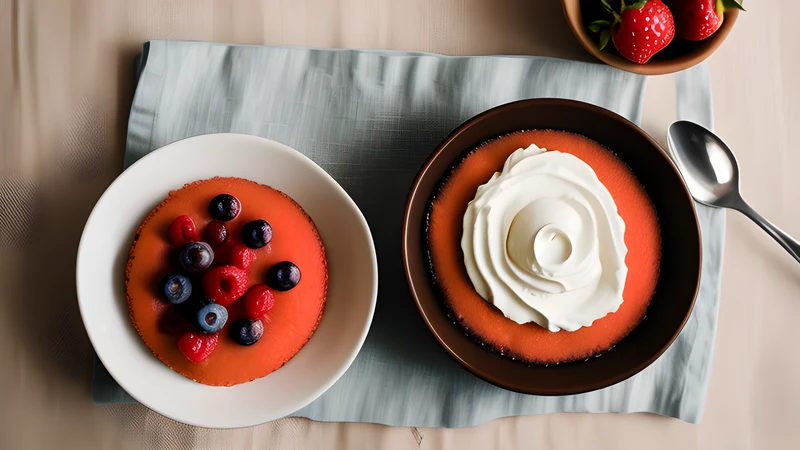
Fløde here means single cream — thin, cold, pouring cream, around 18% fat. Not whipped, not double, not clotted. It goes on at the table, poured in a slow circle over the surface, and it sits in a white pool that slowly marbles into the red.
Do not stir it in. Half the pleasure is the temperature and colour contrast, and the other half is dragging a spoon through both at once so each mouthful has a different ratio. Danish children are taught to eat it from the edge inward for exactly this reason.
Storage and variations
It keeps for four days covered in the fridge, and the flavour improves overnight as the vanilla settles through. It does not freeze — the starch weeps on thawing and you get a grainy pool.
Leftovers have a second life. Spooned over æbleskiver it replaces the usual jam and is considerably better than it, and a spoonful stirred into porridge or thick yoghurt at breakfast is how most of mine actually gets eaten.
For variations worth making: a tablespoon of elderflower cordial stirred in at the end lifts the raspberry noticeably. A splash of dry sherry or a good cassis, about 2 tbsp, added off the heat before the starch, makes it an adult pudding. And if you want the historical version, replace the potato starch with 50 g of fine semolina, stir it into the simmering purée and cook it for eight minutes — you get rote Grütze, thicker and grainier, and you understand instantly why the Danes switched.
Related Content