Roasted Tomato and Goat Cheese Tart with Thyme Pastry
Sweet blistered tomatoes on herb-flecked shortcrust
Contents
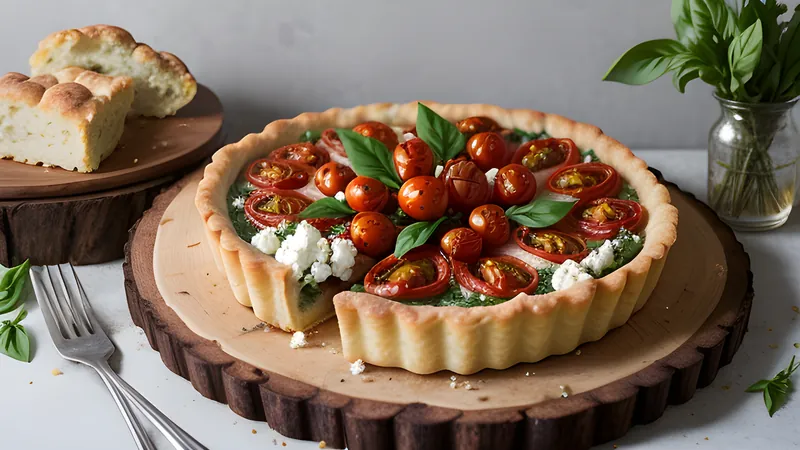
↓ Jump to recipeA tomato tart has a way of looking effortless and tasting of summer, which is exactly why it gets made on the days when summer is being stingy with its tomatoes. A wan, watery tart is one of life’s small disappointments: soggy pastry, pale fruit, nothing much to show for the effort. The fix is not to wait for perfect tomatoes; it is to teach ordinary ones to behave. Roast them low and slow until they collapse into something dense, jammy and twice as sweet, and a midweek punnet from the corner shop starts tasting like the south of France.
A tart with a long history
The savoury tart belongs to no single country and to all of them. The French claim it through the tarte, the Italians through the crostata, the British through endless variations on the cheese-and-onion theme. What they share is the same comforting logic: a crisp base, a soft savoury filling, something to bind it, and the patience to bake it properly. The word tart comes from the Old French tarte, in use by the fourteenth century, and medieval European kitchens were already baking open pastry cases of fruit, cheese and custard.
Goat cheese and tomato is a pairing that turns up all over the Mediterranean for the obvious reason that it works. The cool, lactic tang of the cheese is the perfect foil for the deep sweetness of cooked tomato, and a scrape of mustard underneath sharpens the whole thing. Chevre, France’s soft goat cheese, has been made in the Loire and Poitou regions since at least the eighth century, when, one popular account holds, the Moors retreating after the Battle of Tours in 732 are said to have left their goats behind. It is a good story, if not a firmly documented one; either way, the region’s goat cheeses are ancient and superb.
Roasted Tomato and Goat Cheese Tart with Thyme Pastry
Ingredients
- 200g plain flour, plus extra for dusting
- 110g cold unsalted butter, cubed
- 1 1/2 tbsp fresh thyme leaves, plus a few sprigs
- 1/2 tsp fine salt
- 1 egg yolk
- 2 to 3 tbsp ice-cold water
- 600g mixed ripe tomatoes (a few on the vine)
- 3 tbsp olive oil
- 3 cloves garlic, thinly sliced
- 1 tsp caster sugar
- 150g soft goat cheese log
- 2 tbsp creme fraiche
- 1 tbsp Dijon mustard
- 1/2 tsp sea salt and 1/4 tsp black pepper
- 8 basil leaves, to serve
Method
- Rub 110g cold butter into 200g flour, 1 1/2 tbsp thyme leaves and 1/2 tsp salt until it looks like breadcrumbs, then bind with the egg yolk and 2 to 3 tbsp ice water into a dough. Chill for 30 minutes.
- Halve the 600g tomatoes and roast cut-side up with 3 tbsp olive oil, the sliced garlic, 1 tsp sugar, salt and thyme sprigs at 150C fan for about 50 minutes until shrunken and sweet.
- Roll out the pastry and line a 23cm tart tin, chill for 15 minutes, then blind bake at 190C fan for 18 minutes with baking beans and 8 minutes more uncovered until golden.
- Whisk 2 tbsp creme fraiche with 1 tbsp Dijon mustard and spread thinly over the base of the cooled case.
- Crumble two-thirds of the 150g goat cheese over the mustard layer.
- Arrange the roasted tomatoes over the cheese, tucking the soft garlic slices between them.
- Dot with the remaining goat cheese and trickle over a little of the reserved tomato roasting oil.
- Bake at 190C fan for 15 to 18 minutes until set and bubbling, then scatter with 8 basil leaves and serve warm.
The clever twist: thyme baked into the pastry
The small idea that lifts this tart out of the ordinary is putting the herb in the crust rather than only on top. I work a generous tablespoon and a half of fresh thyme leaves straight into the shortcrust before chilling it. As the pastry bakes, the thyme toasts gently and perfumes the whole base, so every forkful carries that resinous, slightly lemony note even before you reach the filling. It costs nothing and takes thirty seconds, and it makes people pause and ask what the flavour is that they cannot quite place.
If you cannot get fresh thyme, dried works at half the quantity, though you lose a little of the brightness. Rosemary, very finely chopped, is a fine substitute, but go lighter, because it is a louder herb that can dominate the pastry if you are heavy-handed.
The pastry itself rewards a cold, quick hand. Shortcrust turns tough when the gluten develops, and gluten develops with warmth and working, so keep the butter fridge-cold, use ice water, and stop mixing the moment the dough comes together. The egg yolk enriches it and helps it hold, giving a crust that stays crisp and slightly biscuity under the wet filling rather than going soft. Chill the lined tin before it goes in the oven, too: firm, cold pastry holds its shape and slumps far less down the sides as it bakes. If your kitchen is warm, chill the flour and even the bowl beforehand.
Roasting the tomatoes properly
This is where the transformation happens, so do not rush it. Halve the tomatoes, lay them cut-side up, and give them oil, sliced garlic, a pinch of sugar to coax out the sweetness, salt, and a few sprigs of thyme. Then roast them at a low 150C fan for the best part of an hour. You want them shrunken and slightly caramelised at the edges, holding their shape but concentrated, with the garlic gone soft and mellow. The oil they leave behind is liquid gold; save it to drizzle over the finished tart.
Doing this drives off the water that would otherwise ruin your pastry, which is the entire point. A wet tomato is the enemy of a crisp base. Blind baking the case until it is properly golden and dry does the other half of the job, and the thin mustardy creme fraiche spread over the bottom acts as both a seal and a flavour layer, so the pastry stays crisp beneath the topping.
Choose your tomatoes with an eye to their water content. Smaller, denser fruit, cherry or plum, roast down beautifully and hold their shape; big, watery beefsteak tomatoes give up more liquid and can go to mush. A mix is ideal, with a few cherry tomatoes on the vine roasted alongside for their looks. Do not crowd the roasting tin: leave space between the halves so the moisture evaporates rather than steaming them soft. A pinch of sugar helps only if the tomatoes are a little under-ripe or out of season; genuinely ripe summer fruit needs none, so taste and judge rather than adding it out of habit.
Goat cheese does its own bit of balancing. Its natural acidity and salt cut clean through the concentrated sweetness of the roasted tomatoes, which is why the pairing feels so complete. Use a soft, spreadable log rather than a hard, aged crottin here; the softer cheese melts into the filling and blisters attractively, while a very mature goat cheese can turn grainy and split under heat. Crumble most of it under the tomatoes and reserve a little to dot on top, so you get both a melted layer and a few browned, savoury peaks.
Serving, storage and variations
A word on the mustard layer, because it does more than season. Spread thinly over the blind-baked base, the Dijon-spiked creme fraiche forms a barrier that keeps the tomato juices from soaking straight into the pastry, and it adds a sharp, adult note underneath the sweetness. Do not be tempted to skip it or to spread it thick; a heavy layer weeps and softens the base, while a thin, even film does exactly the job you want.
Eat it warm rather than piping hot, scattered with torn basil, with nothing more than a sharply dressed green salad alongside. It is just as good at room temperature the next day, which makes it a quietly brilliant thing to take on a picnic. It keeps for two days in the fridge, loosely covered; bring it back to room temperature or warm it briefly in a low oven, because the pastry turns leaden fan-chilled.
For variations, a layer of caramelised onions under the cheese turns it richer and more autumnal. A handful of black olives or capers adds a salty edge, and a few anchovies melted into the base deepen everything without tasting fishy. Toasted pine nuts scattered over before serving add crunch, and a little balsamic reduction drizzled at the table sharpens the sweetness. However you treat it, the rule holds: roast the tomatoes until they mean it, and the rest takes care of itself.
If you enjoy this style of open savoury bake, my mushroom and Gruyere quiche with thyme pastry uses the same herb-flecked crust to different effect, and for a rich, spiced sweet bake to follow it my browned butter carrot cake is the one I keep coming back to.
Related Content