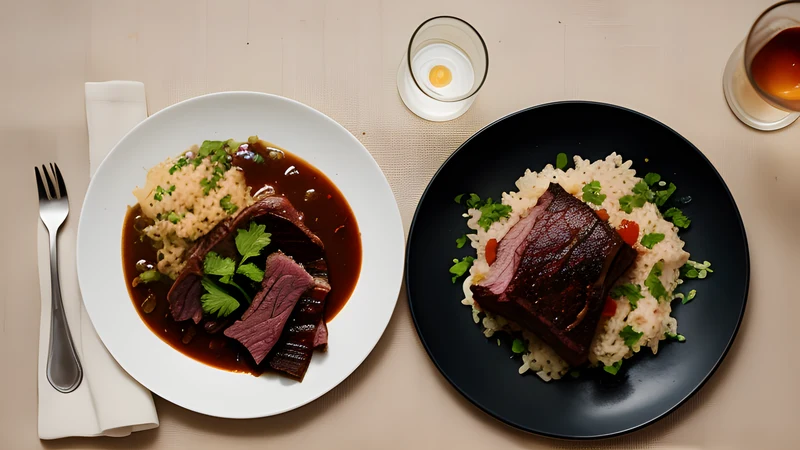
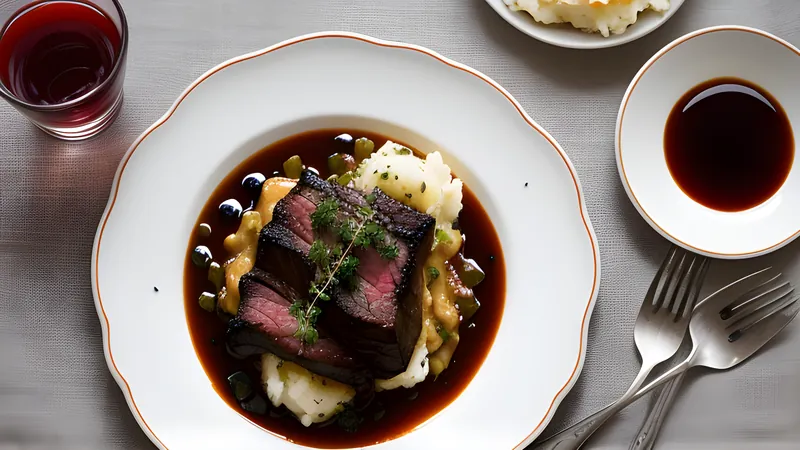
Rindsrouladen: Beef Rolls With Bacon, Pickle and Mustard
Four things on a thin slice of beef, rolled, browned and braised until they surrender
Contents
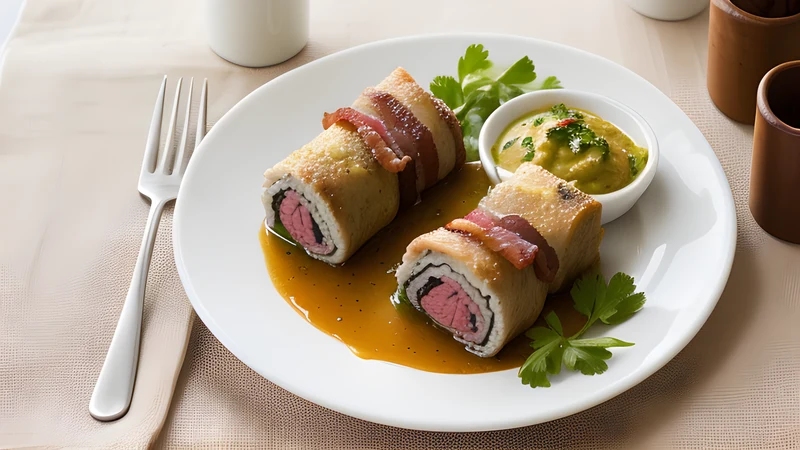
↓ Jump to recipeA Rindsroulade is an argument about how to make cheap beef worth eating, and the German answer is the most direct one anybody has come up with: take a lean, tough, flavourless slice, and roll four aggressive things inside it. Mustard for heat and acid. Bacon for fat and salt. Gherkin for sourness. Onion for sweetness. Then braise the whole thing until the beef gives up and absorbs its own filling.
It is a good trick because it works on the specific problem. Topside is tough because it is worked muscle with a lot of collagen and almost no intramuscular fat. Two hours of wet heat at around 85C converts that collagen to gelatine and the meat goes soft. What it will never do is become juicy on its own, because there is no fat in it to render. So you put the fat inside it, in a strip, and let it baste the roll from the middle out.
Rindsrouladen: Beef Rolls With Bacon, Pickle and Mustard
Ingredients
- 4 slices beef topside or silverside, about 180 g each, cut 8 mm thick across the grain
- 4 tbsp medium-hot German mustard (Dusseldorfer or similar)
- 8 rashers streaky bacon
- 4 large pickled gherkins, quartered lengthways
- 1 large onion (about 180 g), half sliced into rings, half finely chopped
- 1 tsp fine salt
- 1/2 tsp freshly ground black pepper
- 2 tbsp lard or neutral oil
- 1 carrot (about 100 g), diced
- 1 stick celery (about 80 g), diced
- 1 tbsp tomato puree
- 300 ml dark beer (Dunkel or a brown ale)
- 500 ml beef stock
- 2 bay leaves
- 4 juniper berries, lightly crushed
- 2 tbsp gherkin pickling liquid
- 20 g cold butter, diced
Method
- Lay each beef slice between two sheets of cling film and beat with a rolling pin or the flat of a heavy pan until an even 4-5 mm thick and roughly 20 x 14 cm. Work from the centre outwards.
- Season the slices on both sides with the salt and pepper. Spread 1 tbsp mustard over the upward face of each.
- Lay 2 rashers of bacon lengthways on each slice, then 4 gherkin quarters and a scattering of onion rings, leaving a 2 cm clear border at the far end.
- Roll up tightly from the short edge, tucking the sides in as you go. Secure with 2 cocktail sticks each or tie with kitchen string in two places.
- Heat the lard in a heavy casserole over high heat. Brown the roulades on all sides, 8-10 minutes total, turning to get colour everywhere. Lift onto a plate.
- Drop to medium heat. Add the chopped onion, carrot and celery to the pot and cook 8 minutes until softened and browning. Stir in the tomato puree and cook 2 minutes more, until it darkens from red to brick.
- Pour in the beer, bring to the boil and scrape every brown scrap off the base. Let it reduce by half, about 5 minutes.
- Add the stock, bay and juniper. Return the roulades and any juices; they should be about two-thirds submerged. Bring to a bare simmer.
- Cover and cook at the gentlest simmer for 2 hours, turning the roulades once at the halfway point, until a skewer slides into the meat with no resistance.
- Lift the roulades out and keep warm. Strain the sauce through a sieve into a clean pan, pressing hard on the vegetables. Boil to reduce to about 350 ml, 8-10 minutes.
- Off the heat, stir in the gherkin liquid, then whisk in the cold butter a few pieces at a time until the sauce is glossy. Taste and season.
- Remove the sticks or string. Return the roulades to the sauce to warm through for 2 minutes and serve.
The Sunday roulade
Rouladen are Sunday food in Germany, and in a very particular way: they are the thing a grandmother makes, in a quantity that assumes people will come. They are on the menu in every Gasthaus in the Rhineland, in Westphalia, in Silesian-descended households across the country, and they are on the table on Christmas Day in a great many German homes where goose would be the cliché and roulades are the reality.
The name comes from French — rouler, to roll — and the technique arrived in German cooking through the same nineteenth-century channel that brought a great deal of French vocabulary into bourgeois German kitchens. But the filling is entirely local. The French paupiette wraps veal around forcemeat. The German roulade wraps beef around the contents of a Westphalian larder, and the difference is not subtle: one is a refined dish that happens to be rolled, and the other is a preservation cupboard put inside a piece of meat.
Silesia’s contribution deserves a note, because after 1945 the mass movement of German populations westward from Silesia and East Prussia carried a specific version of the recipe into the west — heavier on the bacon, sometimes with a smear of the pickling brine directly on the beef. Regional recipes that look like national ones often have a displacement story underneath. The same holds for Königsberger Klopse, a dish from a city that no longer exists under that name and which every German cook still makes.
Buying and beating the beef
Ask the butcher for Rouladen if you are in Germany and you will get exactly the right thing: long, thin slices cut across the grain from topside or silverside. Elsewhere, ask for topside cut 8 mm thick in slices about 20 cm long, and be prepared to explain. Braising steak in a chunk is the wrong cut here; you need a sheet.
Cut across the grain, always. A roulade cut with the grain running the length of the roll will be stringy no matter how long you braise it, because you are then slicing along the muscle fibres when you eat it.
Beat from the centre outwards with the flat face of something heavy, and use cling film on both sides. A meat mallet’s spiked face tears the fibres apart and makes holes; the flat face, or a rolling pin, or the bottom of a saucepan, spreads the slice without perforating it. You want 4-5 mm and even thickness. Thin spots burst in the pan.
If a slice does tear, patch it with an offcut from another slice before you roll — the collagen will knit them together during the braise and the join will be invisible.
The four fillings and why each one is there
Mustard. German medium-hot mustard, not English (too fierce, and it loses its heat entirely when cooked) and not Dijon (too fine and wine-forward, though it will do). A properly made Düsseldorf-style mustard has vinegar sharpness that survives two hours of braising and enough coarse bran to give the interior texture. Spread it thin and everywhere — it is the layer that seasons the inside face of the beef.
Bacon. Streaky, and preferably smoked. This is the fat delivery system and there is no substitute. Two rashers per roulade sounds generous and renders down to almost nothing you can see, having gone into the meat around it.
Gherkin. The one people leave out and should not. Two hours in a fat-heavy braise produces a very rich, very heavy roll, and the pickled cucumber running through the centre is the thing that stops it cloying. It also softens into something almost sweet and stays visible in the spiral when you slice the roulade, which is half the pleasure of the dish.
Onion. Raw rings, which cook down to sweetness against the salt of the bacon.
The 2 cm clear border at the far end matters. Filling right to the edge means the filling squeezes out the moment you roll, and then it burns in the browning pan.
Roll tight, brown hard
Tight rolls hold their shape and slice into a clean spiral. Loose rolls unwind in the pot and you serve a mess. Tuck the long sides in as you roll so the ends are closed.
Cocktail sticks are quicker; string is better, because sticks leave holes that leak and they are easy to lose in the sauce. Two loops of string per roll, tied firmly but not garrotting the meat.
Brown them properly. This is the single biggest lever on the finished gravy, and the temptation is to rush it because there are four of them and the pan is crowded. Do them two at a time if you must. Every brown patch on the outside of that beef becomes fond on the base of the pot, and every scrap of fond becomes sauce when the beer goes in.
The tomato purée step — two minutes until it darkens from bright red to brick — is doing real work. Raw purée tastes tinny and sour in a braise; cooked out, it turns savoury and adds body and colour. Thirty seconds is not enough.
What goes wrong, and why
The roulade unravels in the pot. Either it was rolled loosely or it was tied in one place instead of two. Two ties, one a third in from each end, and the roll cannot telescope.
The beef is still tough after two hours. This almost always means the pot was boiling rather than simmering. Collagen converts to gelatine happily at 80-85C given time; above about 95C the muscle fibres contract hard and squeeze out their moisture faster than the gelatine can compensate, so the meat gets tougher the longer you cook it. A pot that is bubbling steadily is too hot. You want a bubble every second or two, and the oven at 150C is an easier way to hold that than a hob.
The gravy is thin and tastes of beer. The beer was not reduced before the stock went in. Boiling 300 ml of beer down to 150 ml drives off the raw alcohol and concentrates the malt; skipping it leaves a sauce with a raw grainy edge that no amount of later reduction removes.
The filling has fallen out and burned. Too much filling, or no clear border at the far end. Four gherkin quarters and two rashers is the ceiling for a 180 g slice.
The interior is grey and dry. The bacon was too lean. Streaky bacon has roughly 40% fat; back bacon has closer to 15%, and it will not baste the roll.
The gravy is the point
Germans call the sauce Soße and they mean it seriously. This is the reason the dish exists, in the sense that the roulade is the delivery vehicle and the gravy is what people actually want on their dumplings.
Dark beer gives malt sweetness and a faint bitterness that suits beef, exactly as it does in carbonade flamande across the border. A Munich Dunkel or an English brown ale is right. Avoid anything hoppy — IPA bitterness concentrates under reduction into something genuinely unpleasant.
Strain the sauce and press the vegetables hard through the sieve. The mirepoix has given everything it has and its texture adds nothing; pressing it extracts the last of the flavour and a useful amount of natural thickening.
The two tablespoons of gherkin liquid at the end are mine and they are the fix for the dish’s real flaw. A reduced beer-and-beef gravy is deep, dark and slightly flat by the time it has boiled down. A shot of pickle vinegar at the finish, off the heat, wakes the whole thing up and rhymes with the gherkin in the middle of the roll. Cider vinegar works; the pickle jar is better, because it carries dill and mustard seed with it.
Whisking in cold butter off the heat gives gloss and body without flour. If you want a thicker gravy, German households would use a Mehlschwitze or a spoonful of dark rye breadcrumbs, which is a trick worth knowing.
Serving, make-ahead and variations
Potato dumplings, red cabbage, and that is the plate. Semmelknödel made from yesterday’s rolls are the ideal mop; rotkohl braised with apple and clove provides the sweet-sour counterweight. Buttered spätzle or plain boiled potatoes both work.
Rouladen improve overnight. Cook them a day ahead, cool them in the sauce, chill, and reheat gently — the meat continues to relax and the sauce sets to a jelly that tells you how much gelatine you extracted. They keep 3 days and freeze for 3 months, in the sauce.
A note on quantity: make eight rather than four. The work is entirely in the beating and rolling, and doubling it costs twenty minutes. Rouladen are one of the small number of braises that are genuinely better on day two, and a household with four cooked roulades in the fridge is a household that eats well on Monday.
Variations: some cooks add a thin slice of celeriac inside, some add a strip of carrot for colour in the spiral. A tablespoon of soured cream stirred into the finished sauce makes it paler and rounder, which is the Silesian habit. Leaving the gherkin out to please someone is a mistake you will taste on the fifth mouthful.
Related Content