Ricotta Hotcakes with Honeycomb Butter
The cloud-soft pancake worth queueing for
Contents
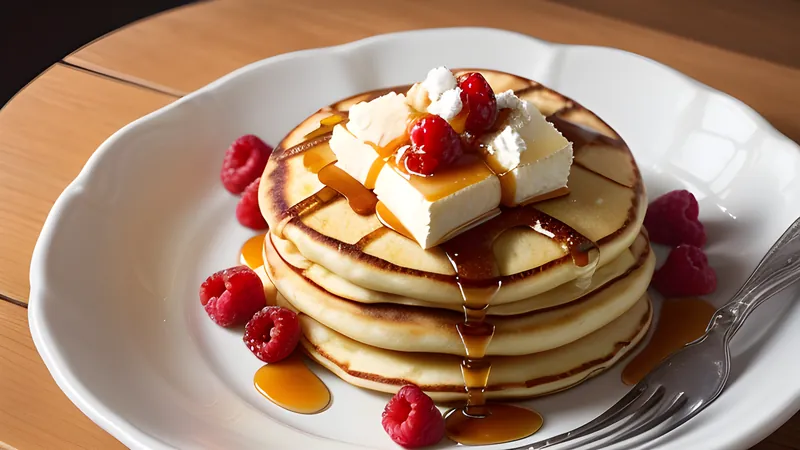
↓ Jump to recipeCut into a proper ricotta hotcake and it sighs. These are not the flat, rubbery discs that come out of a shake-in-a-bottle mix; they are closer to a savoury souffle that happens to be sweet, lifted with whisked egg whites until they are almost weightless. The one clever move that turns a very good breakfast into one people remember is the honeycomb butter melting over the top: soft butter beaten with honey and shards of crunchy honeycomb that half-dissolve into the warm stack, leaving little caramelised, salty-sweet pockets. It makes an ordinary Tuesday feel borrowed from a holiday.
Where they come from
Ricotta hotcakes are the signature dish of the Australian café scene, the inventive, brunch-obsessed culture that also gave us smashed avocado on toast and the flat white. They are inseparable from Bill Granger, the Sydney restaurateur who opened bills in Darlinghurst in 1993 and put ricotta hotcakes with honeycomb butter and banana on the menu. The dish travelled: bills grew into a small international group with sites in Tokyo, London and Honolulu, and the hotcakes were copied onto café menus far beyond Australia. Granger, who died in December 2023, was often called the man who taught the world to eat breakfast out.
The genius of the original is lightness. A standard pancake batter is worked until the gluten tightens, which is why supermarket-mix pancakes turn dense and chewy. Here a generous amount of ricotta and a raft of whipped whites keep the crumb open and custardy in the middle. They read as indulgent and yet somehow barely there, which is exactly why the queues formed.
Ricotta belongs in a batter for the same reason it belongs in a cheesecake: it is a soft, wet curd cheese, high in moisture and mild in flavour, so it enriches without weighing things down. It brings protein and fat that keep the crumb moist, and just enough tang to stop the hotcakes tasting flatly sweet. Cottage cheese, mashed and drained, will stand in at a pinch, though the texture is coarser and you should push it through a sieve first. What you must not do is reach for the low-fat tub; the fat is doing structural work here, and a watery low-fat ricotta gives you a pale, flabby hotcake.
If you like breakfast baking that leans on browned dairy for depth, the same logic runs through my almond financiers with brown butter, where the nut-brown butter is the whole point rather than a topping. And for a savoury take on the whipped-egg idea, Turkish eggs, cilbir, with chilli butter and yoghurt shows how a spiced butter poured over something soft and creamy can turn a simple plate into an event.
Ricotta Hotcakes with Honeycomb Butter
Ingredients
- 250g fresh ricotta, drained
- 180ml whole milk
- 4 large eggs, separated
- 150g plain flour
- 1 tsp baking powder
- 1 tbsp caster sugar
- 1/4 tsp fine salt
- Zest of 1 lemon
- About 30g butter, for frying
- For the honeycomb butter: 120g unsalted butter, softened
- 2 tbsp clear honey
- 40g honeycomb (or a crushed 40g honeycomb chocolate bar), chopped
- 1/4 tsp flaky sea salt
- 150g fresh berries and 1 tbsp extra honey, to serve
Method
- Make the honeycomb butter first: beat 120g softened butter with 2 tbsp honey and 1/4 tsp flaky salt until pale and creamy, then fold through 40g chopped honeycomb. Chill for 15 minutes while you make the batter.
- Whisk 250g drained ricotta, 180ml milk, 4 egg yolks and the zest of 1 lemon together until smooth.
- Sift in 150g flour, 1 tsp baking powder, 1 tbsp sugar and 1/4 tsp salt and fold gently to a thick batter; stop the moment the flour disappears.
- In a clean, grease-free bowl, whisk the 4 egg whites to soft peaks, about 2 minutes by hand or 1 minute with an electric whisk. Fold a heaped spoonful into the batter to loosen it, then fold in the rest in two additions.
- Melt a knob of butter (about 10g) in a non-stick pan over medium-low heat. Spoon in mounds of batter roughly 8cm across and cook for 2 to 3 minutes, until bubbles break the surface and the bases are golden.
- Flip carefully and cook the second side for 1 to 2 minutes, until puffed and set through. Keep warm on a rack in a low oven, 100C, while you cook the rest.
- Stack three or four hotcakes, top with a thick slice of honeycomb butter so it slumps down the sides, and finish with fresh berries and a drizzle of honey.
Why you separate the eggs
The single most important step is whisking the whites on their own and folding them in last. This is the same principle behind a souffle. The yolks enrich the batter and bind it; the whites, beaten to soft peaks, trap air that expands into steam in the pan and gives the hotcakes their rise and their tender, open texture. Fold gently, in two or three additions, and stop the instant the streaks vanish. Beat the air back out and you have thrown away the whole point.
Soft peaks, not stiff, is what you want. Stiff whites are harder to fold in without deflating and can dry the crumb. You are after whites that hold a peak that curls over at the tip. If yours look grainy or watery, you have overbeaten them; start again, because they will not fold in cleanly.
Draining the ricotta matters just as much. Fresh ricotta from the tub can be wet, and a sloppy batter spreads thin and cooks dense. Sit it in a sieve over a bowl for 15 minutes, or press it gently in a clean cloth, and the batter stays thick enough to mound and rise. The lemon zest is small but vital, cutting the richness so the hotcakes never cloy.
The honeycomb butter
This is the part that gets remembered. Compound butters, softened and beaten with other flavours, are a low-effort way to dress up almost anything, and honey, salt and honeycomb together is close to perfect. The honey sweetens and loosens the butter, the flaky salt sharpens it, and the chopped honeycomb brings crunch and a faint caramelised bitterness that stops the whole thing turning sickly.
Use real honeycomb from a good deli if you can find it, or take the cheerful shortcut of crushing a honeycomb chocolate bar, the kind sold as a Crunchie in Britain or hokey pokey in Australia and New Zealand. Honeycomb is only sugar and golden syrup boiled to the hard-crack stage, then aerated with bicarbonate of soda, which is why it is so light and shatters so cleanly. That means it dissolves fast in contact with anything warm, so fold it in at the very end and keep the butter cold until the moment of serving. As a thick slice lands on the hot stack it slumps, and the honeycomb softens into sticky golden pockets rather than melting away entirely.
Soften your butter properly before you start, to the point where a finger leaves a clean dent but it still holds its shape. Butter that is too cold will not take up the honey and you end up beating grease and syrup that refuse to combine; butter that has gone oily and greasy will not hold air and turns to a slick rather than a spreadable cream. Room temperature, and no warmer, is the target.
Cooking and serving
Patience and a gentle heat are everything here. These hotcakes are thick and delicate, so a medium-low flame lets the inside set before the outside scorches; too hot and you get a burnt crust around a raw centre. Wait for bubbles across the whole surface and golden, set edges before you flip, and turn them only once, carefully, with a wide spatula.
Serve them in stacks, honeycomb butter on top, with fresh berries for sharpness and an extra trickle of honey if you like. Sliced banana, caramelised in the same pan for a couple of minutes, is the classic accompaniment and well worth the extra step. They are best eaten straight from the pan, soft and warm, with strong coffee to hand and nowhere in particular to be.
Make-ahead and troubleshooting
Cook for a crowd by holding the finished hotcakes on a rack in a low oven, in a single layer so they do not steam and collapse, while you work through the batter. The batter itself does not improve with sitting: the whisked whites slowly deflate, so mix it just before you cook and resist the urge to make it the night before. If the first hotcake tears when you flip it, the batter is too loose; fold in a tablespoon of extra flour and drain the ricotta harder next time.
The honeycomb butter, on the other hand, keeps for a week wrapped in the fridge and freezes well as a log; slice off coins straight from frozen. It is excellent on toast, warm scones, or a bowl of porridge, so make a double batch. For a similar trick with a rich, spiced sponge, my browned butter carrot cake shows how far a little extra care with the butter can carry a bake. Get these small things right and they are, genuinely, the best pancakes I know how to make.
Related Content