Rice and Beans: The Belizean Coconut Version
A whole Scotch bonnet, toasted rice, and the plate that means Sunday
Contents
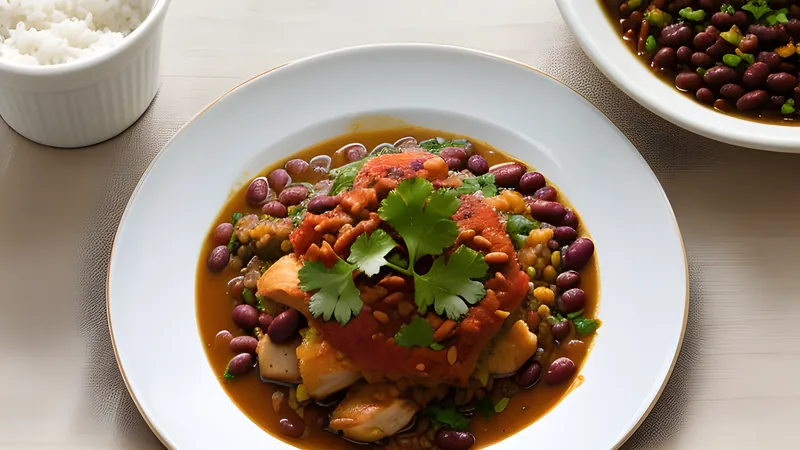
↓ Jump to recipeEvery English-speaking Caribbean country has some version of rice cooked with beans in coconut milk, and every one of them will tell you theirs is the correct one. Belize’s version has its own specific grammar: red kidney beans rather than pigeon peas, a whole Scotch bonnet left unbroken so it perfumes the pot without setting the whole dish on fire, and a role in the national diet so central that “rice and beans” without further qualification means exactly this dish, served under a piece of stewed chicken, with potato salad and coleslaw crowded onto the same plate.
Rice and Beans: The Belizean Coconut Version
Ingredients
- 250 g dried red kidney beans, soaked overnight, or 2 x 400 g tins, drained (reserve 250 ml liquid)
- 2 tbsp coconut oil, or neutral oil
- 1 small onion, finely diced
- 3 garlic cloves, finely chopped
- 400 g long-grain rice, rinsed until the water runs clear
- 400 ml coconut milk
- 500 ml bean cooking liquid or water
- 4 sprigs fresh thyme
- 1 whole Scotch bonnet, left unpierced
- 2 tsp fine salt
- 1/2 tsp freshly ground black pepper
Method
- If using dried beans, drain the soaked beans and put them in a pot with fresh water to cover by 5 cm. Simmer, uncovered, for 45 to 60 minutes until tender, topping up water as needed. Drain, reserving 500 ml of the cooking liquid. If using tinned beans, drain and reserve 250 ml of the tin liquid, topped up with water to 500 ml.
- Heat the coconut oil in a heavy pot over medium heat. Add the onion and cook for 4 minutes until soft, then add the garlic and cook for 1 minute more.
- Add the rinsed rice to the pot and stir constantly for 2 to 3 minutes, until the grains turn glossy, faintly translucent at the edges, and smell toasted rather than raw.
- Add the cooked beans, the reserved cooking liquid, the coconut milk, thyme, whole Scotch bonnet, salt and pepper. Stir once, bring to a simmer, then cover tightly and reduce the heat to low.
- Cook undisturbed for 20 to 25 minutes, until the liquid is absorbed and the rice is tender. Resist lifting the lid before the 20-minute mark.
- Remove from the heat, discard the thyme stems and the whole Scotch bonnet (taste-testing that it hasn't split; discard immediately if it has), and fluff the rice gently with a fork before serving.
Coconut, creole and the Garifuna coast
Belize’s food culture draws on an unusually wide set of influences for such a small country: Kriol communities descended from enslaved Africans and British loggers, the Garifuna of the southern coast, Yucatec and Mopan Maya communities inland, Mestizo populations with ties to Mexico and Guatemala, and East Indian, Chinese and Mennonite arrivals layered on top over the last two centuries. Rice and beans sits at the Kriol and Garifuna end of that spectrum, built on coconut palms that line Belize’s caye-studded coast and a bean that, unlike the pigeon pea favoured in Jamaica, grows well in Belize’s inland milpa plots alongside corn.
The dish’s role as Sunday food specifically, rather than an everyday side, comes from the same rhythm you find across the wider Caribbean: a pot substantial enough to need real time, made once a week, meant to be eaten slowly after church with family rather than assembled on a weeknight. Belizean households that eat plain white rice most days of the week will still make rice and beans on Sunday as a matter of course, alongside stewed chicken, and the pairing is fixed enough in the culture that ordering rice and beans at a Belizean restaurant without specifying a protein will still get you chicken by default.
What actually separates it from its neighbours
Jamaican rice and peas typically uses gungo peas (pigeon peas) or red kidney beans depending on region and season, cooked with coconut milk, thyme, garlic and a Scotch bonnet in a build that looks similar on paper to Belize’s version. The differences that matter are in ratio and technique rather than ingredient list: Belizean rice and beans leans more heavily coconut-forward, often using a full tin of coconut milk against a smaller quantity of rice than the Jamaican version does, giving a richer, more distinctly coconut-flavoured grain. Belizean cooks also tend to toast the rice briefly in fat before adding liquid, a pilaf-adjacent step that Jamaican rice and peas recipes don’t typically call for, and it’s the one change I’d flag as the most useful technique to borrow if you’re used to cooking the Jamaican version and want to taste the difference for yourself.
The garlic, thyme and whole Scotch bonnet appear in both traditions and do the same job in each: aromatic backbone from the first two, and a chile that flavours without burning from the third, provided it goes in whole and comes out again before it splits. If you want to compare the two side by side, Jamaican rice and peas is close enough in spirit and different enough in detail to be worth cooking in the same week.
Toasting the rice
Belizean home cooks who care about getting rice and beans right will toast the rinsed rice briefly in the fat, onion and garlic before any liquid goes in, a step that’s easy to skip and makes a genuine difference to the finished texture. Two to three minutes of stirring over medium heat coats each grain in fat and starts a light, dry-toast flavour developing on the rice’s exterior before it ever touches liquid, the same principle behind a good pilaf or paella. Skip it and simmer raw rinsed rice straight in the coconut milk instead, and the beans-and-rice will still taste fine, just flatter, missing the faint nuttiness that toasting builds in. It costs almost no extra time and is the single easiest upgrade to make to a version you might already be cooking.
The Scotch bonnet stays whole
Do not chop, pierce, or deseed the Scotch bonnet for this dish. It goes into the pot whole and comes back out whole, having spent its twenty-plus minutes in the simmering liquid releasing aroma and a gentle, building warmth without ever rupturing its skin to release the ferociously hot seeds and membrane inside. This is the technique that lets a household with young children and a grandmother who likes real heat eat from the same pot: the chile flavours everyone’s portion, and only the person who deliberately splits the pepper open at the table and stirs it through their own plate gets the full punch. Check the pepper before discarding it; if it’s split during cooking, which sometimes happens if it’s very ripe or the pot boiled too hard, taste the rice cautiously before serving, since a burst pepper can push the whole pot from pleasantly warm to genuinely fierce.
Beans from scratch versus tinned
Dried kidney beans cooked from scratch give a better final texture, holding their shape through the second simmer with the rice rather than turning slightly mushy, and the reserved cooking liquid carries more bean flavour into the rice than tinned liquid does. That said, tinned beans are a completely reasonable shortcut on a weeknight; drain and reserve the liquid from the tin rather than discarding it; it’s thinner than a proper bean pot liquor but still contributes real flavour, and topping it up to the full 500 ml with water gets you to the same place with a fraction of the time investment.
What goes on top
Stewed chicken, a dark, deeply seasoned braise closer to a Jamaican brown stew than a pale Western stew, is the standard partner, along with a simple potato salad bound with mayonnaise and a vinegar-dressed coleslaw, the three together making up what many Belizeans would just call “the plate” without needing to specify further. If you want to build the full Sunday spread, brown stew chicken uses a closely related browning-and-braising technique and sits comfortably next to this rice, even though the two dishes come from neighbouring rather than identical culinary traditions.
Storage and reheating
Rice and beans keeps for up to four days refrigerated and freezes well for up to two months, though the texture softens slightly on reheating since the rice continues to absorb residual coconut milk even once cooled. Reheat gently with a splash of water or coconut milk stirred through to loosen it, either in a covered pan over low heat or in short bursts in a microwave, stirring between each. It rarely needs much correction beyond that splash of liquid; a well-made pot holds its flavour better than most rice dishes do precisely because the coconut fat keeps the grains from drying out the way plain water-cooked rice does.
Making your own coconut milk
Tinned coconut milk works perfectly well here and is what most Belizean households reach for day to day, but fresh coconut milk, grated from a mature brown coconut and pressed through cheesecloth with hot water, is still how rural households and older cooks in Belize prefer to make it, and it’s worth trying at least once to understand why the dish tastes the way it does. Fresh milk has a lighter, slightly sweeter flavour than tinned, with less of the thick, almost creamy body that stabilisers give the tinned version, and a pot made with it needs a touch more reduction time to thicken to the same consistency. If you’re using fresh milk, press the coconut meat twice, once with hot water for a rich first extraction and again for a thinner second milk, and use the richer first pressing here; the second is better saved for a soup or a lighter sauce.
Garifuna cooking, concentrated along Belize’s southern coast in towns like Dangriga and Hopkins, uses coconut even more extensively than the wider Kriol tradition, in dishes like hudut, a mashed plantain and coconut fish stew that shares rice and beans’ reliance on fresh-pressed coconut milk as a base liquid rather than a flavouring afterthought. The techniques cross-pollinate: a Garifuna cook’s instinct for reducing coconut milk slowly to build richness, rather than diluting it thin, shows up in how carefully-made Belizean rice and beans handles its liquid ratio too.
Getting dried beans right
If you’re cooking dried kidney beans rather than reaching for a tin, resist salting the soaking or initial cooking water; salt added before the beans have fully softened toughens their skins and can leave you with a pot of beans that never quite gets creamy inside no matter how much longer you simmer them. Salt goes in later, once the beans are tender and you’re combining everything with the rice. A pinch of bicarbonate of soda in the soaking water can speed softening in very hard water, though it’s rarely necessary with a full overnight soak and isn’t traditional; use it only if your beans are stubbornly slow to soften.
Older dried beans, which is most of what you’ll find on a supermarket shelf without a clear harvest date, can take considerably longer than the 45 to 60 minutes given here, sometimes up to 90 minutes, so treat the timing as a starting point and keep testing rather than assuming doneness at the clock. Beans that are ready should crush easily between two fingers with no chalky centre; anything short of that needs more time in the pot before it goes anywhere near the rice.
Rice choice
Long-grain rice is standard and gives the separate, distinct grains Belizean rice and beans is known for, as opposed to the stickier result a short- or medium-grain rice would produce in the same liquid ratio. Basmati works and adds a floral aroma some cooks like, though it’s not traditional; parboiled rice is a reasonable substitute if you’re prone to overcooking rice, since its slightly firmer structure forgives an extra few minutes on the heat better than standard long-grain does. Whichever you use, rinsing until the water runs clear before it goes anywhere near the pot removes surface starch that would otherwise make the finished dish gummier than it should be, an easy step to skip and a mistake that shows immediately in the texture.
Related Content