Rhubarb and Custard Cake
A sweet-shop memory baked into a soft, custard-rippled sponge
Contents
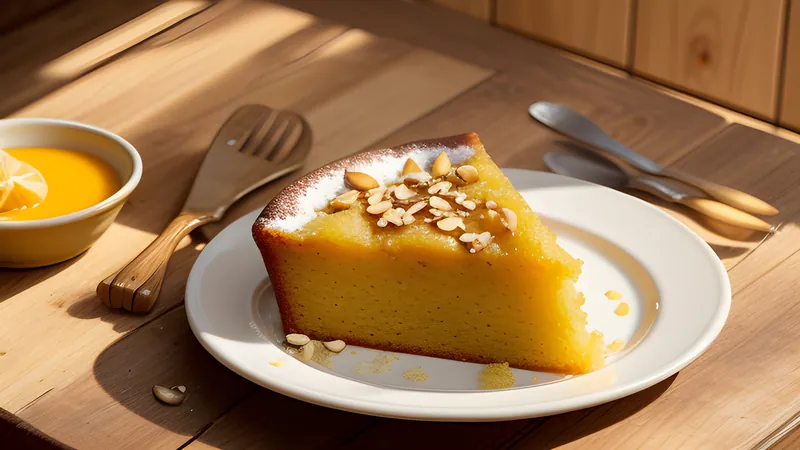
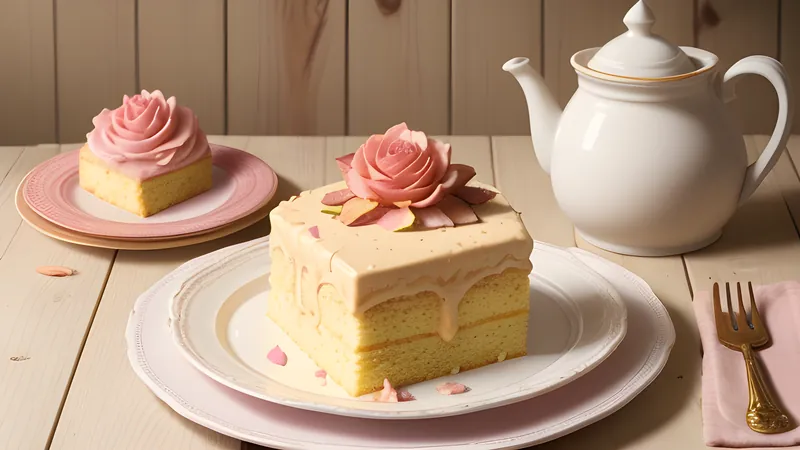
↓ Jump to recipeRhubarb and custard is one of those flavour pairings that lives somewhere deep in the British psyche, summoned instantly by the pink-and-yellow boiled sweets we all sucked on as children. This cake takes that nostalgic duo and makes it real: tart, blush-pink rhubarb baked into a buttery almond sponge that is rippled, before it goes in the oven, with spoonfuls of thick vanilla custard. The custard does something rather magical in the heat, sinking into pockets of the batter and setting into soft, creamy seams that contrast beautifully with the sharp fruit. The twist, if you can call it that, is simply trusting proper custard to behave like a baking ingredient rather than a poured sauce.
Rhubarb and Custard Cake
Ingredients
- 350g rhubarb, trimmed and cut into 2cm pieces
- 175g unsalted butter, softened
- 175g caster sugar, plus 1 tbsp for the rhubarb
- 3 large eggs
- 175g self-raising flour
- 0.5 tsp baking powder
- 50g ground almonds
- 1 tsp vanilla bean paste
- Finely grated zest of 1 orange
- 200g thick fresh custard
- 2 tbsp flaked almonds
- Demerara sugar, to finish
Method
- Heat the oven to 160C fan and line a deep 20cm springform tin with baking paper.
- Toss the rhubarb with the tablespoon of sugar and set aside.
- Beat the butter and caster sugar until pale and fluffy, then add the eggs one at a time, beating well.
- Fold in the flour, baking powder and ground almonds, followed by the vanilla paste and orange zest.
- Spread half the batter into the tin, scatter over half the rhubarb, then dollop over half the custard; repeat with the remaining batter, rhubarb and custard, swirling lightly with a skewer.
- Scatter with flaked almonds and a generous pinch of demerara sugar.
- Bake for 45 to 50 minutes until risen, golden and just set, covering loosely with foil if it browns too fast.
- Cool in the tin for twenty minutes, then release and cool further before serving warm or at room temperature.
A very British romance
The marriage of rhubarb and custard is so familiar that it is easy to forget how recent it is in the long sweep of food history. Rhubarb arrived in British kitchens as a culinary plant only in the late eighteenth century, having long been grown for its medicinal root rather than its stalks. Once cooks discovered that the forced pink stems, sweetened heavily, made a wonderful tart filling, it spread rapidly through Victorian Britain. Custard, meanwhile, had been a staple of British puddings since the medieval period, and the invention of Bird’s custard powder in 1837, made for a cook whose wife could not eat eggs, put a smooth yellow pouring custard within reach of every household. The two ingredients found each other in the great age of the steamed pudding and the school dinner.
The pairing was then sealed in the national memory by a sweet: the rhubarb and custard boiled sweet, those hard pink-and-yellow drops that were a fixture of British sweet shops through the twentieth century. Most of us met the flavour combination in confectionery form long before we ever cooked it, which is why a rhubarb and custard cake reads instantly as comforting even to someone eating it for the first time.
What seals the pairing is the way the two ingredients answer each other’s faults. Rhubarb on its own is mouth-puckeringly sour, all sharp acidity with very little natural sugar; it almost demands the soothing richness of something creamy. Custard, conversely, can be a little bland and cloying eaten alone, but it comes alive against that fruity sharpness. The boiled sweet that fixed the combination in our collective memory was simply bottling a truth that cooks already knew: that sharp and creamy, sour and soft, are made for each other, each covering the other’s weakness. It is the same principle that makes a good lemon tart or a gooseberry fool work, and it is why this cake never cloys however much custard you ripple through it.
Working with rhubarb
The trickiest thing about baking with rhubarb is its water content. Those handsome stalks are mostly liquid, and if you are not careful they will weep into your sponge and leave it soggy. Tossing the cut pieces with a little sugar before you start draws out some of that moisture and seasons the fruit, and keeping the pieces a decent size, around two centimetres, stops them disintegrating entirely. You want recognisable jammy nuggets of rhubarb in the finished cake, not a uniform pink wash.
Forced rhubarb, the early-season stuff grown in the dark sheds of Yorkshire’s famous rhubarb triangle, is the prettiest, with its vivid pink stems and tender texture. The triangle, a nine-square-mile patch of land between Wakefield, Morley and Rothwell, has grown forced rhubarb by candlelight since the nineteenth century, and Yorkshire Forced Rhubarb holds protected designation of origin status, the same legal protection as Champagne. It appears from around January to March. Later maincrop rhubarb, from spring into summer, is greener and more robust but tastes just as good, so do not worry if all you can find is the sturdier sort; it may simply need a couple of extra minutes in the oven.
Getting the custard right
The custard ripple is the whole conceit of this cake, so it is worth being deliberate about it. Use a thick, set-style fresh custard, the kind sold in tubs in the chilled aisle rather than the thin pouring sort, because a runny custard simply sinks and vanishes rather than holding as distinct creamy seams. Dollop it in rough spoonfuls rather than pouring it, and swirl it only two or three times with a skewer. Over-swirl and you marble it evenly into the batter, which tastes fine but loses the pockets of soft custard that make each slice interesting. You are after clear ribbons, not a uniform blend.
Knowing when the cake is done takes a little care because of all that moisture. A skewer test is unreliable here, since it may hit a seam of custard or a piece of soft fruit and read as raw when the sponge around it is perfectly cooked. Judge it instead by look and feel: the top should be risen and golden, and the centre should be set with only the faintest wobble, springing back when you press it gently. If it is browning fast before the middle is done, lay a sheet of foil loosely over the top for the last ten minutes or so. Ovens vary, so start checking at forty-five minutes. Cooling it in the tin for a full twenty minutes matters too, letting the crumb firm up before you attempt to release the springform; a warm custard-rippled sponge is fragile and will tear if you rush it.
Tips and variations
The ground almonds in the batter are not just for flavour, though their faint marzipan note is lovely against the rhubarb. They also keep the crumb tender and help it hold up to all that moisture from the fruit and custard, exactly the trick that keeps a browned butter carrot cake moist rather than dense. If you have a nut allergy to consider, swap the almonds for an equal weight of fine semolina, which does a similar job of keeping the texture loose; it is the same principle behind the syrup-soaked crumb of a semolina and coconut cake.
Shop-bought fresh custard from the chilled aisle works perfectly well here, so do not feel you must make your own, though a proper homemade crème pâtissière is glorious if you have the time. For variations, a stem or two of poached rhubarb saved back and arranged on top after baking makes for a striking finish, and a spoonful of chopped stem ginger folded into the batter gives a warming kick that suits the fruit beautifully. A little chopped preserved ginger’s syrup brushed over the warm cake pushes it further in that direction.
Storage
The cake keeps well for three to four days in an airtight tin at cool room temperature; the custard and rhubarb keep the crumb moist, so it improves rather than staling for the first day or two. In warm weather, or if you have topped it with fresh custard, keep it in the fridge and bring it back to room temperature before serving so the sponge softens again. It also freezes: wrap individual slices well and freeze for up to two months, then defrost at room temperature. Serve it as a pudding with extra custard, of course, or simply with a cup of tea and the memory of a sweet shop. It is the kind of cake that quietly disappears from the tin over a couple of days, a slice at a time, which is exactly what a good home bake should do. Bake it once and it tends to become a fixture of your rhubarb season.
Related Content