Ratatouille with Herbes de Provence
Sun-ripened vegetables, slowly coaxed
Contents
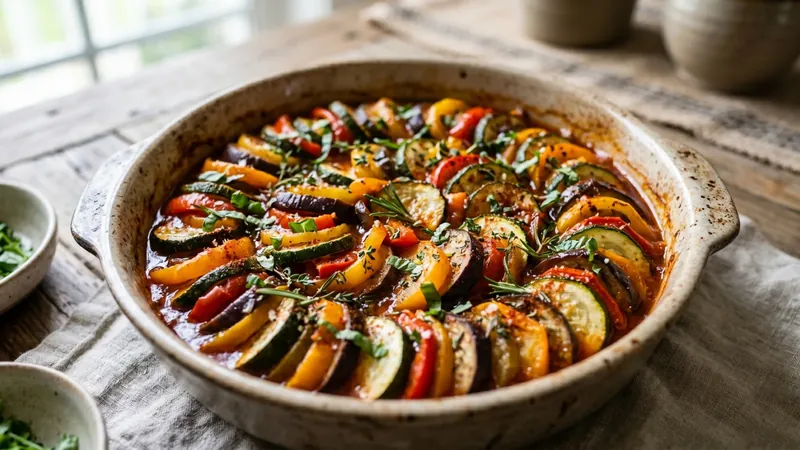
↓ Jump to recipeThere is a version of ratatouille that most of us have eaten and quietly filed away as fine but forgettable: a sludgy, khaki-coloured stew where every vegetable has surrendered its shape and you can no longer tell the aubergine from the courgette. It gave the dish an undeserved reputation as school-canteen filler. This recipe is my argument against that, and the whole argument rests on one stubborn bit of method: you fry each vegetable separately before you bring them together, so the aubergine keeps its silky, golden edge, the courgette stays bright, the peppers hold a little char, and only the tomatoes are allowed to break down into sauce. A couple of teaspoons of herbes de Provence carry the scent of the south, and torn basil goes in at the end. It is good warm, and honestly better the next day at room temperature, once the flavours have settled.
Ratatouille with Herbes de Provence
Ingredients
- 1 large aubergine, cut into 2cm chunks
- 2 courgettes, cut into 2cm chunks
- 1 red pepper, deseeded and chopped
- 1 yellow pepper, deseeded and chopped
- 1 large onion, sliced
- 4 ripe tomatoes, chopped (or 400g tin chopped tomatoes)
- 3 garlic cloves, sliced
- 5 tbsp olive oil
- 1 tbsp tomato puree
- 2 tsp herbes de Provence
- 1 bay leaf
- A handful of fresh basil, torn
- Salt and black pepper
Method
- Heat 1 tbsp olive oil in a large pan and fry the aubergine over a medium-high heat until golden on all sides. Remove and set aside.
- Add another tablespoon of oil and fry the courgettes until lightly coloured. Remove and set aside.
- Fry the peppers in a little more oil until softened and beginning to char at the edges. Remove and set aside.
- Lower the heat, add the remaining oil and soften the onion gently for 8 minutes.
- Stir in the garlic and cook for a minute, then add the tomato puree and cook for a further minute.
- Add the chopped tomatoes, herbes de Provence and bay leaf, and simmer for 10 minutes until thickened.
- Return all the cooked vegetables to the pan and stir gently to combine.
- Season, cover and simmer very gently for 20-25 minutes, stirring occasionally, until everything is tender and melded.
- Remove the bay leaf and check the seasoning.
- Stir through the torn basil and serve warm or at room temperature.
The Story
Ratatouille is the great vegetable stew of Provence, the region of south-eastern France running from the Rhone down to the Italian border, whose summer markets overflow with aubergines, courgettes, peppers and tomatoes. Its name comes from the Occitan and French verb touiller, meaning to stir or toss about; the rata- prefix is old French army and student slang for a coarse, chunky stew, so the word carries a faint whiff of mess-hall cooking from the start. This was thrifty country food, a way for farmers around Nice to turn a glut of ripe vegetables into a satisfying meal, and the version most closely associated with the city, ratatouille nicoise, dates in its documented form to around the eighteenth century.
Several of ratatouille’s defining vegetables are recent arrivals to French soil. Tomatoes, peppers and aubergines all reached Europe from the Americas and Asia after the sixteenth century, and were slow to be trusted. Tomatoes in particular were grown as ornamentals long before anyone ate them, viewed with suspicion as a relative of deadly nightshade. Provencal and Italian cooks, working in a warm climate where these plants thrived, were among the first to bring them properly into the kitchen, and by the nineteenth century the combination we now think of as inseparable had become the settled backbone of southern French cooking.
There is a long-running argument among cooks about how ratatouille should be built, and it is worth understanding before you start. The simplest, most rustic approach tips everything into one pot to stew together. The problem is that these vegetables cook at wildly different rates: aubergine drinks oil and turns meltingly soft, courgette collapses in minutes, peppers want a good while longer, and tomatoes want to become sauce. Cooked all at once, the quick vegetables have disintegrated long before the slow ones are ready, which is exactly how you get the grey mush. Julia Child’s method of frying each vegetable in turn, then layering them, was an influential fix. The great French chef Michel Guerard went further with a confit byaldi arrangement of thin sliced discs, later made famous by a certain animated film. This recipe sits in the practical middle: fry each vegetable separately for character, then finish them together so the flavours marry.
The separate-frying step is the one thing I will not let you skip. When aubergine hits properly hot oil it caramelises at the edges and develops a nutty depth it simply never gets when simmered from raw; the same golden Maillard browning is what makes the courgettes and peppers taste of something rather than of nothing. Frying them apart also means you control the fat: aubergine is a notorious sponge, so give it the hottest pan and the most oil, and it will actually take on less than if you crowd it in a cold, wet pot.
Getting the technique right
Cut everything to a roughly even two-centimetre dice so it cooks at a predictable rate and looks handsome in the bowl. Work in batches and resist the urge to crowd the pan; vegetables piled on top of each other steam in their own moisture and go soft and pale instead of browning. If your pan looks crammed, split each vegetable into two batches. Get the oil shimmering-hot before the aubergine goes in, and leave each face undisturbed for a minute or two so it can colour before you turn it.
The onion and garlic are the base, so treat them gently: eight minutes of slow cooking to soften the onion without browning, then the garlic for barely a minute, because I am firmly of the view that scorched, bitter garlic ruins more Mediterranean dishes than any other single mistake. The tomato puree wants a minute of frying too, which cooks off its raw, tinny edge and deepens the colour.
Herbes de Provence ties the dish to its homeland. This is a dried blend from the region, typically thyme, rosemary, oregano, marjoram and savory, sometimes with a little fennel seed and, controversially, lavender in the tourist-shop versions. Their warm, resinous aroma is the whole point, and a couple of teaspoons stirred through the tomato base scents the entire pan. Add them to the tomatoes rather than at the end, so the oil has time to draw out their flavour.
What can go wrong
The most common failure is watery ratatouille, a pool of thin liquid pooling under the vegetables. This almost always comes from crowding and under-frying, so the vegetables poached rather than seared and dumped their water into the pan. The fix is patience at the frying stage, and using a wide pan so there is room for the water to evaporate rather than pool. If it does happen anyway, lift the vegetables out with a slotted spoon and reduce the liquid hard for a few minutes before returning them.
A related mistake is salting too early. Salt draws water out of aubergine and courgette, so season the finished pan rather than each batch as it fries, or you will chase moisture you created yourself. And do not skip the resting time off the heat before serving; like most vegetable stews, ratatouille tastes flat when it is scorching hot and comes properly into focus once it has cooled to just-warm, which is why it is so often served at room temperature in the south.
The second is over-cooking at the final stage. Once everything is back in the pan you only want a gentle twenty to twenty-five minutes to let the flavours knit; any longer and the courgette turns to pulp. It should look like distinct, glossy pieces of vegetable coated in a thick tomato sauce, not a homogeneous paste.
Substitutions, storage and variations
Fresh tomatoes are lovely in high summer when they are properly ripe, but a good tin of chopped tomatoes is more reliable the rest of the year and I use them without apology. If you only have green peppers, they work but taste sharper; red and yellow bring the sweetness that balances the aubergine.
Ratatouille keeps beautifully. Cooled and covered, it holds in the fridge for up to four days and genuinely improves after a night, much like a good ribollita or a slow vegetable soup. It also freezes well for up to three months. Reheat gently so you do not cook it further into mush.
It is endlessly useful once made. Serve it warm as a side to roast lamb or grilled fish, or as a light main with crusty bread and, if you like, a fried egg on top. Fold it through pasta, spoon it over polenta, or use it cold as a bruschetta topping. A generous grating of Parmesan and a final drizzle of your best olive oil at the table is never wrong. For a rounder Mediterranean spread, I like to serve it alongside a tin of good white beans dressed simply and finish the meal with something light and citrus-sharp such as an olive oil and lemon drizzle cake.
Related Content