Railway Mutton Curry: The Anglo-Indian Dining Car
A vinegar-sharp, potato-heavy curry built for hours on a hot plate between stations
Contents
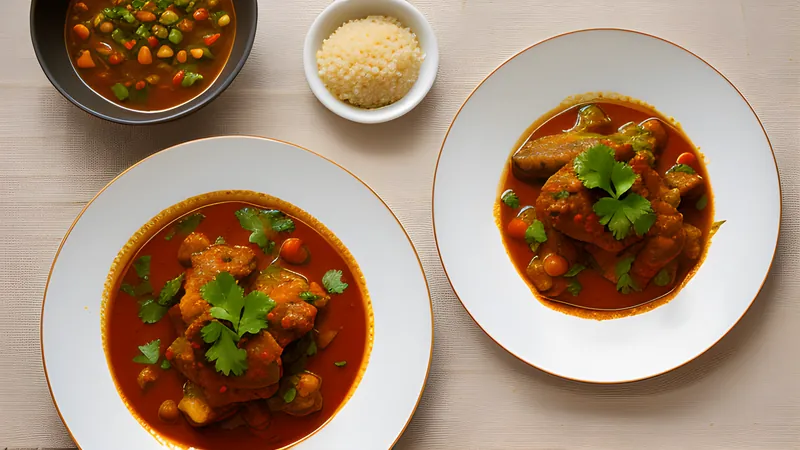
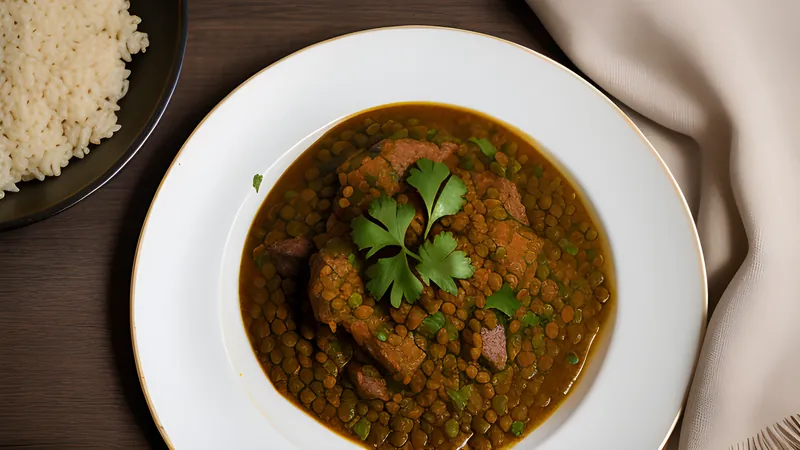
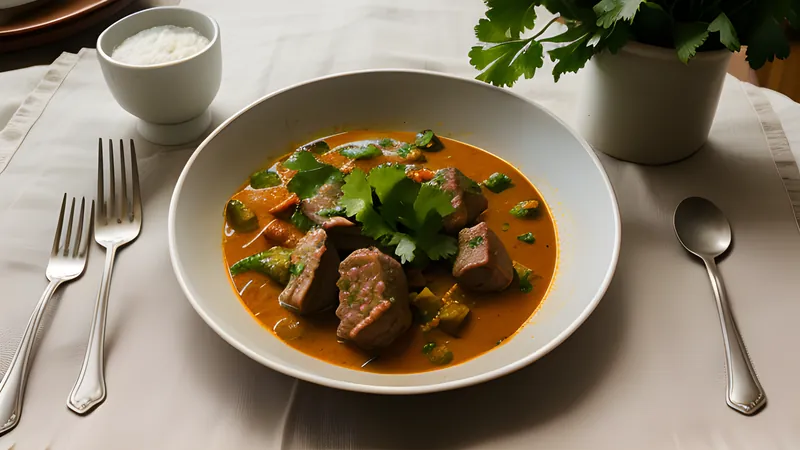
↓ Jump to recipeRailway mutton curry gets its name honestly: it was the standard dish served in the dining cars of Indian Railways for most of the twentieth century, cooked by Anglo-Indian catering staff who ran the kitchens on long-distance trains between Calcutta, Bombay, Madras and Delhi. It has a thinner gravy than most home mutton curries, a distinct vinegar sourness, and potatoes cut large enough to survive hours on a hot plate without disintegrating — all details that trace directly back to the practical demands of cooking three services a day in a galley the size of a cupboard, rattling along at speed.
Railway Mutton Curry: The Anglo-Indian Dining Car
Ingredients
- 700g mutton or lamb shoulder, bone-in, cut into 4cm pieces
- 3 large potatoes, peeled and quartered
- 3 onions, finely sliced
- 4 tomatoes, chopped
- 6 garlic cloves, crushed
- 3cm ginger, grated
- 3 dried Kashmiri chillies, or 1 tbsp chilli powder
- 2 tbsp railway curry powder (2 tsp cumin, 2 tsp coriander seed, 1 tsp turmeric, 1 tsp fennel seed, 4 cloves, 1 cinnamon stick, 1 tsp black peppercorns, all ground)
- 2 tbsp white vinegar
- 1 tbsp soft brown sugar or jaggery
- 1 tsp mustard seeds
- 8 curry leaves
- 4 tbsp vegetable oil or ghee
- 500ml hot water or stock
- salt to taste
- coriander leaves to finish
Method
- Season the mutton with salt and half the vinegar. Set aside for 15 minutes while you prepare the other ingredients.
- Heat 3 tbsp oil in a heavy pot. Add the mustard seeds and curry leaves and let them splutter for 20 seconds, then add the sliced onions and cook 12 minutes until deep golden.
- Add garlic, ginger and dried chillies, cook 2 minutes. Stir in the railway curry powder and cook a further minute until fragrant, then add the tomatoes and cook down to a paste, 10 minutes.
- Add the mutton and brown it in the paste for 8 minutes, turning to coat every piece.
- Pour in the hot water, add the remaining vinegar and the sugar, bring to a simmer, cover, and cook on low heat for 1 hour, stirring occasionally.
- Add the potatoes and simmer uncovered a further 25 minutes, until the potatoes are tender and the gravy has reduced to a thin, sharp, pourable consistency rather than a thick paste.
- Adjust salt, vinegar and sugar to taste — the finished curry should taste distinctly sour-sweet, not just savoury. Finish with fresh coriander and serve with plain rice or bread.
Cooking for a moving kitchen
The Anglo-Indian community — descendants of British and other European settlers who intermarried with Indian families, concentrated historically in railway towns like Kharagpur and Jhansi — supplied much of the catering staff for Indian Railways from the colonial period onward, and their cooking shaped what became known simply as “railway curry” on menus nationwide. The dining-car kitchens had none of the conveniences of a home kitchen: a single hot plate, limited water, and a curry that had to survive being kept warm for several hours between stops without breaking or turning bitter. That constraint produced a distinctive style — a thinner, more vinegar-forward gravy than a home-cooked curry, since acidity holds up better to prolonged heat than a rich, reduced sauce, and a reliance on potato as bulk filler because meat was rationed tightly against the number of covers sold on any given run.
The sweetness from jaggery or brown sugar isn’t a modern addition either. Anglo-Indian cooking generally runs a little sweeter than either British or mainstream Indian food, a legacy of Portuguese and Dutch colonial influence along the coasts where many Anglo-Indian communities first took root, and railway curry carries that inheritance directly onto the plate: sour, sweet and hot all present at once, in a way that’s distinct from either a north Indian mutton curry or a British curry-house dish. Recipes were passed down within catering families rather than published, which is why versions vary noticeably between cooks who all learned in the same dining-car tradition — the vinegar-sugar-chilli balance is the constant, the exact spice ratio is not.
Why the gravy stays thin
Home cooks who’ve only had curry-house mutton, thick and clinging to the meat, sometimes reduce railway curry too far, assuming a thicker sauce reads as better cooked. Resist that instinct. The thin, almost soupy consistency is deliberate — it’s what let dining-car cooks ladle the curry generously over rice without running out partway down the carriage, and it’s also what keeps the dish tasting bright rather than heavy after an hour on a low simmer. If your gravy has reduced to a thick paste by the time the potatoes go in, add a splash more hot water; you want a sauce that pools rather than clings.
The potatoes matter for the same reason. Cut into large quarters rather than small dice, they hold their shape through the second half of cooking and give the dish bulk without turning starchy and mushy, which would cloud the thin gravy. Waxy potatoes — Charlotte, Désirée, or a similar all-rounder — hold up better here than a floury baking potato, which tends to break down at the edges and thicken the gravy in a way that fights against the dish’s whole character. Bone-in mutton shoulder or neck, cut into pieces no smaller than four centimetres, holds together through the full ninety minutes of simmering better than a leaner leg cut, which tends to dry out and shred before the potatoes are even tender.
The curry powder itself
Railway curry powder is a specific, recognisable blend — heavier on fennel and cinnamon than most north Indian masalas, with black pepper doing more of the heat-carrying work than fresh chilli. That fennel note is the detail most home versions miss, and it’s the one that makes railway curry taste distinct from a generic curry-powder mutton dish; toast the fennel seed along with the cumin and coriander before grinding so it releases its aniseed sweetness rather than tasting raw and bitter in the finished gravy.
Railway curry powder is also one of the direct ancestors of the tinned “curry powder” that British grocers started stocking from the nineteenth century onward — returning colonial administrators and army officers took a taste for this style of pre-mixed, sweetish, fennel-and-cinnamon spice blend back to Britain, and early British curry recipes lean much closer to railway curry’s profile than to the fresh-ground masalas used in most regional Indian cooking. That’s worth knowing if railway curry tastes oddly familiar on the first bite: it’s plausibly one of the closest surviving links between the two culinary traditions, cooked the way it always was rather than adapted for a supermarket spice tin.
Vinegar goes in twice — once at the start to season the raw meat, and again near the end to sharpen the finished gravy — because vinegar added only at the beginning mellows considerably over an hour of simmering. The second addition is what gives railway curry its characteristic tang; taste before adding it all, since vinegar brands vary in strength, and you’re aiming for a curry that makes your mouth water on the first spoonful rather than one that simply tastes rich.
Troubleshooting the sourness
Getting the sour-sweet balance right takes more attention than most curries, because unlike a tamarind-based dish where the sourness is baked in early, here it’s adjusted live at the very end. If the finished curry tastes flat, it almost always needs more vinegar rather than more chilli — a common mistake is reaching for extra heat when what the dish actually needs is more acid. Conversely, if the vinegar tastes raw and sharp rather than rounded, it usually means the sugar addition was too timid; jaggery in particular needs a moment to dissolve fully into the hot gravy before you can judge whether the balance is right, so taste again after a minute rather than immediately after stirring it in.
The dining-car ritual
Meals on Indian long-distance trains were historically served in sittings, announced by a steward walking the corridor, and the curry itself travelled from the pantry car to each carriage in covered tiffin-style containers rather than being plated fresh at a stove beside the table. That logistics chain is part of why the dish had to hold its texture and flavour over time rather than being finished a la minute — by the time it reached a passenger three carriages down, the curry might have been sitting, covered, for the better part of an hour since it left the hot plate. Cooking it at home, you get the advantage the original never had: you can serve it the moment the potatoes are done, gravy at its brightest, rather than after a slow journey down a rattling corridor. Some Anglo-Indian families still call any thin, vinegar-forward curry a “railway” preparation regardless of the protein, which is a reasonable way to think about the term — less a fixed recipe than a whole approach to keeping a curry stable, sharp and appetising over a long unpredictable service.
Serving it properly
Railway curry is traditionally served with plain boiled rice or, on some routes, with bread rolls, rather than with the elaborate breads that accompany richer north Indian mutton dishes. The thin gravy is meant to soak into plain rice rather than sit on top of a naan, and a squeeze of extra lime at the table is standard practice among Anglo-Indian families who still cook this at home. If you want to see the same catering-hall logic applied to a different mutton dish, kosha mangsho takes almost the opposite approach — a thick, dry-fried Bengali mutton cooked down until barely any gravy remains — and the contrast is a useful lesson in how much a dish’s texture is dictated by how and where it needs to be served, rather than by the meat itself.
Common mistakes
Overcooking the potatoes into the gravy is the most common fault; they should hold their shape and offer resistance when pierced with a knife, not collapse into the sauce. Skipping the second vinegar addition is the second — without it, the curry reads as merely savoury rather than the sour-sweet-hot combination that makes railway curry distinct from any other mutton preparation. Finally, don’t rush the onion browning at the start: a properly caramelised onion base, cooked a full twelve minutes rather than five, is what gives the thin gravy enough underlying sweetness to carry the vinegar without tasting sharp in a bad way.
Variations
Chicken railway curry is common and popular, cooked the same way with a shorter simmer of around 35 minutes total. Some versions add a handful of green beans or carrots alongside the potato for extra bulk and colour, a reasonable adaptation for a family meal rather than a train service. If you prefer a richer, less sour result, halve the vinegar and add a spoonful of coconut milk at the end, a legitimate modern variation, well outside the original dining-car recipe, that several Anglo-Indian home cooks make for guests who find the original too sharp. A hard-boiled egg, halved and added at the very end just to warm through, is another common family addition that stretches the dish without diluting the gravy.
Storage and make-ahead
Like most long-simmered curries, railway mutton curry improves the next day once the vinegar and spices have had time to settle into the meat and potato. It keeps well in the fridge for three days and freezes for up to two months, though the potatoes soften further on reheating, so if freezing, consider holding the potatoes back and adding them fresh when you reheat the meat and gravy. For a slower, richer mutton dish from further along the same rail network’s culinary map, nihari rewards the same kind of make-ahead patience, its long-cooked beef shank gravy deepening considerably by the second day, while lamb rogan josh shows what the same mutton cut looks like once you drop the vinegar in favour of yoghurt and Kashmiri chilli.
Related Content