Raggmunk: Swedish Potato Pancakes With Pork
Lacy, crisp-edged and served with salt pork and lingonberries
Contents
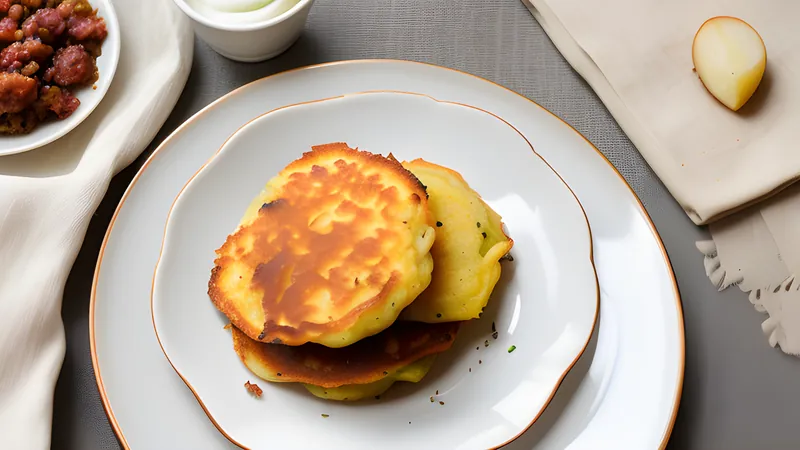
↓ Jump to recipeRaggmunk is what happens when a country decides that a potato pancake should be a pancake first. Everywhere else in Europe — Belarus, Poland, Bohemia, Ukraine — the grated-potato fritter is essentially potato held together with the minimum of binder. Sweden went the other way and started with a proper crêpe batter of flour, milk and egg, then loaded it with grated raw potato until the batter was carrying more potato than it had any right to. The result is lighter than a rösti, lacier than a latke, and structurally quite different from either.
The name is a small joke. Ragg means coarse hair or bristle, and munk is a doughnut or fritter — a shaggy fritter, named for the ragged fringe of potato shreds that stick out from the edge and fry to filaments in the fat. That fringe is the point. A raggmunk with clean edges has been made wrong.
It arrives with fried salt pork and lingonberry jam, a combination Sweden calls raggmunk med fläsk, and if you have ever wondered why Nordic food keeps putting tart red berries next to salty pig, one plate of this answers the question permanently.
Raggmunk: Swedish Potato Pancakes With Pork
Ingredients
- 800 g floury potatoes, such as King Edward or Maris Piper
- 100 g plain flour
- 300 ml whole milk
- 2 medium eggs
- 1 tsp fine sea salt
- 0.25 tsp freshly grated nutmeg
- 0.5 tsp freshly ground white pepper
- 250 g salt pork belly or thick-cut streaky bacon, in 5 mm strips
- 40 g unsalted butter, for frying
- 4 tbsp lingonberry preserve, to serve
Method
- Whisk the flour with 100 ml of the milk in a large bowl until completely smooth with no lumps. Whisk in the remaining 200 ml milk, then the eggs, salt, nutmeg and white pepper. Set aside for 20 minutes.
- Fry the pork in a dry heavy frying pan over medium heat for 8–10 minutes, turning, until the fat has rendered and the strips are crisp at the edges. Lift onto kitchen paper and keep warm. Reserve the rendered fat in a small bowl.
- Peel the potatoes and drop them into cold water. Working with one at a time, grate on the coarse side of a box grater directly into the batter, stirring after each potato so the shreds coat immediately and do not brown.
- Stir well. The mixture should be loose enough to spread on its own in the pan; if it is stiff, add milk 1 tbsp at a time.
- Heat 1 tbsp reserved pork fat and a knob of butter in the frying pan over medium-high heat until the butter foams and subsides.
- Ladle in roughly 90 ml of mixture per pancake and spread it to about 12 cm across and 5 mm thick. Cook 2–3 pancakes at a time without crowding.
- Fry for 3–4 minutes until the underside is deep golden and lacy at the edges, then flip and fry a further 2–3 minutes.
- Transfer to a warm plate. Repeat with the remaining mixture, adding fresh fat and butter for each batch.
- Serve two pancakes per person with the crisp pork alongside and a spoonful of lingonberry preserve.
Where it comes from
Potato pancakes appear across northern Europe wherever the potato took hold in the eighteenth century and where wheat was scarce enough to be worth stretching. Sweden’s contribution has a specific ancestry: the country already had a tradition of plättar and pannkakor — thin egg-and-milk pancakes eaten as a meal, often on Thursdays after pea soup — and raggmunk reads as that batter put to work as dinner rather than pudding.
The Thursday connection is real and worth knowing. Swedish institutional canteens still serve yellow pea soup followed by pancakes on Thursdays, a rhythm that pre-dates the twentieth century and is variously explained as pre-Friday-fast loading or simply as a cook’s convenience. Raggmunk sits in the same family of thinking: batter, a pan, whatever the cellar has.
The dish is strongest in Södermanland and Östergötland, the flat agricultural counties south-west of Stockholm, where both potatoes and pigs were plentiful. It became national in the twentieth century through husmanskost — the codified canon of Swedish home cooking that restaurants and canteens adopted as a standard menu. Raggmunk is a fixture of that canon, and it is the kind of thing a Stockholm lunch place will still put on the board on a Tuesday in November.
Its relatives are worth tasting side by side. The Belarusian draniki are almost pure potato with a spoonful of flour. The Czech bramborák goes hard on garlic and marjoram. Raggmunk is the mildest of the three and the only one that tastes of dairy.
The starch problem, and why raggmunk sidesteps it
Grate a raw potato and two things start happening immediately. First, polyphenol oxidase in the cut cells meets oxygen and the shreds go pink, then grey, then a colour nobody wants on a plate. Second, the ruptured cells leak amylose and amylopectin — free starch — along with a lot of water.
Most potato-pancake recipes tell you to fight this: wring the shreds in a tea towel, let the liquid settle, pour it off, scrape the white starch sludge from the bottom of the bowl and put it back in. That is genuinely good advice for draniki, where the potato has nothing else to hold it together and the free starch is the only glue available.
Raggmunk does not need any of it, and this is the single most useful thing to understand about the dish. The batter is already a complete binder — flour, egg and milk will set on their own. So you grate the potato straight into the batter and stir. The batter coats every shred within a second, which physically excludes oxygen and stops the browning dead. The leached water thins the batter, which is fine and in fact desirable, because a thin batter is what gives you lace instead of cake. The leached starch stays in the mix and helps the edges crisp.
The whole squeeze-and-reserve ritual is skipped, and the pancake is better for it. Grate directly into the bowl, one potato at a time, stirring between each. If you grate all eight hundred grams into a pile on the board first, the bottom of the pile will be grey before you get there.
Getting the texture right
Three variables decide whether your raggmunk is lacy or leaden.
Grate size. Use the coarse holes of a box grater — the ones that produce shreds around 3 mm wide. A food processor’s grating disc works and is much faster, but it cuts shorter shreds and you lose some of the fringe. The fine holes give you a purée, which fries into a dense disc.
Batter thickness. The mixture should pour off the ladle in a steady stream. When you ladle it into the pan it should spread most of the way by itself with only a nudge from the back of the ladle. Potatoes vary enormously in water content by variety and by season — a January potato from storage is drier than an October one — so treat the milk quantity as a starting point and adjust. Too thick and the middle steams before the outside crisps.
Pan temperature. Medium-high, and hot enough that the batter sizzles the instant it lands. Too cool and the pancake absorbs fat and turns greasy; too hot and the flour burns before the potato inside has cooked through. Raw potato in the middle of a raggmunk is unpleasant and unmistakable — it squeaks.
Thickness matters too. Five millimetres is the target. Thicker than about eight and you are making a potato cake; thinner than three and it tears when you flip it.
The pork
Traditionally this is rimmat sidfläsk — salt-cured pork belly, unsmoked, sliced thick and fried until the fat renders and the lean crisps. It is a common enough item in a Swedish supermarket and essentially impossible in a British one. Thick-cut streaky bacon is the practical stand-in, though it brings smoke that raggmunk does not traditionally have. If that bothers you, use unsmoked back bacon or a piece of unsmoked pork belly rubbed with salt and left overnight in the fridge.
Fry the pork first, always. You want its rendered fat for the pancakes — a pancake fried in pork fat and butter tastes markedly better than one fried in butter alone, and the fat carries salt and browning compounds into every edge. Butter alone burns at raggmunk temperatures anyway; the pork fat raises the smoke point enough to keep the pan usable.
The lingonberries
Lingonberry preserve with a savoury fried thing is an acid-and-fat mechanism, as sound as apple sauce with pork or redcurrant with lamb. Lingonberries are properly sour — around pH 2.5, with a benzoic acid content high enough that raw-stirred preserve keeps for months without cooking — and that acid slices through rendered pork fat in a way sugar alone never could.
Use the raw-stirred kind if you can, either made yourself or the Swedish supermarket sort labelled rårörda. Cooked lingonberry jam is sweeter and duller. A tablespoon per person is right; more and the plate tips into pudding.
Redcurrant jelly is a passable substitute. Cranberry sauce fails here: too sweet, too heavily spiced, and it fights the nutmeg in the batter.
Where it goes wrong
Grey pancakes. You grated ahead. There is no recovery once the oxidation has run; the pigment forms inside the shreds and no rinsing lifts it out. Grate into the batter next time. If you must prep early, grate into the batter and press cling film onto the surface — the batter itself is the barrier.
They fall apart on the flip. Either too thin, or the underside was not set. A raggmunk releases from the pan when it is ready and clings when it is not; if the spatula meets resistance, give it another 45 seconds. The edges going from pale to lacy brown is the visual cue.
Greasy. The pan was under temperature. Fat absorption in shallow frying is almost entirely a function of heat — below about 160°C the batter’s surface never sets fast enough to form a seal, and the oil goes in rather than the water coming out. Get the fat properly shimmering before the ladle goes anywhere near it.
Dense in the middle. Batter too thick, pancake too thick, or both. There is no fixing a made one, but you can thin the remaining mixture with a splash of milk and the next batch will be right.
Bitter. Burnt butter. Butter’s milk solids scorch around 175°C and raggmunk want a pan hotter than that, which is why the pork fat is doing structural work here. Wipe the pan between batches if the residue is going dark.
The case against
Raggmunk is a heavy plate. Eight hundred grams of potato, a quarter-kilo of pork belly and a batter enriched with eggs and whole milk, all fried in rendered fat and butter — this is agricultural-labour food, and it was designed for people who were about to go and dig something. Eaten before an afternoon at a desk it will put you to sleep by three.
It is also genuinely mild. If you have come from bramborák with its garlic and marjoram, or from a latke eaten with sharp apple sauce and soured cream, raggmunk can taste underseasoned. The nutmeg is doing more work than it appears to, and I would not skip the white pepper. Some cooks push the salt up to a heaped teaspoon, which I think is right when the pork is unsmoked and wrong when it is bacon.
And it does not travel. A raggmunk is at its best somewhere between ninety seconds and four minutes after it leaves the pan, which makes it a poor dinner-party dish and an excellent reason to eat in the kitchen.
Make-ahead, storage and variations
The batter can be made without the potato and refrigerated overnight; the resting time actually improves it, letting the flour hydrate fully so the pancakes are more tender. Grate the potato in at the last possible moment.
Cooked raggmunk hold in a 120°C oven on a wire rack for about 30 minutes, which is how you get eight pancakes onto four plates at the same time. Do not stack them — trapped steam turns the lace to leather. Leftovers reheat acceptably in a dry frying pan and badly in a microwave.
For variations, a fistful of chopped chives in the batter is common and good. Some Östergötland cooks add a grated onion, which contributes sweetness and a little more moisture. And a raggmunk topped with a fried egg and eaten standing over the hob at eleven at night is one of the better arguments for owning a box grater.
Related Content