Rabo de Toro: Andalusia's Slow-Braised Oxtail
Four hours, a bottle of red, and a bull
Contents
↓ Jump to recipeRabo de toro is a Córdoba dish and a bullfighting dish, and the honest version of its history is less romantic than the one on the menu. The story goes that the tails of the bulls killed in the Plaza de Toros were sold off to the butchers and cooks of the surrounding streets, and the poorest cut of the most theatrical animal in Spain became the city’s signature stew. That much is true. What the story leaves out is that oxtail was being braised in Andalusia long before anyone was selling tickets, because it is a cheap, tough, gelatinous cut that becomes extraordinary if you leave it alone for four hours, and cooks everywhere have always known this.
My twist is a strip of dried orange peel dropped into the pot with the bay. It is a Provençal move borrowed for a Spanish dish, and it earns its place. Four hours of oxtail, red wine and beef stock produces something enormously rich and slightly one-note, and the peel — bitter, floral, faintly resinous — cuts a line through the fat and lifts the whole braise. Nobody at the table works out what it is. They just eat more.
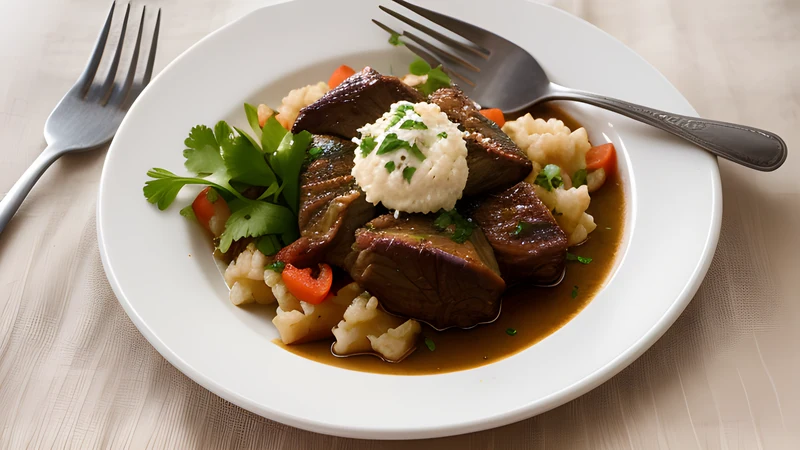
Rabo de Toro: Andalusia's Slow-Braised Oxtail
Ingredients
- 1.6 kg oxtail, cut into 4 to 5 cm pieces through the joints
- 2 tsp fine salt
- 40 g plain flour
- 4 tbsp olive oil
- 2 medium onions, roughly chopped
- 2 carrots, cut into 2 cm chunks
- 1 leek, sliced
- 6 garlic cloves, peeled and lightly crushed
- 1 green pepper, roughly chopped
- 2 ripe tomatoes, coarsely grated, skins discarded
- 500 ml full-bodied red wine (Rioja or Ribera del Duero)
- 150 ml dry oloroso sherry
- 600 ml beef stock, plus more if needed
- 2 bay leaves
- 1 tsp sweet smoked paprika
- 6 black peppercorns
- 3 cloves
- 1 strip of dried orange peel, about 6 cm long
- 1 tbsp flat-leaf parsley, chopped, to serve
Method
- Take the oxtail out of the fridge 1 hour before cooking. Pat every piece completely dry with kitchen paper and season all over with 2 tsp fine salt.
- Dust the pieces lightly with the flour, shaking off all the excess. You want a bare film.
- Heat 3 tbsp olive oil in a heavy casserole over medium-high heat. Brown the oxtail in 3 batches, 8 to 10 minutes a batch, turning so every face is deep mahogany. Do not crowd the pot. Transfer the browned pieces to a plate.
- Pour off all but about 2 tbsp of the fat. Turn the heat to medium and add the onions, carrots, leek and green pepper with a pinch of salt. Cook for 12 to 15 minutes, scraping the browned residue off the base as the vegetables release their moisture, until everything is soft and golden.
- Add the crushed garlic and cook for 2 minutes, then the grated tomato, and cook for 8 minutes more until it darkens and the oil separates at the edges.
- Stir in the paprika and cook for 30 seconds only. Pour in the sherry, turn the heat to high, and let it bubble for 2 minutes, scraping the base.
- Add the red wine and boil hard for 5 minutes to drive off the raw alcohol.
- Return the oxtail and any juices to the pot. Add the stock, bay leaves, peppercorns, cloves and the strip of dried orange peel. The liquid should come about three-quarters of the way up the meat; top up with stock if it does not.
- Bring to a bare simmer, cover with a tight lid, and cook over the lowest heat for 3.5 to 4 hours, or in an oven at 140C fan. Turn the pieces every hour. It is done when the meat retreats from the bone and a fork slides in with no resistance.
- Lift the oxtail pieces out carefully onto a plate. Fish out and discard the bay leaves and the orange peel.
- Pass the sauce through a sieve into a clean pan, pressing hard on the vegetables with a ladle to extract everything, then discard the solids. Alternatively, blitz the sauce smooth with a stick blender for a rustic finish.
- Skim the fat from the surface with a ladle. Simmer the sauce over medium heat for 10 to 20 minutes, until it has reduced to a glossy gravy that coats the back of a spoon. Taste and adjust the salt.
- Return the oxtail to the sauce and warm through gently for 5 minutes, spooning it over the pieces. Scatter with parsley and serve.
The bull, the tail and the Plaza
Córdoba’s claim is strong. The city’s rabo de toro cordobés is the version everyone else copies, and the bars around the Mezquita have been serving it for well over a century. The connection to the ring is real: after a corrida, the carcasses are butchered and sold, and the tail — heavy, bony, almost meatless in appearance — went cheap.
The romance ends at the biology. A fighting bull is four to six years old, enormously muscled, and lives an athletic life on open pasture. Its tail is magnificently flavourful and extremely tough, which is fine when you are braising for four hours, and a real fighting bull’s tail would need closer to six. What you buy from a butcher today is almost certainly ox — a castrated steer, younger and fatter — and the dish is better for it.
Bullfighting is diminishing in Spain, and the tails have long since become a normal butcher’s item rather than a by-product of the ring. The name survived the supply chain, which happens often in food.
Why oxtail is worth four hours
Oxtail is the caudal vertebrae of a cow, sold in cross-sections, each one a disc of bone ringed with dense dark muscle and threaded with connective tissue. It is one of the hardest-working muscles on the animal — a cow’s tail is in constant motion for years, swatting flies — and hard-working muscle means tough fibres and a great deal of collagen.
That collagen is the entire reason to cook it. Held at around 80C for several hours, collagen hydrolyses into gelatin, which does two things at once: it releases the muscle fibres from their casing so the meat falls apart, and it dissolves into the braising liquid, giving the sauce a body and a lip-sticking richness that no amount of reduction or butter will replicate. A rabo de toro sauce that has gone properly is one that sets to a wobbling jelly in the fridge overnight.
This is also why oxtail cannot be rushed. Collagen conversion is a function of time and temperature together, and you cannot substitute more heat for less time — above about 90C the muscle fibres seize and squeeze out their water faster than the gelatin can compensate, and you get dry, stringy meat sitting in a thin sauce. A pressure cooker gets you there in 50 minutes and gives a slightly coarser result; it is a fair trade on a Tuesday.
Buying it
Ask for oxtail cut through the joints into 4 to 5 cm pieces. A good butcher does this with a saw and will give you the thick end, which has the most meat. Supermarket packs are often the thin tip sections, which are mostly bone and cartilage — fine for flavouring a stock, disappointing on a plate.
1.6 kg sounds like a great deal for four people. It is not: oxtail is roughly half bone by weight, and it loses more in rendered fat. Reckon on 400 g raw per person.
Fat is good here. A tail with a thick creamy layer of fat around the muscle will make a better sauce, and you skim it off at the end anyway.
Browning is a job in its own right
Twenty-five minutes of browning across three batches, and every minute earns its keep. The mahogany crust on the outside of each piece is Maillard chemistry — hundreds of new aromatic compounds formed from amino acids and sugars at temperatures above 140C — and it is the difference between a deep, savoury braise and a grey stew.
Three rules. Dry the meat obsessively, because water must boil off before browning can start and wet meat steams itself for four minutes before it does anything useful. Do not crowd the pot: three batches, in a single layer, with space between the pieces, because crowding traps moisture and drops the temperature. Leave it alone — each face needs two to three minutes of contact, and the piece will release from the metal by itself when the crust has formed.
The flour dusting is a Córdoba habit and it is optional. It accelerates browning and thickens the sauce slightly. Use a bare film, and shake off everything loose, because excess flour scorches in the pan and turns the sauce bitter and pasty.
Wine, sherry and the sofrito
Use a red you would drink. Four hours of reduction concentrates whatever is in the bottle, and a thin, acidic, cheap wine becomes a thin, acidic, cheap sauce. A Rioja or Ribera del Duero with some weight is the local choice. Boil it hard for five minutes before the meat goes back in.
The oloroso is what makes it Andalusian. Dry oloroso is oxidatively aged, nutty and savoury, and 150 ml of it in this pot supplies a whole register the wine cannot reach. Amontillado works. Pedro Ximénez is a dessert sherry and will push the whole pot sweet, though a splash of it stirred in at the very end is a different and defensible idea.
The vegetable base is a proper sofrito and needs its full fifteen minutes, plus the eight for the tomato. Rush it and the sauce tastes raw underneath everything else. The same reduction cue applies as in fideuà: wait for the oil to split back out of the tomato.
The orange peel, and other things in the pot
The strip of dried peel is worth explaining, because it looks like an error on the ingredient list.
Dried orange peel carries the same aromatic compounds as fresh zest — limonene, linalool, and a set of bitter flavonoids concentrated by the drying. Fresh zest would give you a bright citrus note that reads immediately as orange and would sit oddly on top of a four-hour braise. Dried peel behaves differently: the volatile top notes have gone, and what is left leaches out slowly over hours into the fat, where it dissolves and disperses. The effect is structural. It gives the palate somewhere to go after the richness, and it makes the fourth mouthful taste as good as the first.
Make your own by peeling an orange with a vegetable peeler, scraping the white pith off the back with a knife, and leaving the strips on a plate on a windowsill for four days until they are brittle. They keep indefinitely in a jar. One 6 cm strip per pot; two and it starts tasting of marmalade.
The cloves are the other thing people query. Three, whole, fished out at the end. Clove is aggressive and eugenol dominates anything it is allowed to, so the count matters — three in a pot this size is a background warmth that reads as depth, and six is a Christmas ham.
The green pepper is authentically Cordoban and does real work: it is slightly bitter and vegetal, and it stops the carrot and onion making the sauce too sweet.
Things that go wrong
The meat is tough after four hours. It needs longer. This is almost never a mistake and almost always impatience — a big-jointed tail from an older animal can want five or six hours. Put the lid back on and check every thirty minutes. Oxtail does not overcook in the way a steak does.
The meat is dry and stringy. The braise boiled instead of simmering. You want the occasional lazy bubble breaking the surface and nothing more. An oven at 140C is far easier to control than a hob burner, which is why I use one.
The sauce is thin and watery. Under-reduced, or too much liquid at the start. The liquid should come three-quarters up the meat, never cover it. Reduce hard at the end.
The sauce is bitter. Burnt flour, scorched paprika, or the base caught during browning and you deglazed the carbon into the pot. If the fond in the pan looks black rather than brown before the vegetables go in, wash the pot and start the sofrito fresh.
It tastes flat despite everything. Under-salted. A braise this size wants more salt than seems reasonable, and it needs a final adjustment after reducing, because reduction concentrates what is already there.
Sieve or blitz
Two schools. Sieving the sauce and pressing hard through the mesh gives you a smooth, glossy, restaurant gravy. Blitzing the softened vegetables into it gives a thicker, more rustic sauce with more body and more sweetness from the carrot.
Either way, reduce afterwards until it coats a spoon, and skim the fat. There will be a lot — 1.6 kg of oxtail renders a startling amount — and the easiest method is to make the whole dish a day ahead, refrigerate it, and lift the set fat off the top in a single disc.
Make it the day before
This dish is better on day two, and it is better by a real margin. Overnight in the fridge, the gelatin sets, the flavours settle and marry, and the fat solidifies where you can remove it cleanly. Reheat it gently, covered, for half an hour.
It keeps four days in the fridge and freezes very well for three months — one of the few braises that loses nothing at all to a freezer, because the gelatin protects the meat fibres from ice damage.
What to serve with it
Chips. Córdoba serves rabo de toro with fried potatoes and it is the correct answer, because the sauce needs something to be soaked up by and a chip is better at it than anything else. Mashed potato is the alternative. Rice works.
For a Spanish table around it, patatas bravas before it stay in register, and something sharp beforehand helps — the braise is very rich, and a plate of pimientos de Padrón or a bowl of chilled ajoblanco sets it up properly. Afterwards, crema catalana if anyone still has room, which they will not.
Related Content