Pretzel Knots with Brown Butter and Mustard Salt
chewy, burnished, and quietly improved by nutty butter
Contents
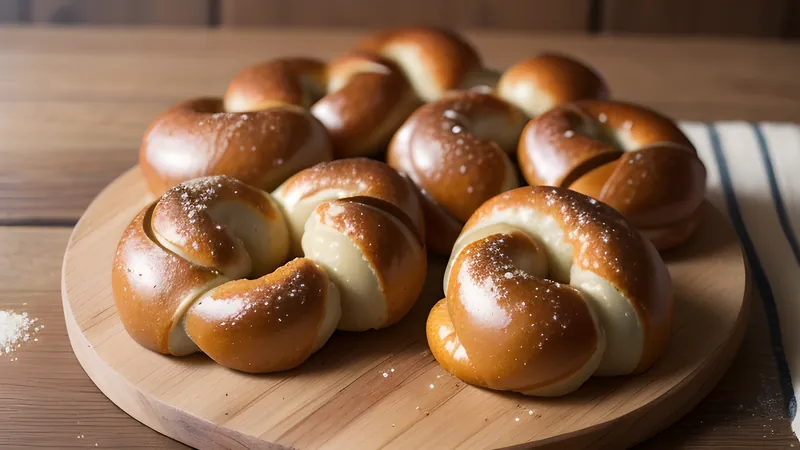
↓ Jump to recipeThere is a particular noise a good pretzel makes when you bite into it, a soft crackle of burnished crust giving way to dense, chewy crumb, and I have spent more weekends than I will admit chasing it. Most home pretzels fall down in two places: they go pale and bready instead of deeply lacquered, and they taste of nothing but salt. These pretzel knots fix both. The bicarbonate bath gives them that proper bronzed shell, and a slick of brown butter brushed on hot turns the whole thing nutty and savoury in a way a plain pretzel can only dream of.
Pretzel Knots with Brown Butter and Mustard Salt
Ingredients
- 450 g (3½ cups) strong white bread flour
- 7 g (1 sachet) fast-action dried yeast
- 1 tsp fine salt
- 1 tbsp soft light brown sugar
- 250 ml (1 cup) warm water
- 2 tbsp unsalted butter, melted, for the dough
- 60 g (¼ cup) unsalted butter, for browning
- 1 tbsp wholegrain mustard
- 1½ tbsp flaky sea salt, for the mustard salt
- 1 tsp mustard powder
- 60 g (4 tbsp) bicarbonate of soda, for the bath
- 1.5 litres (6 cups) water, for the bath
- 1 egg, beaten, to glaze
Method
- Mix flour, yeast, salt and sugar, then add warm water and melted butter to form a dough. Knead 8 minutes until smooth and elastic.
- Cover and prove 1 hour until doubled.
- Brown the 60 g butter over medium heat until nutty and amber, then stir in the wholegrain mustard and set aside.
- Mix the flaky salt with the mustard powder to make the mustard salt.
- Divide dough into 12 pieces, roll each into a 30 cm rope and tie into a loose knot. Rest 10 minutes.
- Bring water and bicarbonate of soda to a rolling boil. Dip each knot for 30 seconds, turning once, and lift out to drain.
- Arrange on lined trays, brush with beaten egg and scatter generously with mustard salt.
- Bake at 220°C (200°C fan) for 13–15 minutes until deep mahogany.
- Brush the hot knots with the brown butter and mustard mixture. Serve warm.
A short history of the twist
The pretzel is old, and its precise origin is genuinely undocumented, so I will not pretend to certainty that isn’t there. The most-repeated story credits a monastery in the Alpine borderlands somewhere between the sixth and seventh centuries, where a monk is said to have shaped scraps of dough into a form resembling arms folded in prayer, the three holes standing for the Trinity. It is a charming tale with no hard evidence behind it, and food historians treat it as folklore rather than fact.
What we can say with more confidence is that the pretzel is firmly a South German, Austrian and Alsatian thing, and the word itself descends from the Latin bracchium, meaning arm, by way of the diminutive bracellus and the Old High German brezitella. The Bavarian Brezn and the Swabian Bretzel are the direct ancestors of what most of us now picture. By the medieval period the shape had become a bakers’ guild emblem across the German-speaking lands, which is why you still see a golden pretzel hanging outside old-fashioned bakeries in Munich and Vienna. The lye bath that gives the Laugenbrezel its dark, glossy skin is a later refinement, and it is the single technique that turns bread into a pretzel.
Why knots, not pretzels
I tie mine into knots rather than the classic looped shape for the simple reason that knots are far quicker to form and almost impossible to get wrong. You roll a rope, tie it like a shoelace, tuck the ends, done. They also bake into lovely fat little parcels with a high crust-to-crumb ratio, which is exactly what you want when the crust is the best part. If you are a purist and want the heraldic twist, by all means do, but on a Tuesday night the knot wins every time. The same dough will happily make either shape, so there is no penalty for choosing the easy road.
The dark secret of the alkaline bath
The thing that separates a real pretzel from a bread roll wearing salt is the alkaline bath. Traditional Bavarian bakers use food-grade lye (sodium hydroxide, roughly 3 to 4 per cent in water), which is gloriously effective and also mildly terrifying to keep in a kitchen with children about. At home I use bicarbonate of soda dissolved in boiling water, which is safe, cheap, and gets you most of the way there.
The chemistry is the interesting part. An alkaline surface raises the pH of the dough’s skin, and a higher pH dramatically accelerates the Maillard reaction, the browning that happens when sugars and amino acids meet heat. That is why lye pretzels go so much darker and taste so distinctive: the crust is browning far faster and further than a plain dough ever would at the same temperature. Boiling your bicarbonate for a few minutes before you use it nudges it towards a stronger alkali (some of it converts to sodium carbonate, which is more caustic), so a bath that has had a proper hard boil will colour better than one you have merely warmed through.
A few honest notes. Use a generous amount of bicarb, keep the water at a proper rolling boil, and only dip each knot for around thirty seconds, turning once. Longer and they go slimy; shorter and they stay pale. Lift them out with a slotted spoon, let them drain, and handle them gently, because they will be a little tacky on the surface. That tackiness is good. It is what grips the salt.
The twist: brown butter and mustard salt
Here is where these stop being merely good and start being the ones people ask you to make again. Two small moves, both built on the same flavour.
First, the mustard salt. I mix 1½ tablespoons of flaky sea salt with 1 teaspoon of mustard powder and scatter it over the egg-glazed knots before baking. As they cook, the mustard mellows into a warm, peppery hum that plays beautifully against the dark crust. It is the same trick you would use on a good pork chop, redirected onto bread.
Second, and this is the real magic, brown butter stirred through with wholegrain mustard, brushed over the knots the moment they come out of the oven. Browning butter is the easiest upgrade in cooking: you melt 60 g of it in a pale pan over medium heat, keep it going for three or four minutes until the milk solids turn golden and it smells of toasted hazelnuts, then pull it off the heat before it tips from brown to black. Stir in a tablespoon of wholegrain mustard off the heat and paint it onto the hot pretzels, where it soaks just into the surface. Strong opinions about garlic are my usual department, but here I leave it out on purpose, because the brown butter and mustard want a clear stage. If you love the brown-butter flavour as much as I do, the same technique underpins my brown butter chocolate chip cookies and the almond financiers, where the toasted milk solids do the heavy lifting.
Making the dough
The dough itself is a straightforward enriched white bread dough. Mix 450 g strong white bread flour, a 7 g sachet of fast-action yeast, 1 teaspoon of fine salt and 1 tablespoon of soft light brown sugar in a bowl, keeping the salt and yeast on opposite sides until you start mixing so the salt does not knock the yeast back. Add 250 ml of warm water (blood temperature, not hot) and 2 tablespoons of melted butter, and bring it together into a shaggy dough.
Knead for a full 8 minutes, either by hand on a lightly floured surface or 5 minutes in a stand mixer with the dough hook, until it is smooth, elastic and passes the windowpane test: a small piece stretched between your fingers should go translucent without tearing straight away. Cover and prove for about 1 hour at room temperature until doubled. Under-proved pretzels stay tight and tough, so give it the full rise even if the kitchen is cool and it takes longer.
Shaping, bathing and baking
Divide the risen dough into 12 pieces of roughly 60 g each; a set of scales makes this quick and keeps the bake even. Roll each into a rope about 30 cm long, tapering the ends slightly, then tie it into a loose overhand knot and tuck the ends underneath. Rest the shaped knots for 10 minutes under a cloth while you bring 1.5 litres of water and 60 g of bicarbonate of soda to a rolling boil in a wide pan.
Dip each knot for 30 seconds, turning once, then lift onto lined trays. Brush with beaten egg and scatter generously with the mustard salt. Bake at 220°C (200°C fan) for 13 to 15 minutes until deep mahogany, then brush the hot knots with the brown butter and mustard mixture the second they leave the oven.
Getting them right
Roll your ropes evenly so the knots bake at the same rate; a fat middle and thin ends will give you a pale centre and burnt tails. Do not skimp on oven temperature, because pretzels want a hot, fast bake to set that crust before the inside dries out. If your knots are browning too fast before they are cooked through, drop the oven by 10 degrees rather than pulling them early. And if the bath foams up alarmingly when you add the bicarb, that is normal; just add it gradually to a pan with plenty of headroom.
They are at their absolute peak within an hour of baking, still slightly warm, the brown butter just set. Cold, they are still very good with a bit of cheese, and they reheat happily for 4 to 5 minutes in a 180°C oven to bring the crust back. If you want to get ahead, you can shape and bath them, then keep them uncovered in the fridge for a couple of hours before baking, which actually deepens the flavour; just bring them back to room temperature before they go in.
Serving and variations
I like them with a sharp cheddar and a cold beer, or torn open and stuffed with ham and more mustard, because apparently I cannot be stopped. They make brilliant vehicles for a soup supper too, torn and dunked into something like butternut squash soup instead of a bread roll. For a sweet version, skip the mustard salt entirely, dip in the bath as usual, then toss the warm baked knots in melted butter and cinnamon sugar. For a cheesy one, press a cube of Emmental into the centre of each rope before you knot it, so it melts into a molten pocket. Make a double batch. They vanish.
Related Content