Potjiekos: The Three-Legged Pot Over Coals
Layered lamb and vegetables that cook themselves, if you leave the lid alone
Contents
↓ Jump to recipePotjiekos means, literally, small pot food, and the whole dish is built around the pot rather than any fixed list of ingredients. It is a stew cooked slowly over coals in a round-bellied, three-legged cast-iron pot, built up in distinct layers, meat at the bottom, vegetables stacked on top, and then left alone. The single rule that governs everything is that once the lid goes on, you do not stir. Heat rises, steam does the work of basting, and the layers cook into each other from the bottom up, arriving at the table as a dish that tastes stirred without ever having been touched.
That rule sounds fussy until you understand why it exists. A potjie pot has thick, curved cast-iron walls that hold heat unevenly around an open fire, and stirring would drag the delicate top layers, the beans and squash, down into the fierce heat at the base where the meat is braising, turning them to mush long before the meat is done. Layering by cooking time and leaving it be is the only way the dish works at all. It is the same logic that runs through slow, undisturbed layered cooking everywhere, from a proper tagine built in a cone-lidded vessel to keep steam circulating back down onto the meat, to the low, patient coal cookery of nyama choma over charcoal in Kenya, where the fire is managed rather than fought.
Potjiekos: The Three-Legged Pot Over Coals
Ingredients
- 1.5kg lamb neck or beef shin, cut into 5cm chunks
- 3 tbsp sunflower oil
- 200g streaky bacon, cut into 2cm lardons
- 3 large onions, sliced into thick rings
- 6 garlic cloves, crushed
- 2 tbsp smooth apricot jam
- 3 tbsp fruit chutney (Mrs Balls or similar)
- 250ml red wine
- 500ml beef or lamb stock
- 2 bay leaves
- 1 tsp ground allspice
- 1 cinnamon stick
- 6 medium carrots, peeled and cut into thick batons
- 800g potatoes, peeled and quartered
- 500g butternut squash, peeled and cut into 4cm chunks
- 150g dried apricots
- 250g green beans, trimmed
- 2 tsp fine salt, plus more to taste
- 1 tsp freshly ground black pepper
Method
- Build a bed of hot coals, roughly the size of a large dinner plate, and let them burn down until they glow a steady orange with a light grey ash coat, about 30 to 40 minutes from lighting. Set the three-legged pot directly over them.
- Heat the oil in the pot and fry the bacon lardons until golden and crisp, about 5 minutes, then lift out and set aside. Brown the lamb or beef in batches in the same fat, turning to colour all sides, about 10 minutes per batch; do not crowd the pot. Remove the meat and set aside with the bacon.
- Add the onions to the pot and fry in the rendered fat for 6 to 8 minutes until soft and starting to catch colour at the edges. Stir in the garlic, apricot jam, chutney, allspice and cinnamon stick and cook for 1 minute until fragrant.
- Return the meat and bacon to the pot, spreading it in an even layer over the onions. Pour over the wine and stock, tuck in the bay leaves, and season with 1 tsp of the salt and half the pepper. Bring to a gentle simmer.
- From here, build the layers without stirring: carrots first, then potatoes, then butternut, then dried apricots, then green beans on top, each in its own even layer. Season the top layer with the remaining salt and pepper.
- Cover with the lid and cook over low, steady coals for 3.5 to 4 hours, checking the coal bed every 45 minutes and replenishing a few glowing coals as needed to keep a gentle simmer audible under the lid. Do not lift and stir; if the pot looks dry, tilt it slightly to check the liquid level and top up with a splash of hot stock poured gently down the side, never over the top layer.
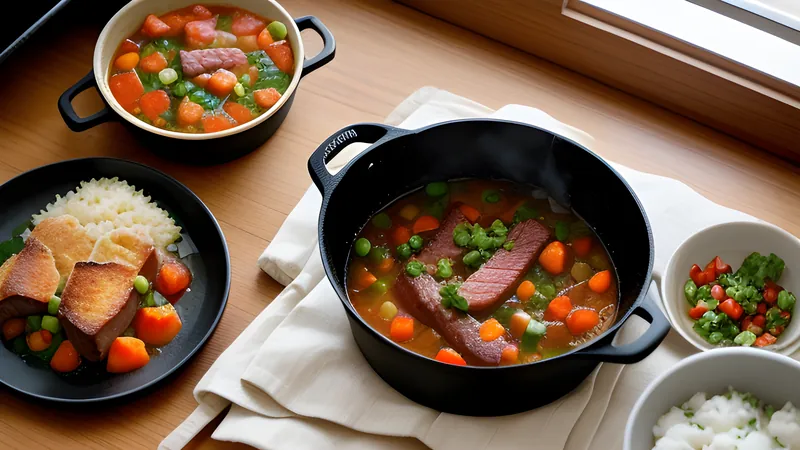
- The potjiekos is ready when the meat yields to a fork with no resistance and the vegetables are tender but still holding their shape. Remove the cinnamon stick and bay leaves, taste the gravy pooled at the bottom for seasoning, and serve straight from the pot with rice or stywepap.
A pot with Voortrekker roots and a fiercely competitive present
The three-legged pot arrived in southern Africa with Dutch and later Voortrekker settlers, who carried cast-iron cookware on ox wagons through the nineteenth century as they trekked inland from the Cape. A pot with legs could stand directly over an open fire without a tripod or grate, which made it ideal for people who cooked every meal outdoors, on the move, with whatever meat and vegetables the day’s hunting or trading had produced. Over generations it settled into a distinctly South African form: a slow, deliberate, all-afternoon event, cooked while people talked, drank and waited.
That social rhythm is still the point. Potjiekos is Saturday food, what happens when friends gather around a fire from midday, the pot goes on early, and nobody expects to eat before the sun starts dropping. South Africa now has a genuinely competitive potjiekos culture, with cook-offs judged on the balance of the layers, the depth of the gravy, and the discipline of not lifting the lid too often, because every lift lets heat escape and adds minutes to the cook. Regional variations run from Cape Malay versions sweetened with dried fruit and warmed with cinnamon and allspice, close to the one here, through to Karoo lamb potjies built on nothing more than mutton, onion and potato, and Afrikaner versions that lean on oxtail for the gravy’s body.
The pot itself is graded by size, numbered from a small size 1 up to a size 14 or larger for feeding a crowd, and a genuine potjie pot is unglazed cast iron, seasoned like a good skillet, never enamelled. Cast iron holds and releases heat evenly across the curved base, which matters more than it sounds: an enamelled pot scorches at the bottom before the top layers have softened, because the heat cannot spread as forgivingly through the walls.
New cast iron needs seasoning before its first fire: a wipe of oil rubbed into the warm metal and heated until it stops smoking, repeated a couple of times, builds the dark patina that stops food sticking and stops the pot rusting between uses. A well-kept potjie pot in a South African family often outlasts the person who bought it, passed down still carrying the seasoning of decades of Saturday fires. Wash it with hot water and a stiff brush rather than soap, dry it thoroughly over low heat straight after, and rub in a thin film of oil before it goes back in the shed; skip any of those steps and rust finds the bare iron within days.
Building the layers, and why the order matters
The method depends on stacking ingredients by how long they take to cook, slowest at the bottom nearest the heat, quickest at the top furthest from it. Meat goes in first, browned directly in the pot so the fond it leaves behind seasons everything stacked above it, then onions and aromatics worked into that fat, then the liquid, then the vegetables in a deliberate order: root vegetables that can withstand hours of heat first, softer vegetables and anything that turns to mush quickly, like green beans, right at the top where they steam gently rather than boil.
Getting the coal management right matters as much as the layering. You want a bed that glows steadily rather than flares, which means burning your wood or charcoal down until flames have died away and the coals wear a thin coat of grey ash; a pot set over open flame will scorch the base before the middle of the pot has come up to temperature. Replenish with a few fresh coals scraped from the edge of the fire every 45 minutes or so rather than piling on more heat at once, aiming for a gentle, steady simmer you can hear ticking under the lid but never a hard boil.
Resist checking. Every lid-lift costs heat and steam, and steam trapped under that heavy lid is doing real work, condensing on the underside and dripping back down through the layers to keep the top vegetables from drying out. If you genuinely need to check the liquid level, tilt the whole pot slightly rather than stirring, glance at the gravy pooling at the base, and top up down the side wall rather than over the top layer, which would wash seasoning off the vegetables before they have had a chance to absorb any of it.
Judge the fire by sound and smell rather than by the clock alone. A potjie ticking gently under its lid, a faint wisp of steam at the rim, and a rich, sweetish smell of onion and spice drifting off the coals all say the pot is behaving. A sharp hiss and the smell of scorching sugar mean the base has run dry and the coals need pulling back immediately, before the fond at the bottom turns from savoury to bitter. Positioning the pot slightly off-centre over the coal bed, rather than dead in the middle, also helps on windy days, since a stiff breeze across an exposed fire pit can double the effective heat on one side of the pot within minutes.
Tips, substitutions and what tends to go wrong
The most common failure is impatience: turning up the coals to rush the meat and ending up with a scorched base and undercooked top layers, because a potjie genuinely needs its three to four hours and cannot be hurried without breaking the whole method. The second is over-filling the pot; leave at least a couple of centimetres of headspace under the lid; a potjie packed to the rim traps too little steam to do its basting work properly.
Lamb neck and beef shin both work well here because they carry enough connective tissue to turn silky over a long, gentle cook; leaner cuts like loin will dry out long before the vegetables are ready and are wasted on this method. If lamb neck is hard to find, beef shin, oxtail or a bone-in chicken thigh potjie all follow the same layering logic, though chicken needs only about 90 minutes and a lighter hand with the coals. Vegetarian potjies exist and follow the same rule, layering chickpeas or beans at the base under root vegetables, though without meat fat to fry the onions in, a splash more oil at the start helps.
No genuine potjie pot at home, no fire pit? A heavy enamelled cast-iron casserole with a tight lid, cooked in a low oven at 150°C for the same 3.5 to 4 hours, gets remarkably close, though you lose the smoke that coals bring. Building the same layers and resisting the urge to stir still matters even in an oven; the mechanism, steam basting from the top down, works exactly the same way with a lid on a Dutch oven as it does under a potjie lid over coals.
The pairing of sweet dried apricot, fruit chutney and warm spice against slow-braised meat runs through a good deal of South African cooking beyond the pot; it is the same instinct behind bobotie’s spiced, custard-topped mince, where dried fruit and curry powder meet an unmistakably British baked-custard top. Both dishes carry the layered history of the Cape, Malay spice trade, Dutch settlement and British rule folded into a single plate, and both reward the same patience: get the base right, season with a confident hand, and let time and gentle heat do what a hurried pan never could.
Storage, leftovers and where else this logic turns up
Potjiekos keeps for three days in the fridge, covered, and the flavour genuinely improves overnight as the spices settle further into the meat; reheat gently on the hob with a splash of stock to loosen the gravy, stirring is fine once the dish has already finished cooking. It also freezes well for up to three months in an airtight container; thaw fully in the fridge before reheating, since the vegetables turn watery if reheated straight from frozen.
The same principle, that a slow fire and undisturbed layers can do more work than a spoon ever could, runs through a lot of southern and central African one-pot cooking, from the palm-oil-rich stews of moambe chicken from the Congo to the layered, patient braises found across the region. Potjiekos rewards exactly the kind of afternoon where nobody is in a hurry and the fire is doing more of the actual cooking than any hand at the stove. Get the coals right, trust the layers, and put the spoon down; the pot will finish the argument for you.
Related Content